Lesson 4 Rectangles
star
star
star
star
star
Last updated 4 months ago
30 Nsɛmmisa
Untitled Section 1
1
1
1
1
1
1
1
1
1
1
1
1
1
1
1
1
1
1
1
1
1
Proving a Quadrilateral/Parallelogram is a Rectangle
1
1
1
1
Quadrilateral Family Tree
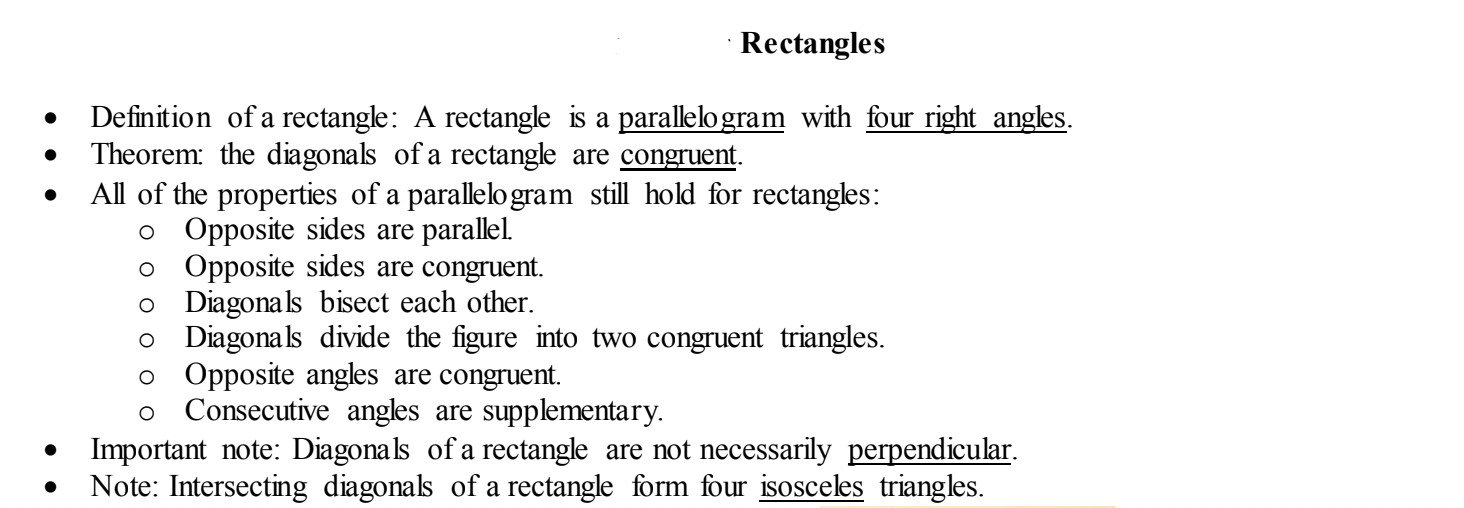
Using the applet on the previous slide, determine the properties of rectangles. Since a rectangle is a parallelogram, it will have all SIX parallelogram properties. A rectangle will also have an additional TWO "special" properties that distinguishes them from other parallelograms
Diagonals bisect its angles
Diagonals are congruent.
Both pairs of opposite sides are parallel
Both pairs of opposite sides are congruent
Equilateral quadrialteral
Consecutive angles are supplementary
Only one pair of opposite sides parallel
Only one pair of opposite sides congruent
Both pairs of opposite angles are congruent
Diagonals bisect each other
4 right angles (Equiangular quadrilateral)
Diagonals are perpendicular.
A diagonal divides the parallelogram into two congruent triangles
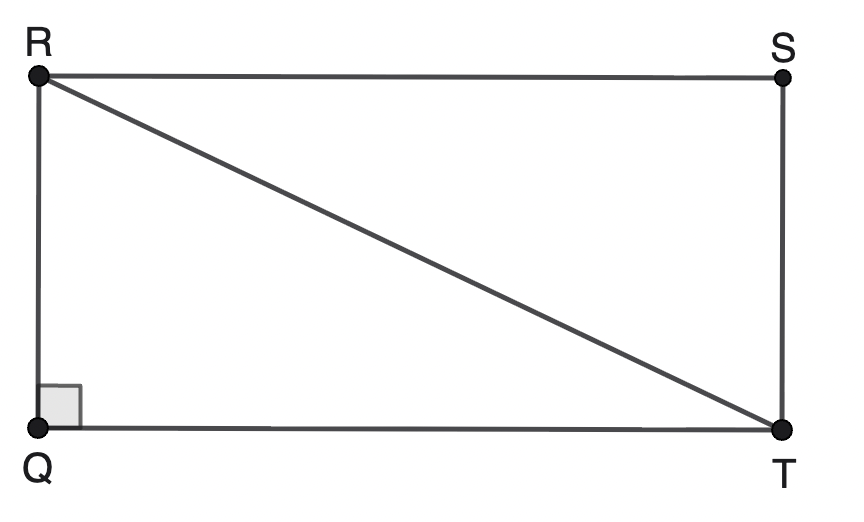
In Rectangle QRST,
Explain your reasoning for your answer to the previous question.
In Rectangle QRST, which of the following statements MUST BE TRUE?
True Statement
A diagonal of a rectangle divides the rectangle into 2 triangles.
List some right triangle applications, you might be able to apply when given a diagonal of a rectangle.
In Rectangle QRST,
Find the following:
a)
b) Perimeter of QRST =
c) m
d) m
*Round to the nearest tenth.
In Rectangle WXYZ, m
Find:
a) m
b)
c)
d) Perimeter of WXYZ=
*Round to nearest tenth.
In Rectangle QRST,
Find the following:
a)
b) Perimeter of
c) m
d) m
*Round to the nearest tenth.
In Rectangle WXYZ, m
Find:
a) m
b)
c)
d) Perimeter of WXYZ=
*Round to nearest tenth.
If ABCD is a rectangle, find the values of:
Always, Sometimes , Never:
a) A parallelogram is a rectangle.
b) The diagonals of a parallelogram are congruent.
c) The diagonals of a rectangle bisect each other.
d) The diagonals of a rectangle are congruent.
e) A parallelogram is equiangular.
sometimes
never
always
QRST is a rectangle. Which of the following statements are (ALWAYS) TRUE?
m
True Statement
Not (necessarily) True
ABCD is a rectangle with diagonals
If
ABCD is a rectangle with diagonals
If
ABCD is a rectangle with diagonals
If
ABCD is a rectangle with diagonals
If
ABCD is a rectangle with diagonals
If m
m
m
m
m
ABCD is a rectangle with diagonals
Which triangles are congruent?
ABCD is a rectangle with diagonals
If m
m
m
m
m
m
LMNP is a rectangle with diagonals
If m
m
m
m
m
m
LMNP is a rectangle with diagonals
If m
m
m
m
m
m
METS is a rectangle with diagonals
If m
m
m
m
m
m
YANK is a rectangle with diagonals
If
m
m
m
*Round to nearest tenth.
NDFB is a rectangle with diagonals
If
m
m
m
Perimter of NDFB =
*Round to nearest tenth.
*Must first prove/state that quadrilateral is a parallelogram then use the following to prove that the parallelogram is a rectangle.

When using coordinate geometry to prove that a quadrilateral is a rectangle:
STEP 1 - Find the SLOPE of all 4 sides.
STEP 2 - Prove that quad is a parallelogram by showing that both pairs of opposite sides are parallel (2 sets of equal slopes)
STEP 3 - Prove that parallelogram is a rectangle by showing one of its angles is a right angle (show that the slopes of one pair of consecutive sides are negative reciprocals --> perpendicular --> form right angles)
Example: Quadrilateral READ has vertices with coordinates R(−1,3), E(2,7), A(10,1), and D(7,−3). Prove READ is a rectangle. [The use of the set of axes below is optional.]
The coordinates of the vertices of quadrilateral HYPE are H(−3,6), Y(2,9), P(8,−1), and E(3,−4). Prove HYPE is a rectangle. [The use of the set of axes below is optional.]
The coordinates of the vertices of quadrilateral ABCD are A(0,4), B(3,8), C(8,3), and D(5,−1). Prove that ABCD is a parallelogram, but not a rectangle. [The use of the set of axes below is optional.]
The vertices of quadrilateral MATH have coordinates M(−4,2), A(−1,−3), T(9,3), and H(6,8). Prove that quadrilateral MATH is a parallelogram. Prove that quadrilateral MATH is a rectangle. [The use of the set of axes below is optional.]