Twa kɔ nsɛm atitiriw so
Log in
Sign up for FREE
arrow_back
Laabri

D UNIT 1 REVIEW SUMMATIVE

star
star
star
star
star
Last updated 2 months ago
13 Nsɛmmisa
1
1
1
1
1
1
1
1
1
Asemmisa {{asɛmmisaAhyɛnsode}}
1.

The table below gives selected values for the function $h$.

$x$

1

2

3

4

5

$h(x)$

824

330

132

53

21

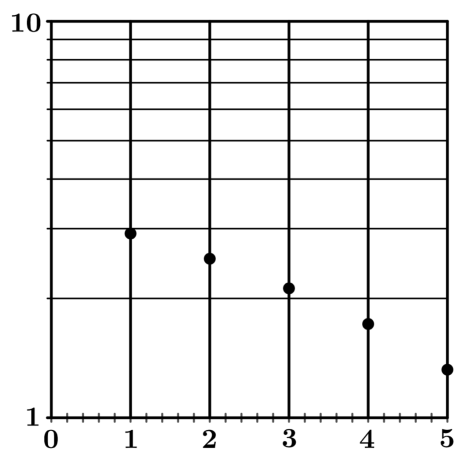
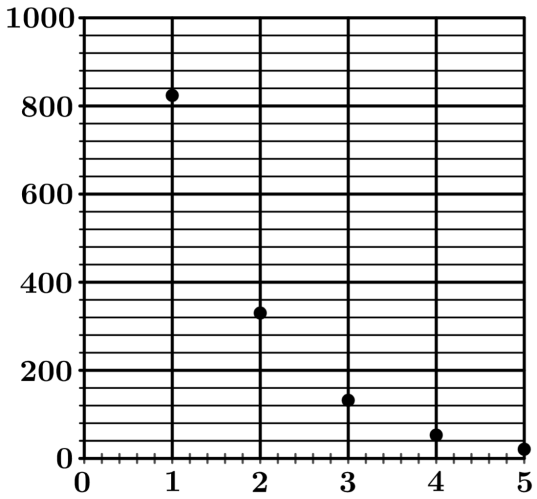
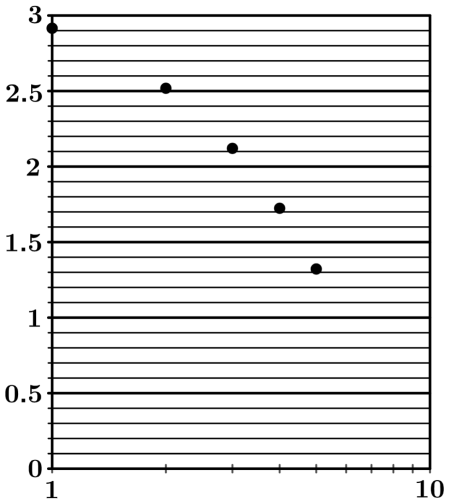
Which of the following graphs could represent these data in a semi-log plot, where the vertical axis is logarithmically scaled?

(A)
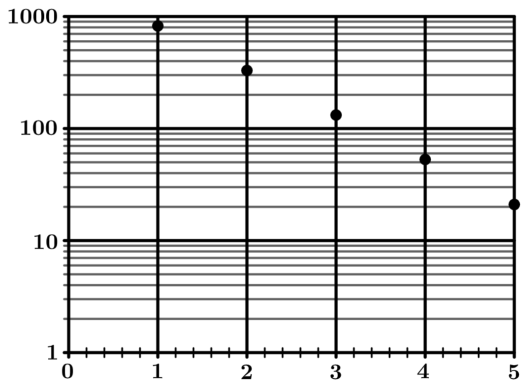
Graph A for question 2

(B)

Graph B for question 2

(C)

Graph C for question 2

(D)

Graph D for question 2

Asemmisa {{asɛmmisaAhyɛnsode}}
2.

Where both expressions are defined, which of the following is equivalent to $\dfrac{\sin(2x)\cdot\tan x}{\csc x}$?

Asemmisa {{asɛmmisaAhyɛnsode}}
3.

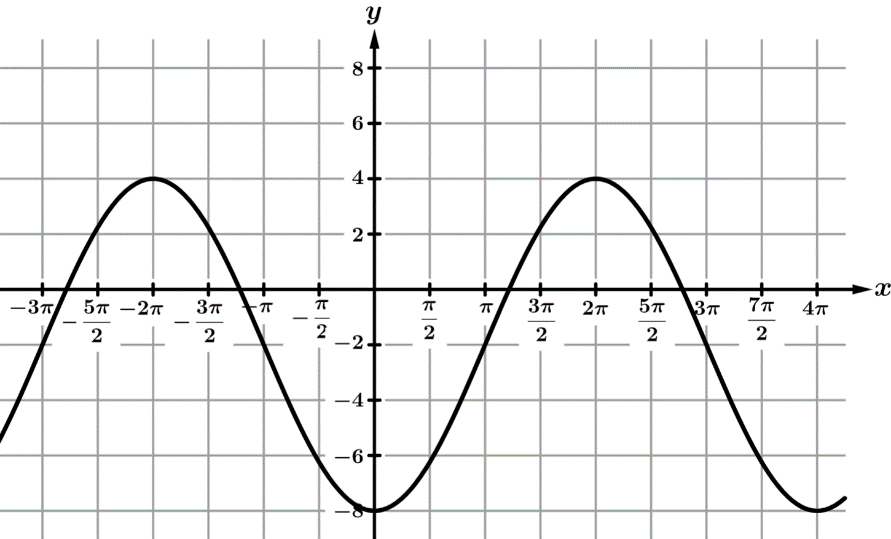
Graph of a cosine function in the xy-plane

The figure shows the graph of the sinusoidal function $f(x) = a \cos\left(\frac{1}{2}x\right) + d$ in the $xy$-plane, where $a$ and $d$ are constants. Which of the following gives the value of $a \cdot d$?

1
Asemmisa {{asɛmmisaAhyɛnsode}}
4.
Asemmisa {{asɛmmisaAhyɛnsode}}
5.

Given that the function $g(x) = (5x + 3)^2(x - 5)(x - 3)^k$ has its end behavior defined by $\lim_{x \to -\infty} g(x) = \infty$ and $\lim_{x \to \infty} g(x) = \infty$, which value of $k$ would satisfy the end behavior condition for the function?

Asemmisa {{asɛmmisaAhyɛnsode}}
6.

Suppose that the function $h(x) = (x^2 + k)(x - 3)^2(x + 5)$ has two imaginary roots with integer coefficients. What value(s) of $k$ would satisfy these conditions?

Asemmisa {{asɛmmisaAhyɛnsode}}
7.

What is the coefficient of $x$ in the expansion of $(2x + 5)^3$?

Asemmisa {{asɛmmisaAhyɛnsode}}
8.

Let $h(x) = -2x^{2}(x+2)(x-3)$. What are all the intervals for which $h(x) > 0$?

Asemmisa {{asɛmmisaAhyɛnsode}}
9.

Let $h$ be a polynomial function whose graph has a point of inflection at $x = 4$. Which of the following statements about $h$ must be true?

Asemmisa {{asɛmmisaAhyɛnsode}}
10.

The function $y = f(x)$ has a domain of $-7 \le x \le 12$ and a range of $-3 \le y \le 6$. The graph of $y = g(x)$ is the result of the transformation $g(x) = f(x + 3) - 4$. Which of the following gives the domain of $g(x)$?

1
Asemmisa {{asɛmmisaAhyɛnsode}}
11.
1
Asemmisa {{asɛmmisaAhyɛnsode}}
12.
1
Asemmisa {{asɛmmisaAhyɛnsode}}
13.