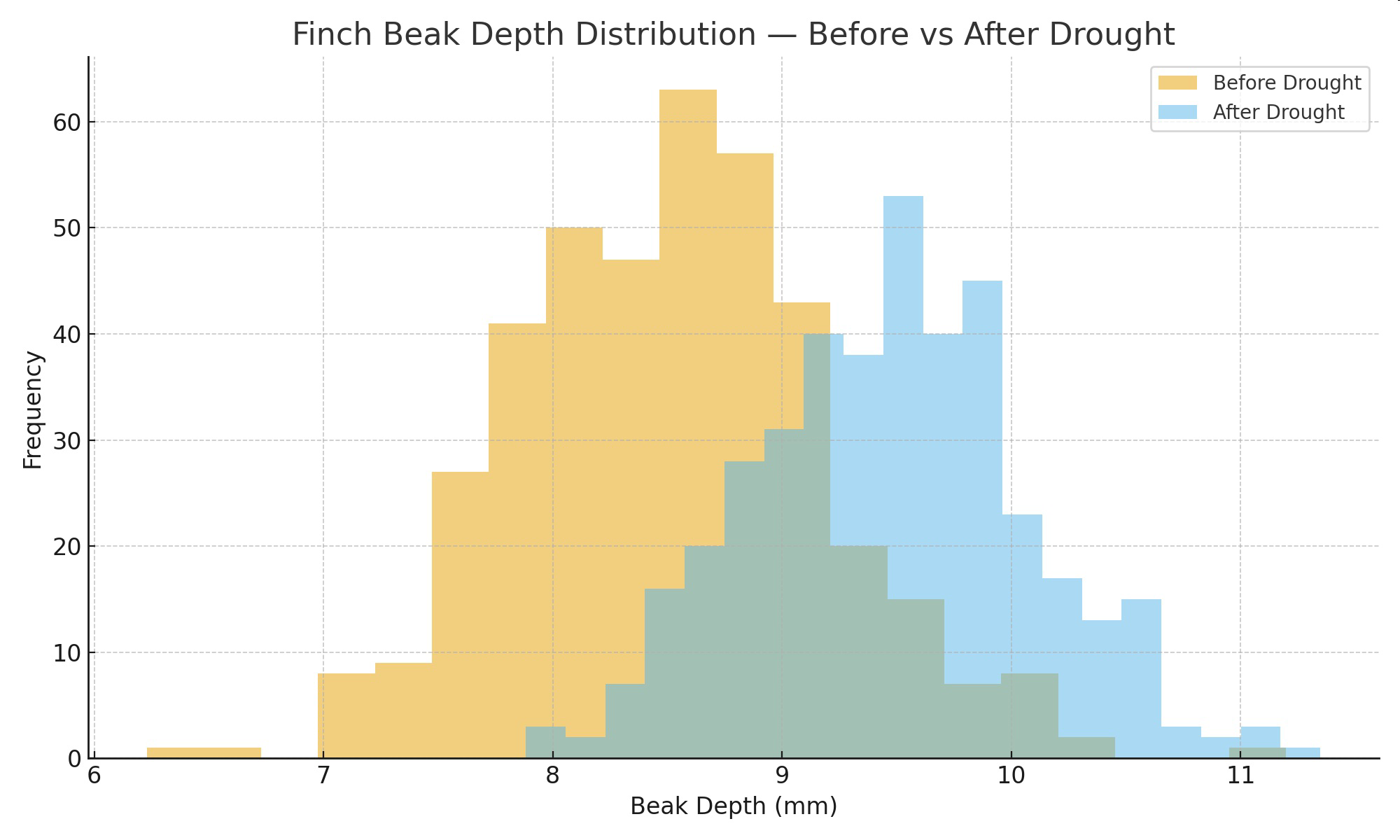
Distribution of Beak Sizes in Finch Populations During Drought
Diagram 1.
 Source:
https://bio.libretexts.org/Bookshelves/Introductory_and_General_Biology/General_Biology_(Boundless)/18%3A_Evolution_and_the_
Origin_of_Species/18.01%3A_Understanding_Evolution/18.1C%3A_The_Galapagos_Finches_and_Natural_Selection
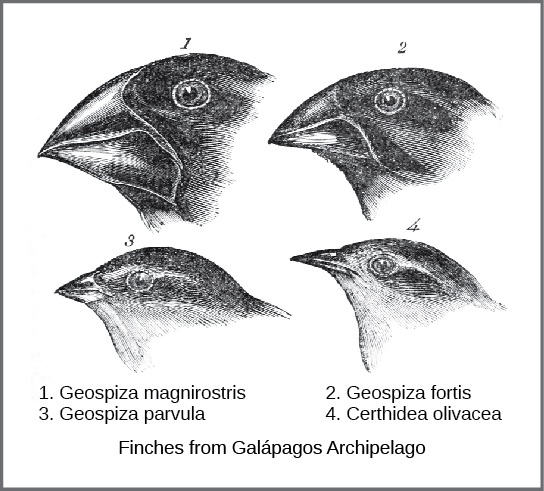
Finches from Galápagos Archipelago
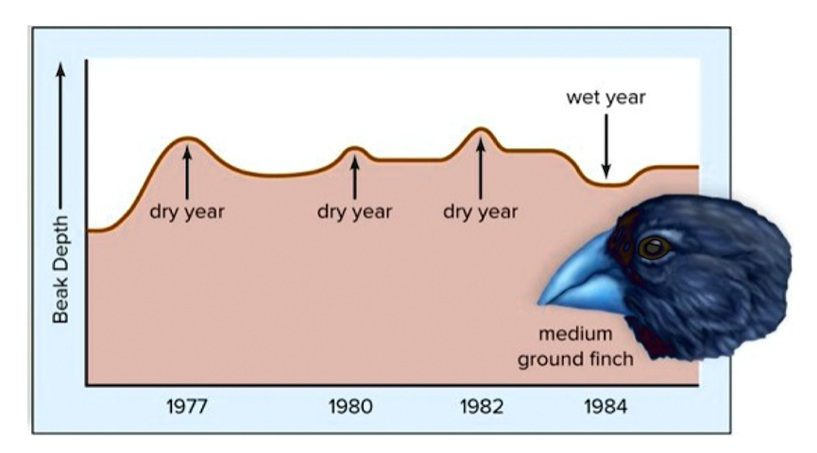
Finches on the Galápagos Islands provide one of the best-known examples of how environmental conditions shape the distribution of traits in a population. Beak size in finches varies continuously, much like human height or other polygenic traits. During normal years, when seeds of many sizes are available, finches with a range of beak sizes survive and reproduce. However, during drought years, small soft seeds become scarce, and only birds capable of cracking larger, harder seeds survive. This environmental pressure shifts the distribution of beak sizes within the population.
Diagram 2.
 Source:
https://www.numerade.com/ask/question/explain-how-the-graphed-data-of-beak-size-and-weather-conditions-is-evidence-for-natural-selection-wet-year-dry-year-dry-year-dry-year-3-medium-ground-finch-1977-1980-1982-1984-11138/
Beak size is influenced by multiple genes, making it a quantitative trait. Because many genetic and environmental factors affect beak depth and width, finches show a continuous range of measurements rather than discrete categories. This produces a distribution that can be analyzed using tools such as mean, standard deviation, and variance.
When researchers measure beak sizes before and after droughts, they often find that the average beak depth increases. For example, prior to a drought, the distribution might center around 8.5 mm, while after the drought it might shift to 9.5 mm. This shift indicates that finches with larger beaks were more likely to survive and pass on their traits. Statistical analyses help confirm whether observed changes reflect random variation or true selection pressures.
Probability also helps explain these patterns. If larger-beaked birds survive drought at higher rates, the probability that the next generation will inherit larger beaks increases. The distribution of traits becomes skewed toward those favorable under the new environmental conditions. Over time, repeated selection events can cause substantial evolutionary change in the population.
Scientists analyzing finch populations frequently use histograms, scatter plots, and probability curves to describe how beak size varies across thousands of individuals. By comparing distributions from multiple years, researchers can identify patterns, quantify changes, and predict how future environmental conditions might affect the population.
Table 1.
Before Drought | After Drought |
|---|
Beak Depth (mm) | Number of Individuals | Beak Depth (mm) | Number of Individuals |
|---|
7 | 8 | 7 | 0 |
7.25 | 13 | 7.25 | 0 |
7.5 | 25 | 7.5 | 0 |
7.75 | 45 | 7.75 | 2 |
8 | 48 | 8 | 3 |
8.25 | 51 | 8.25 | 15 |
8.5 | 69 | 8.5 | 29 |
8.75 | 49 | 8.75 | 41 |
9 | 41 | 9 | 54 |
9.25 | 17 | 9.25 | 60 |
9.5 | 15 | 9.5 | 68 |
9.75 | 9 | 9.75 | 55 |
10 | 6 | 10 | 33 |
10.25 | 1 | 10.25 | 18 |
10.5 | 0 | 10.5 | 16 |
10.75 | 0 | 10.75 | 2 |
11 | 1 | 11 | 3 |
11.25 | 0 | 11.25 | 1 |
11.5 | 0 | 11.5 | 0 |
Graph of Information - Figure 1.