8.10C Cyclones, Typhoons, and Hurricanes
star
star
star
star
star
Last updated 4 months ago
20 Nsɛmmisa
1
SCI.8.10c
1
SCI.8.10c
1
1
1
1
1
1
1
1
1
1
1
1
1
1
1
1
1
After you have watched the video, what is the reason that hurricanes do not form on the western coast of the United States?
Tropical cyclones (hurricanes) form only over warm ocean waters near the ___________________.
Storms that form north of the equator spin counterclockwise. Storms south of the equator spin clockwise. This difference is because of Earth's ____________________.
(note: this is known as the Coriolis effect)
What is it like in the center or eye of the hurricane?
When the wind speeds reach______ mph, the storm is officially a "tropical cyclone," or hurricane.
Tropical cyclones (hurricanes) usually get weaker when they hit land because they are no longer being "fed" by the energy from the ____________________ waters.
Most destruction on land is caused due to a storm surge that accompanies a hurricane. According to the chart, in a category 5 hurricane the storm surge is ___________ feet?
Do low pressure systems make hurricanes stronger or weaker?
Does cooler water make hurricanes stronger or weaker?
Do high pressure systems make hurricanes stronger or weaker?
Does warmer water make hurricanes stronger or weaker?
Why does hurricane season in Texas go from June to November?
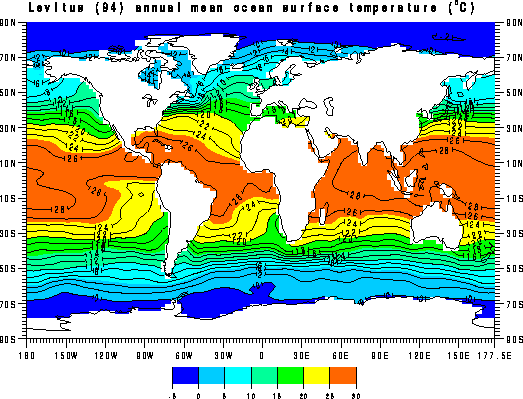
Based on the map above, where are hurricane likely to form?
Based on the map above, where are hurricane NOT likely to form?
Cyclones, typhoons, and hurricanes all need ___ water.
Cyclones, typhoons, and hurricanes lose ___ as they move inward toward land.
Tropical storms that occur near North America, Mexico, and the Caribbean are called ___.
___ are tropical storms that form in the South Pacific, Indian Ocean, and Arabian Peninsula, impacting countries such as India, Sri Lanka, Indonesia, and Madagascar in East Africa.
Tropical storms that occur near Southeast Asia, East India, and Northern Australia are called ___.
Are there any active cyclones, typhoons, or hurricanes?