6.9A Seasons
star
star
star
star
star
Last updated 4 months ago
27 Nsɛmmisa
1
1
1
1
1
1
1
1
1
1
1
1
1
1
1
1
1
1
1
1
1
SCI.8.7a
1
SCI.8.7a
1
SCI.8.7a
1
SCI.8.7a
1
SCI.8.7a
1
SCI.8.7a
1
SCI.8.7a
The yearly cycle of seasons on Earth is caused by what motion of Earth?
The yearly cycle of seasons on Earth is caused by Earth's ____.
True or False:
The changing distance from the Sun to the Earth is the reason for the seasons.
True or False:
Earth's rotation and tilt is the reason for the seasons.
True or False:
Earth's revolution and tilt is the reason for the seasons.
The number of daylight hours is the greatest during which season?
The number of daylight hours is the least during which season?
The Earth's revolution/orbit around the sun is how long?
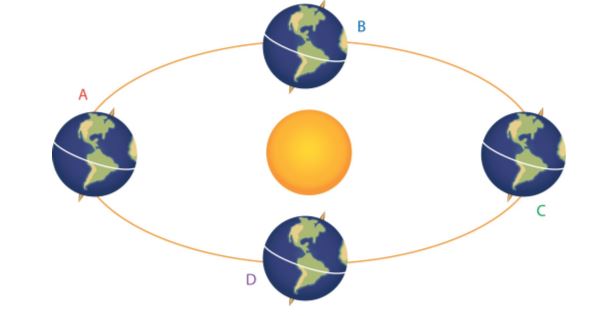
Using the diagram above, what position shows winter in the northern hemisphere.
Using the diagram above, what position shows winter in the southern hemisphere.
Using the diagram above, what position shows summer in the southern hemisphere.
Using the diagram above, what position shows summer in the northern hemisphere.
How long would it take to go from position B to position D?
How long would it take to go from position B to position C?
How long would it take to go from position B back to position B?
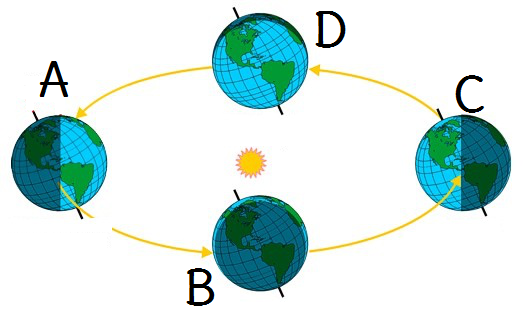
Using the diagram above, what position shows summer in the northern hemisphere.
Using the diagram above, what position shows summer in the southern hemisphere.
Using the diagram above, what position shows winter in the southern hemisphere.
Using the diagram above, what position shows winter in the northern hemisphere.
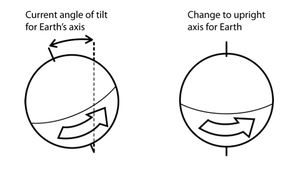
What would happen if the Earth was not tilted?
The warmer weather of summer in many parts of the Northern Hemisphere is caused by the fact that during this period -
Which of the following changes would cause the seasons on Earth to change more rapidly?
The axis on which Earth now rotates is tilted at an angle. If the axis was to be changed so that it was perfectly upright, which change would be expected on Earth?
The seasons on the Earth are the result of -
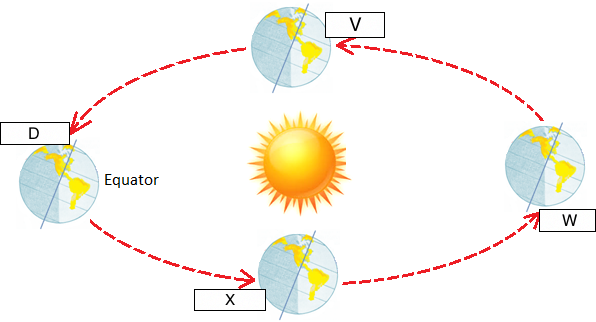
Which point on the diagram best represents the relationship between Earth and the Sun when it is summer in North America?
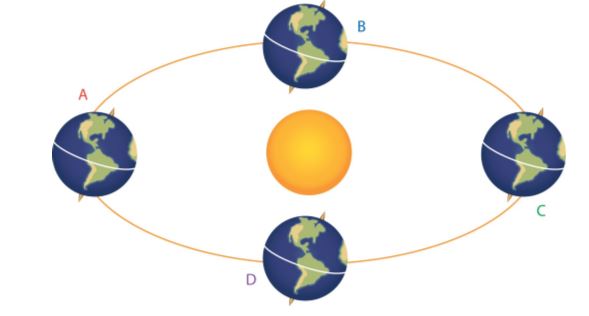
How long does it take the Earth to move from Point A to Point C?
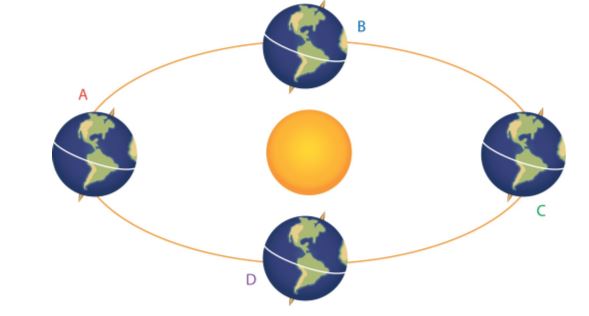
At which point on the diagram is the number of hours of daylight shortest in North America?