Prairie to Shrubland Transition After Long-Term Fire Suppression
For thousands of years, fire has been a natural and essential ecological process in maintaining North American prairie ecosystems. Frequent, low-intensity fires limit the growth of woody shrubs and trees, recycle nutrients, promote grass regeneration, and maintain open habitat structure. The grasses that dominate prairies - including big bluestem, Indian grass, and switchgrass - are well-adapted to fire and often flourish after burns. As a result, prairies historically supported stable communities of specialized birds, insects, and mammals that rely on open grassland conditions.
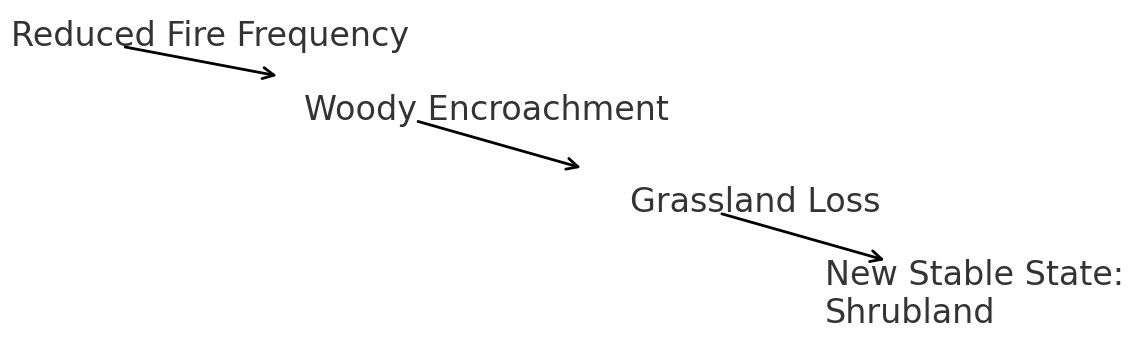
However, over the last century, fire suppression policies have dramatically altered these ecosystems. As prescribed burns and natural fires become less frequent, shrubs and trees begin to encroach on formerly open prairies. This process, known as woody encroachment, changes both the physical structure and ecological dynamics of the system. Shrubs outcompete grasses for sunlight and water, and once established, they can form dense thickets. This reduces the amount of continuous grassland habitat available and makes it more difficult for fires to spread, creating a feedback loop that accelerates the transition toward shrubland.
Grassland specialist species - such as meadowlarks, sage wrens, prairie chickens, and certain butterflies - depend on large, open patches of grassland for nesting and foraging. As shrubs expand, habitat becomes fragmented and unsuitable for these species. Long-term datasets show clear declines in grassland specialist abundance as shrub cover increases. Predation rates often rise as well, because woody vegetation provides perches and cover for predators such as hawks and raccoons.
Mathematical data reveal strong relationships: as the fire return interval increases, shrub density rises while grass cover declines. Over multiple decades, even small decreases in fire frequency can result in dramatic shifts in plant composition. Regions that once contained fire-maintained prairies may undergo complete state transitions, becoming shrublands dominated by woody vegetation.
Table 1.
Fire Return Interval years | Grass Cover % | Shrub Density per/ha |
|---|
1 | 78 | 120 |
3 | 65 | 260 |
5 | 49 | 480 |
10 | 32 | 910 |
20 | 18 | 1500 |
Graph of Information - Figure 1.
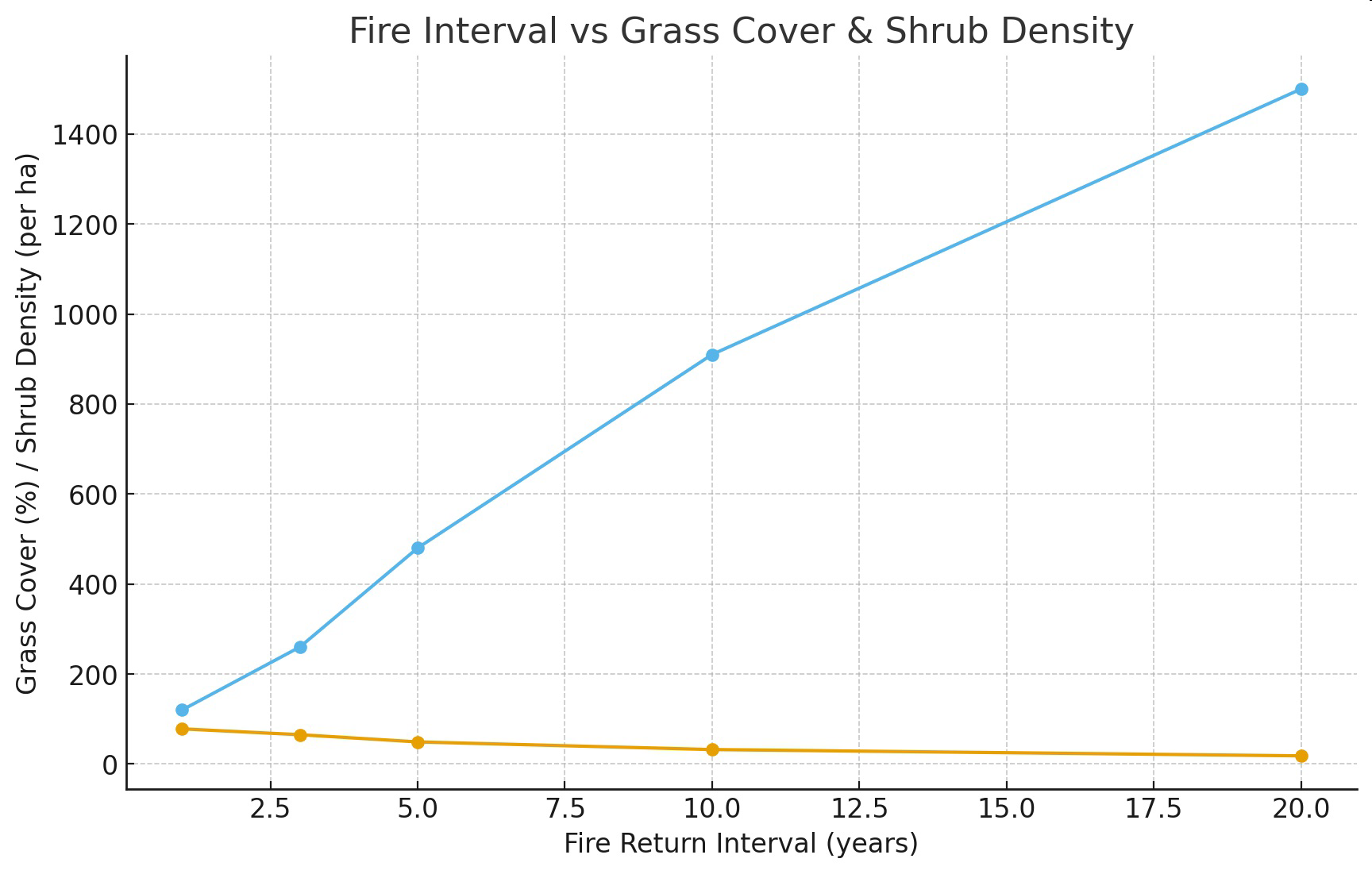
Diagram 1.
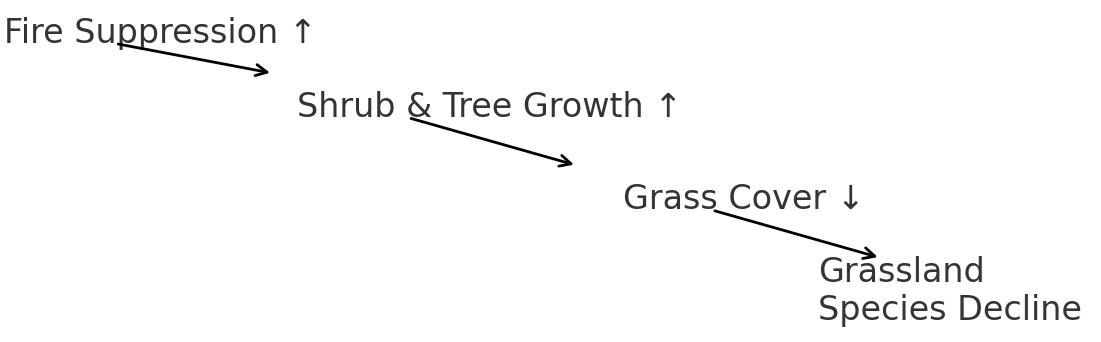
Table 2.
Year | Tree Shrub Cover % | Grassland Specialist Abundance | Fire Frequency events/decade |
|---|
2000 | 9 | 640 | 7 |
2005 | 15 | 520 | 5 |
2010 | 23 | 410 | 3 |
2015 | 33 | 290 | 2 |
2020 | 46 | 180 | 1 |
Graph of Information - Figure 2.
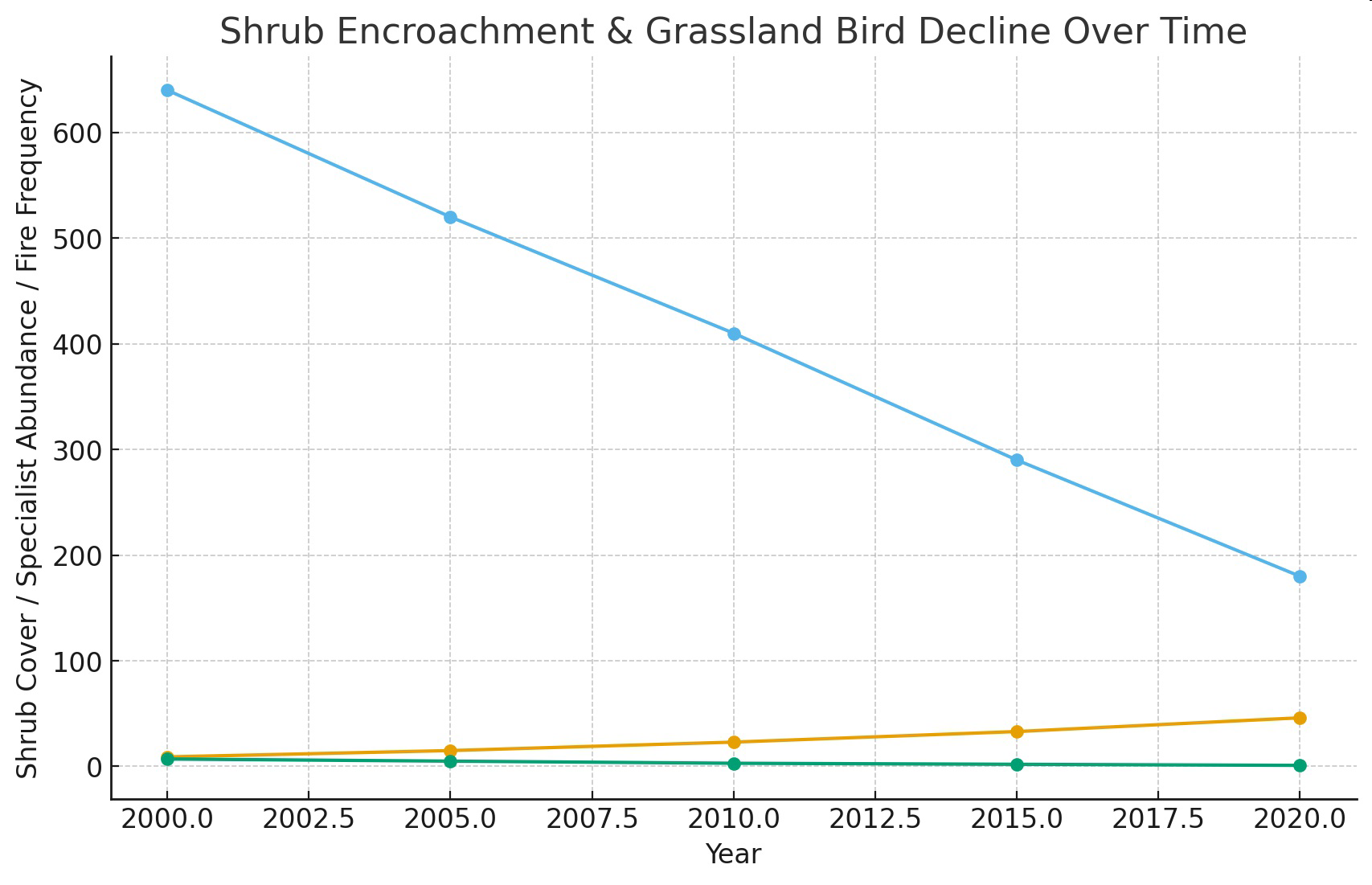
Diagram 2.