West Nile Virus
Key Points
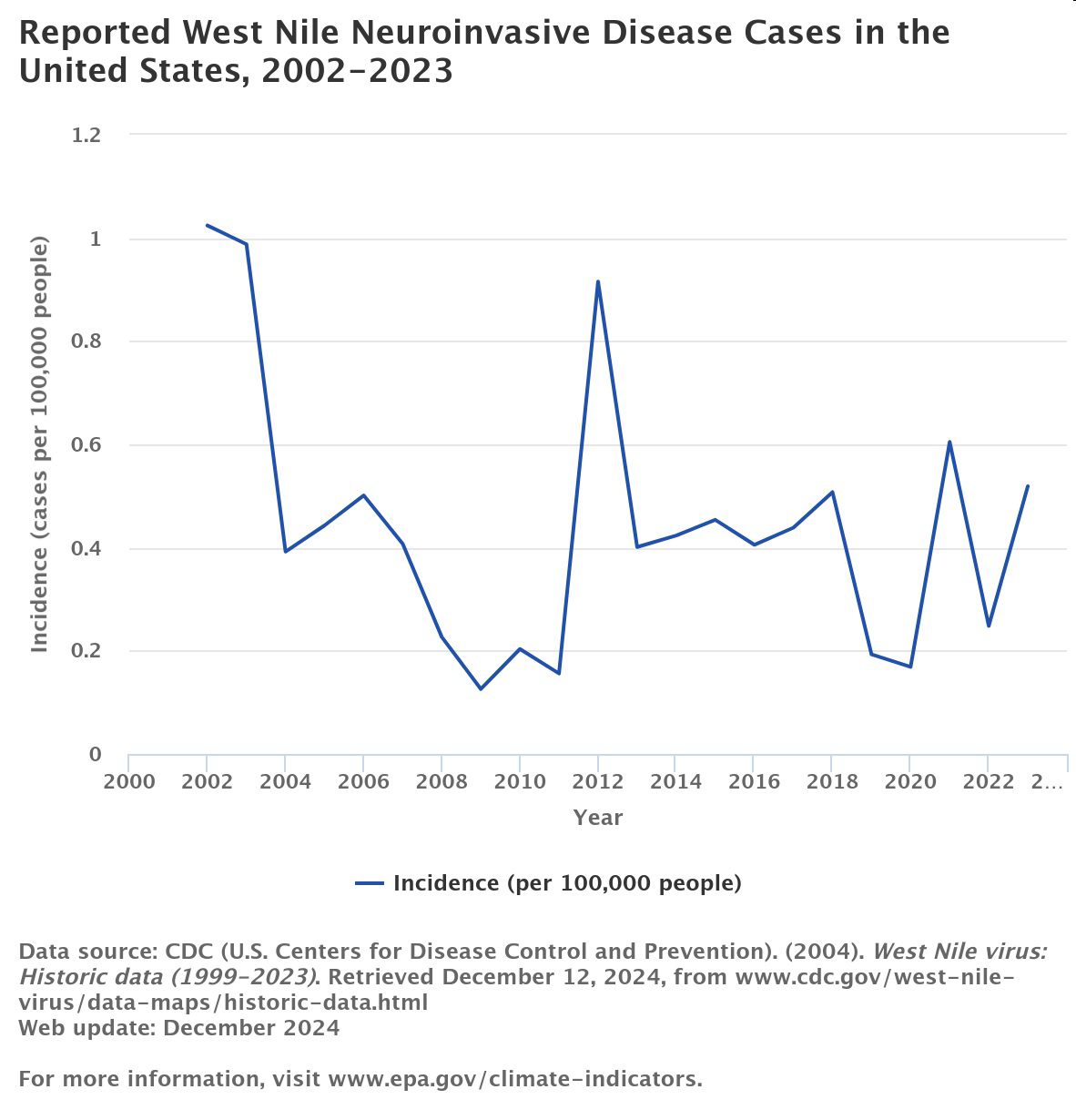
The incidence of West Nile neuroinvasive disease in the United States has varied widely from year to year (see Figure 1). No obvious long-term trend can be detected yet through this limited data set.
The years 2002, 2003, and 2012 had the highest reported incidence rates, around one case per 100,000 people (see Figure 1).
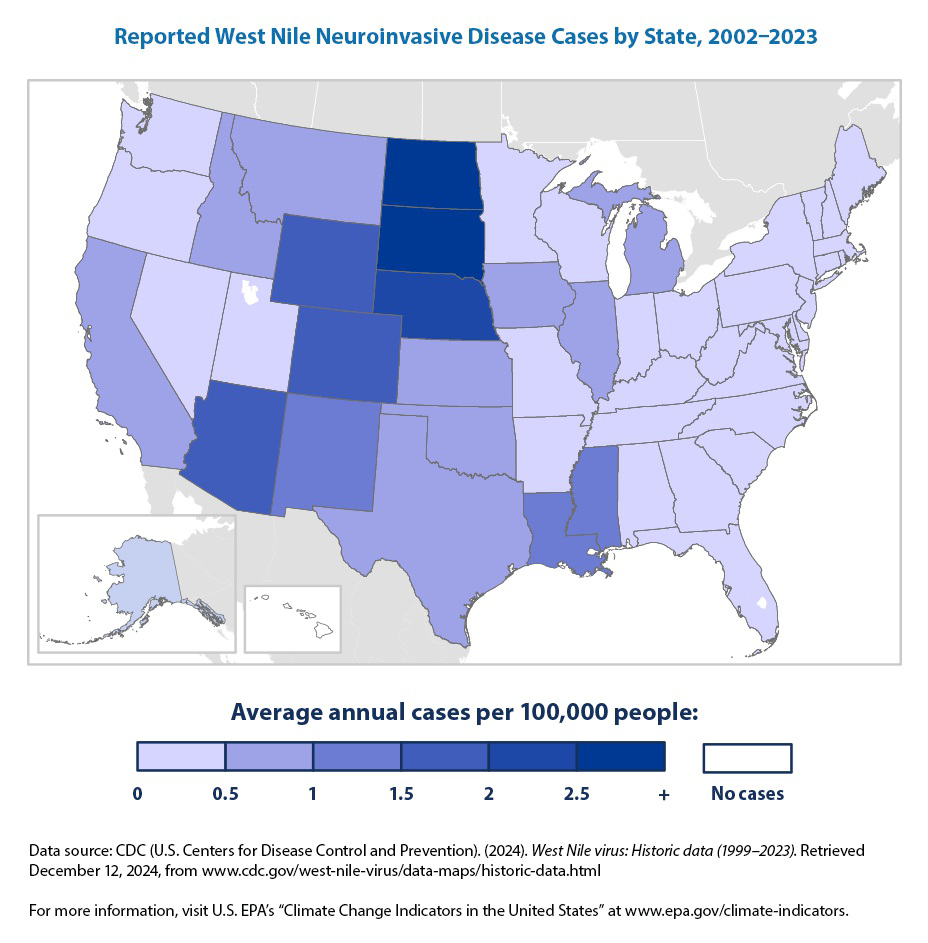
West Nile virus occurs throughout the contiguous 48 states. Based on reported neuroinvasive cases, average annual incidence is highest in parts of the Southwest, the Mississippi Delta region, the Great Plains, and the Rocky Mountain region (see Figure 2).
Background
Climate change is expected to affect the geographic and seasonal patterns of vector-borne diseases (that is, diseases caused by pathogens transmitted by mosquitoes, ticks, fleas, or other arthropods) in the United States. West Nile virus was first detected in the United States in 1999 and is now the most common cause of mosquito-borne disease in the United States in most years. While many infected people feel no symptoms, others can experience symptoms such as headache, body aches, joint pains, vomiting, diarrhea, and rash, as well as more severe damage to the central nervous system in some patients, causing encephalitis, meningitis, and occasionally death. From 1999 to 2023, a total of 59,141 cases of West Nile virus disease were reported to the U.S. Centers for Disease Control and Prevention (CDC). More than half of the reported cases of people infected with West Nile virus were neuroinvasive - that is, affecting the brain or causing neurologic dysfunction. Mosquitoes acquire the virus by biting infected birds, which are the main hosts of the virus. People are then infected when they are bitten by these virus-carrying mosquitoes.
Climate change increases the risk of human exposure to West Nile virus. Studies show that warmer temperatures associated with climate change can accelerate mosquito development, biting rates, and the incubation of the disease within a mosquito. The effect of climate change on the timing of bird migration and breeding patterns may also contribute to changes in long-range virus movement. Mild winters and drought have been associated with West Nile virus disease outbreaks, while rainfall can also contribute by creating breeding sites for mosquitoes.
Climate is just one of many important factors that influence the transmission, distribution, and incidence of West Nile virus disease. Human exposure to infected mosquitoes is also influenced by multiple factors, including changes in the proximity of human populations to mosquitoes and host bird species, increased awareness of West Nile virus, and modified behaviors, such as spending less time outdoors during peak mosquito-biting times and taking precautions to avoid being bitten. West Nile disease is one of many diseases transmitted to humans by mosquitoes that CDC tracks.
Graph of Information - Figure 1.
This figure shows the annual incidence of West Nile neuroinvasive disease, which is calculated as the number
of new cases per 100,000 people. The graph is based on cases that local and state health departments report to
CDC’s national disease tracking system. Neuroinvasive cases, which account for less than 1 percent of people infected with West Nile virus, are those that affect the brain or cause neurologic dysfunction.
Graph of Information - Figure 2.
This map shows the average annual incidence of West Nile neuroinvasive disease in each state, which is
calculated as the average number of new cases per 100,000 people per year from 2002 to 2023. The map is
based on cases that local and state health departments report to CDC’s national disease tracking system.
Neuroinvasive cases, which account for less than 1 percent of people infected with West Nile virus, are those
that affect the brain or cause neurologic dysfunction.