Carbon Cycling in a Coastal Wetland or Mangrove System
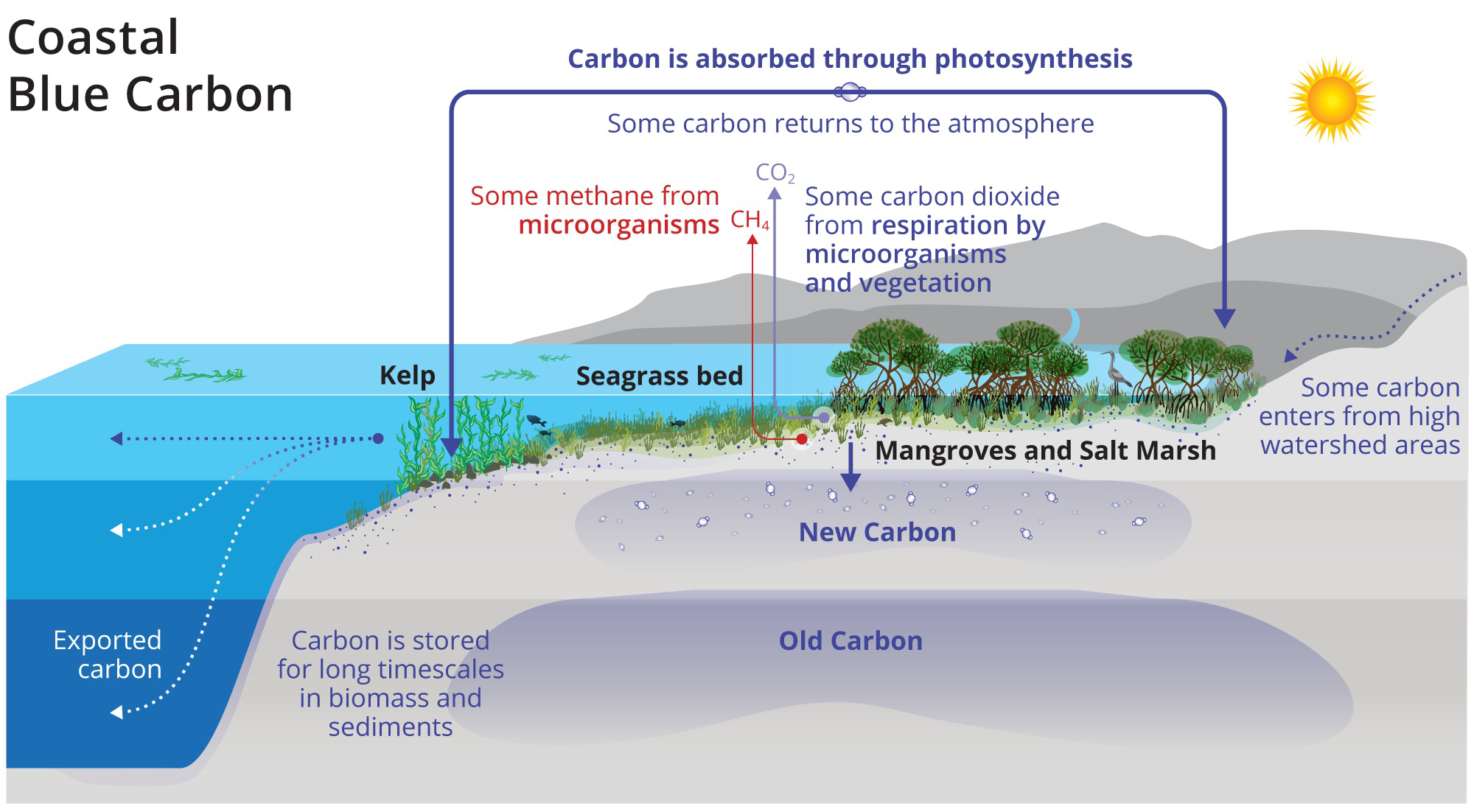
Diagram 1.
Source: https://www.geographyrealm.com/blue-carbon/
Coastal wetlands - such as salt marshes, tidal flats, and mangrove forests - play a powerful role in the Earth’s carbon cycle. These ecosystems act as “carbon sinks,” meaning they take in more carbon than they release. Despite covering less than 2% of Earth’s surface, wetlands store up to 30% of global soil carbon, making them one of the most efficient natural carbon-storing systems.
Mangrove trees absorb atmospheric $CO_2$ during photosynthesis. Some of this carbon becomes part of the tree’s biomass, while a large portion moves into wetland soils through falling leaves, buried roots, microbial activity, and sediments trapped by mangrove root systems. Because wetland soils lack oxygen, decomposition is extremely slow. As a result, carbon remains buried for centuries to thousands of years.
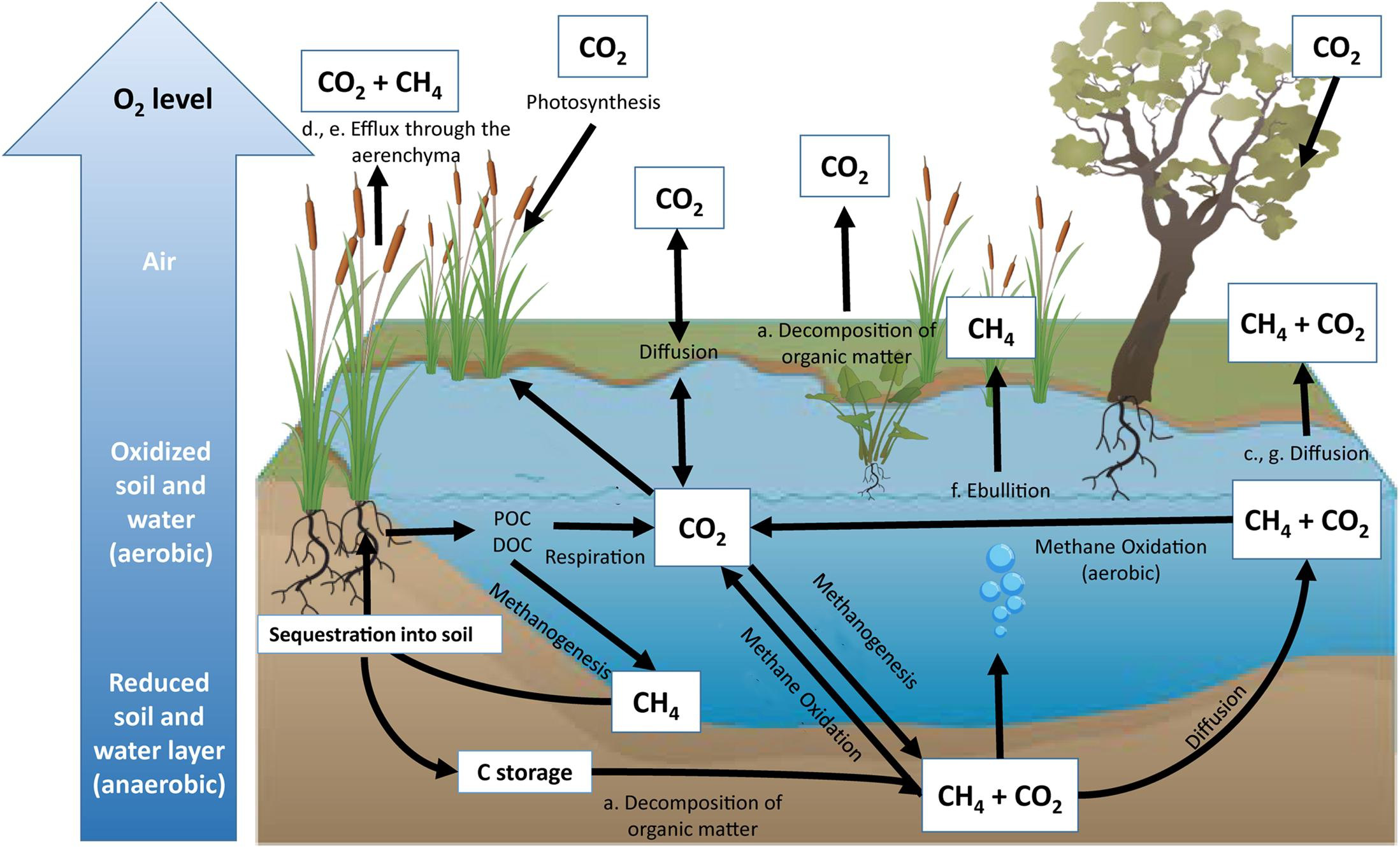
Wetlands also exchange carbon back to the atmosphere. Plant respiration releases $CO_2$, and anaerobic bacteria produce methane $(CH_4)$, a greenhouse gas. While methane emissions are significant, coastal wetlands still remain net carbon sinks because the amount of carbon they bury underground exceeds the carbon they release.
Changes in environmental conditions strongly influence this carbon cycling. Warmer temperatures increase plant growth and carbon capture, but they also increase decomposition and methane release. Rising sea levels can expand wetland area inland, increasing the total carbon burial potential. However, sea-level rise may also drown wetlands that cannot accumulate sediment quickly enough.
Human impacts also shape carbon storage. When wetlands are drained or cleared for development, the previously buried carbon is suddenly exposed to oxygen. This rapid oxidation can release large amounts of $CO_2$ back into the atmosphere. Restoring wetlands reverses this process by rebuilding soil carbon storage and reestablishing plant uptake of $CO_2$.
Diagram 2.
 Source: https://www.frontiersin.org/journals/environmental-science/articles/10.3389/fenvs.2020.00008/full
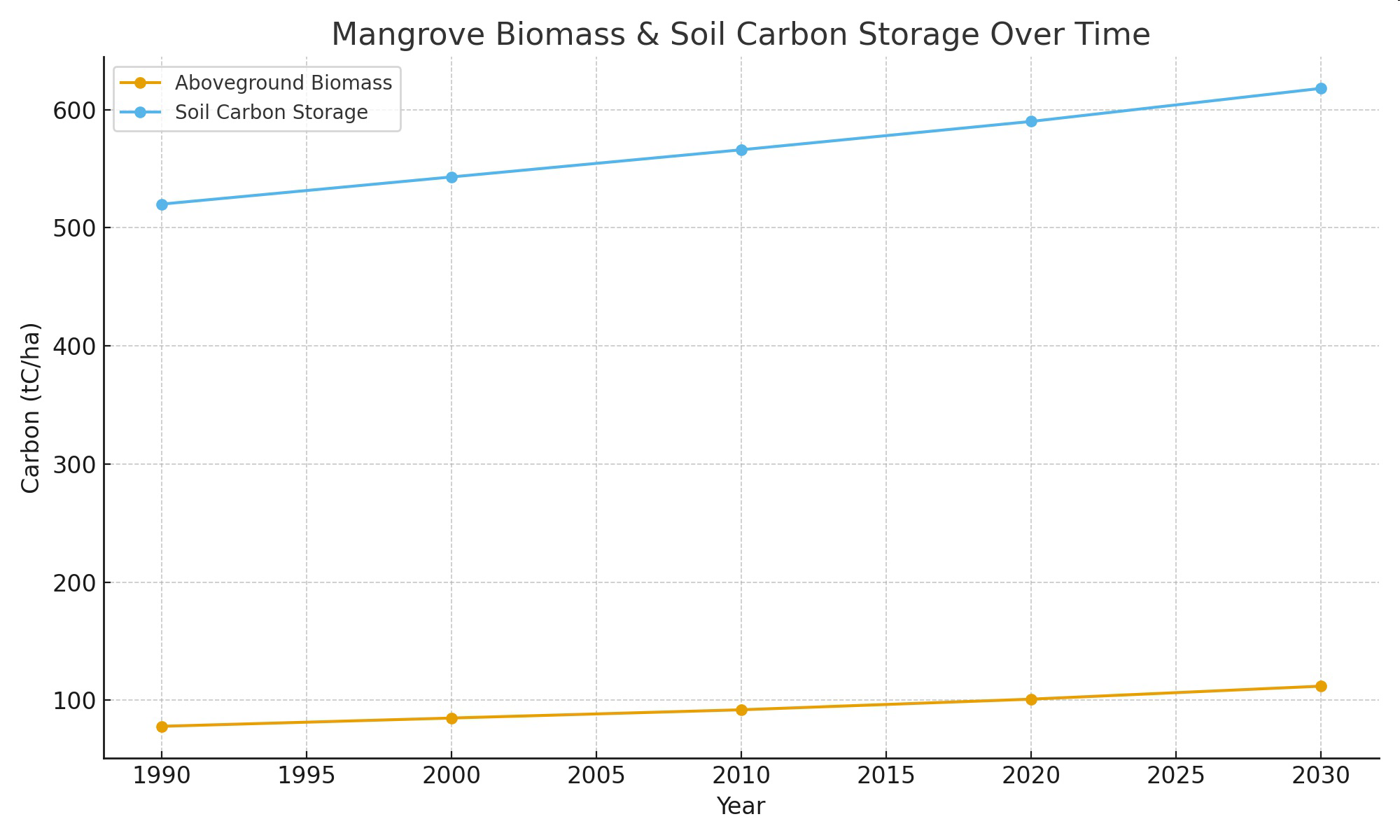
Scientists quantify wetland carbon cycling using measurements such as carbon flux (movement of carbon between reservoirs), soil carbon storage, and biomass accumulation. By tracking these variables over time, researchers develop quantitative models to understand and predict how coastal systems influence the global carbon cycle.
Table 1.
Process | Carbon Flux (MtC/year) |
|---|
Atmospheric CO2 to Plant Photosynthesis | 520 |
Plant Respiration to Atmosphere | 410 |
Soil Carbon Burial | 180 |
Methane Release | 65 |
Tidal Export of Dissolved Carbon | 95 |
Graph of Information - Figure 1.
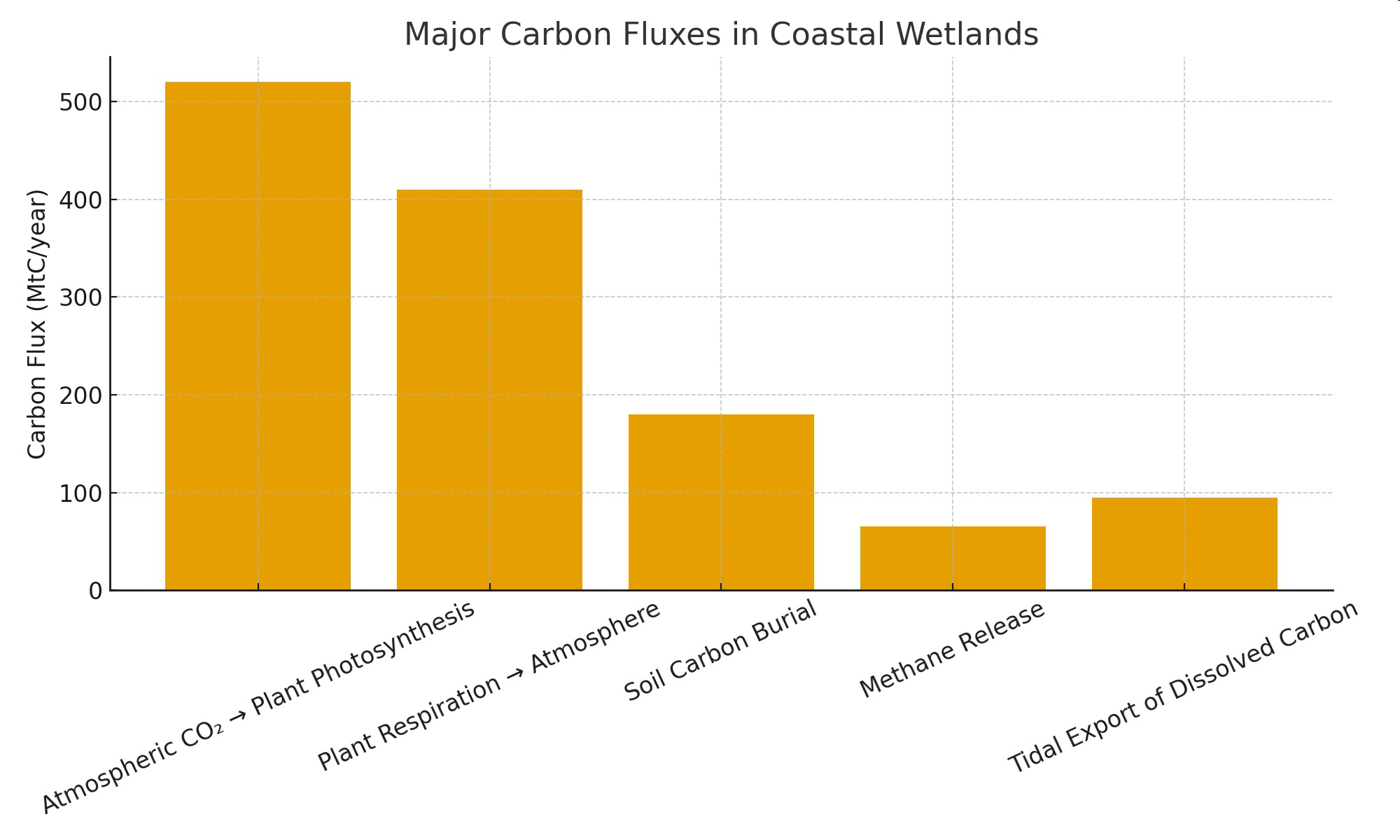
Table 2.
Year | Aboveground Biomass (tC/ha) | Soil Carbon Storage (tC/ha) |
|---|
1990 | 78 | 520 |
2000 | 85 | 543 |
2010 | 92 | 566 |
2020 | 101 | 590 |
2030 | 112 | 618 |
Graph of Information - Figure 2.