Cases of Lyme Disease
Key Points
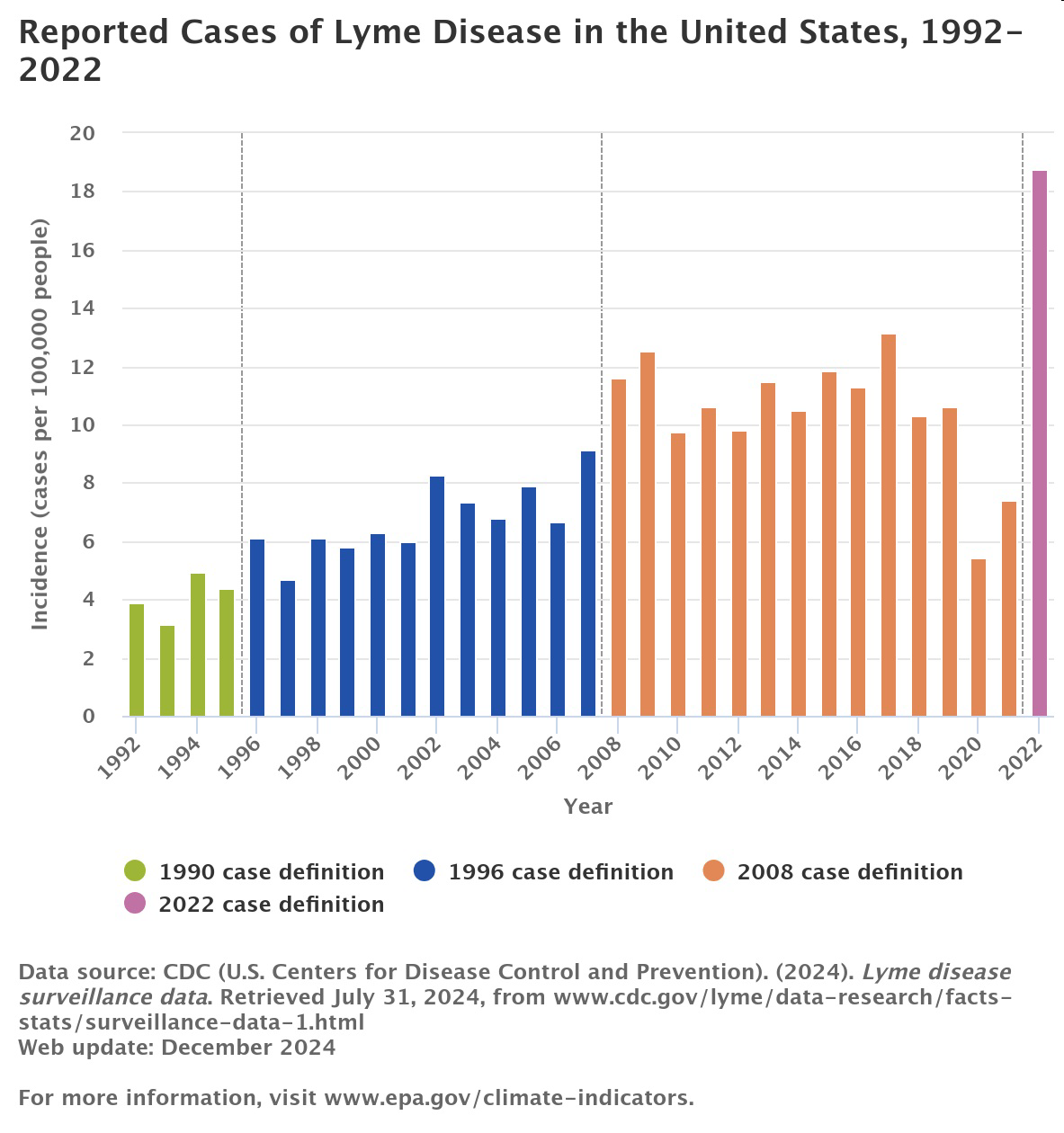
Between 1992 and 2022, the incidence of Lyme disease in the United States has ranged from a minimum of $3.2$ reported cases per $100{,}000$ people in 1993 to a maximum of $18.8$ per $100{,}000$ people in 2022 (Figure 1). Changes in the way Lyme disease cases have been defined and reported over time make it challenging to identify long-term trends.
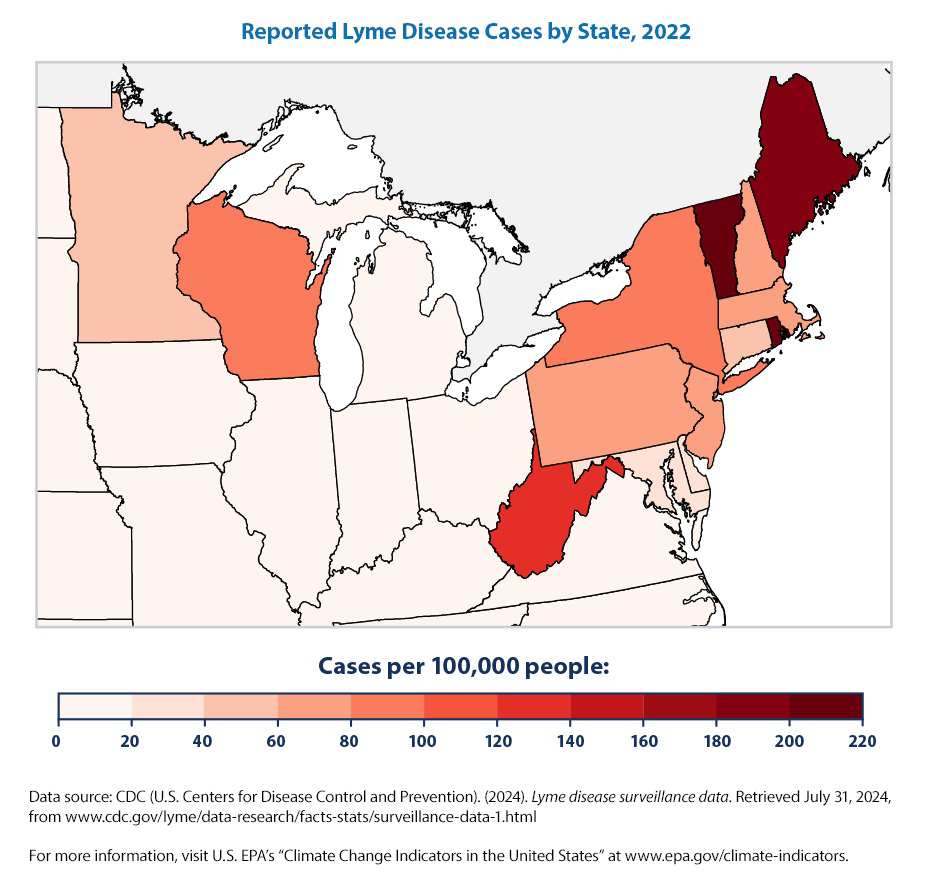
Lyme disease is much more common in the Northeast, mid-Atlantic, and upper Midwest than in other regions (Figure 2). The CDC has identified 15 states and the District of Columbia as “high-incidence jurisdictions” where Lyme disease cases consistently occur at a high rate. These states plus D.C. accounted for about 95 percent of the nation’s reported Lyme disease cases in 2022.
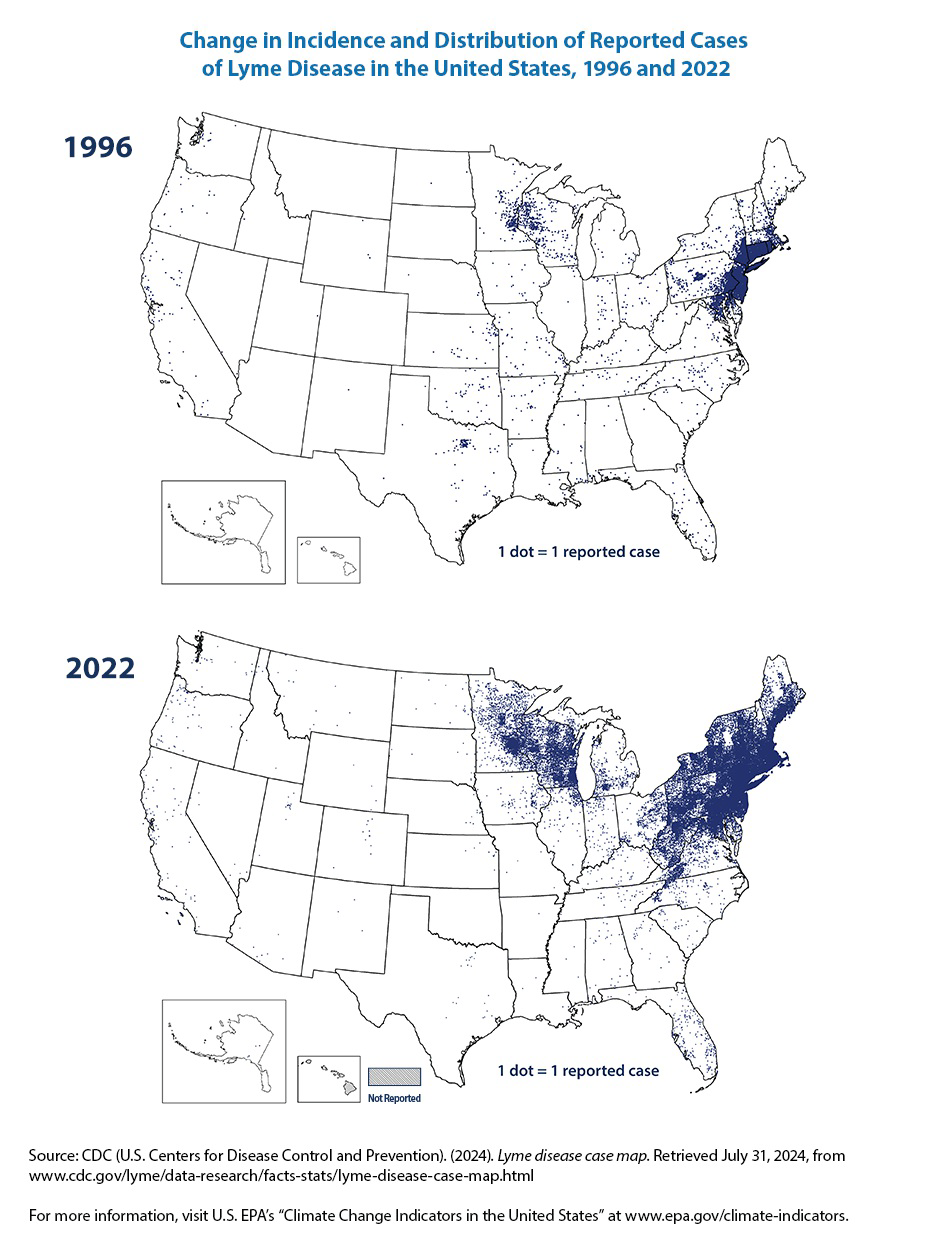
Driven by multiple factors, the distribution of reported cases of Lyme disease has expanded over time (Figure 3).
Background
Lyme disease is a bacterial illness that can cause fever, fatigue, joint pain, and skin rash, as well as more serious joint and nervous system complications. Lyme disease is the most common vector-borne disease (that is, a disease transmitted by mosquitoes, ticks, or fleas) in the United States. Lyme disease is transmitted through the bite of certain species of infected ticks (referred to commonly as deer ticks) that carry the bacteria that cause Lyme disease. These ticks live not only on deer, but also on rodents, birds, and other host animals. Deer do not harbor the bacteria that cause Lyme disease, but certain other hosts such as white-footed mice do, and ticks pick up the bacteria by feeding on these infected hosts.
Studies provide evidence that climate change has contributed to the expanded range of ticks, increasing the potential risk of Lyme disease, such as in areas of Canada where the ticks were previously unable to survive. The life cycle and prevalence of deer ticks are strongly influenced by temperature. For example, deer ticks are mostly active when temperatures are above $45^\circ \text{F}$, and they thrive in areas with at least 85-percent humidity. Thus, warming temperatures associated with climate change are projected to increase the range of suitable tick habitat and are, therefore, one of multiple factors driving the observed spread of Lyme disease. Because tick activity depends on temperatures being above a certain minimum, shorter winters could also extend the period when ticks are active each year, increasing the time that humans could be exposed to Lyme disease. Unlike some other vector-borne diseases, tick-borne diseases in patients are generally less influenced by short-term changes in weather (weeks to months) than by longer-term climate change.
Climate is just one of many important factors that influence the transmission, distribution, and incidence of Lyme disease. Other factors that affect the number of Lyme disease cases include changes in the populations of host species (particularly deer), which affect tick population size. The percentage of ticks that are infected depends on the prevalence and infection rates of white-footed mice and certain other hosts. Host species populations and habitats can be affected by climate change and other ecosystem disturbances. Human exposure to infected ticks is also influenced by factors such as changes in the proximity of human populations to ticks and other hosts, increased awareness of Lyme disease, and modified behaviors, such as spending less time outdoors, taking precautions against being bitten, and checking more carefully for ticks. Occupation influences exposure, as people who work outdoors, like farmers and landscapers, may be especially at risk. Lyme disease is one of many diseases transmitted to humans by ticks or mosquitoes that CDC tracks.
Graph of Information - Figure 1.
This graph shows the annual incidence of Lyme disease, which is calculated as the number of cases per 100,000 people. The graph is based on cases that local and state health departments report to CDC’s national disease tracking system. Due to the COVID-19 pandemic, 2019 and 2020 data from some jurisdictions are incomplete.
Graph of Information - Figure 2.
This map shows reported Lyme disease by jurisdiction in 2022 for the portion of the country where Lyme disease is common, based on the number of total cases per 100,000 people. All states not shown had rates below 10 cases per 100,000 people.
Maps of Information - Figure 3.
These maps show the distribution of Lyme disease cases reported to CDC in 1996 and 2022 across the 50 states and the District of Columbia. Each dot represents an individual case. Dots are placed randomly within each patient’s county of residence, which might differ from the county where they were exposed. The year 1996 was
chosen as the first year after a major case definition update that incorporated standardized testing approaches.