Coral Reef Restoration Using Coral Gardening and Micro-Fragmentation
Diagram 1.
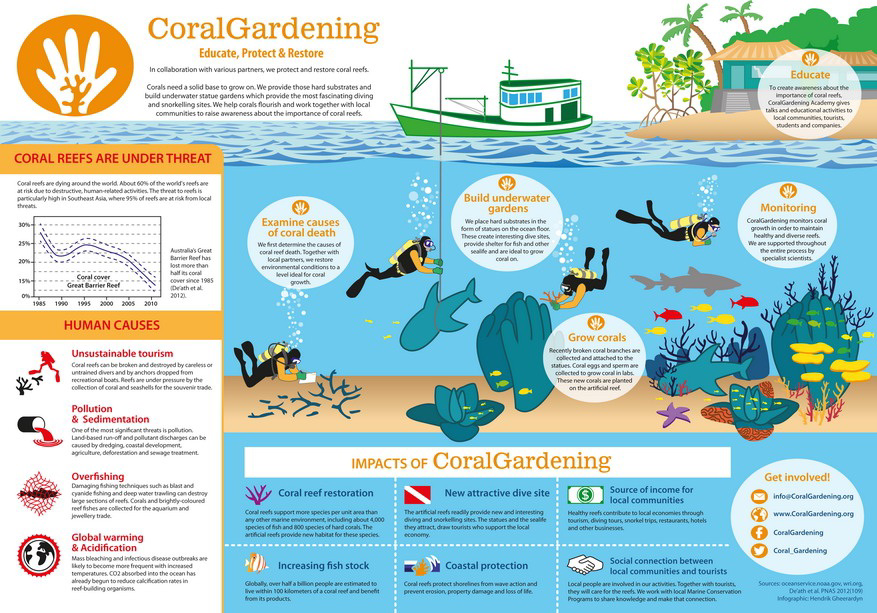
Source:
https://www.coralgardening.org/restore/
Coral reefs around the world have been declining due to ocean warming, pollution, destructive fishing, and coastal development. As reefs lose living coral cover, the ecosystem becomes less structurally complex, less productive, and less biodiverse. Over the last decade, many coastal communities have turned to active coral restoration as a solution to reduce the impacts of human activities and support reef recovery. Two widely used strategies are coral gardening and micro-fragmentation.
In coral gardening, small fragments of healthy corals are collected from donor colonies or rescued from damaged areas. These fragments are placed into nurseries – either underwater “tree” structures or land-based tanks – where they grow under protected conditions. Once the fragments reach a suitable size, they are outplanted back onto degraded reefs. This increases coral density, enhances habitat structure, and can jump-start ecological recovery. Coral gardening is especially effective for branching corals that grow quickly and provide habitat for fish and invertebrates.
Micro-fragmentation is a newer technique particularly useful for massive, slow-growing coral species. Large corals are cut into many tiny pieces – often only one square centimeter each. These fragments grow rapidly and fuse together when placed close to one another, allowing large colonies to form far faster than they would naturally. This approach dramatically speeds up restoration timelines and has become a promising tool for recovering coral species that were previously difficult to restore.
However, restoration efforts must be carefully designed and evaluated. Survival and growth rates differ depending on fragment size, nursery type, water quality, and site selection. In some reefs, outplants experience high mortality due to continued heat stress, algae overgrowth, or low herbivore populations. Students can analyze data on coral survival, growth, algal cover, and fish abundance to evaluate which restoration strategies work best under different environmental conditions.
Coral restoration cannot fully counteract global threats like climate change, but it can reduce local impacts and help maintain biodiversity while broader solutions are implemented. Restoration is especially effective when paired with actions such as reducing pollution, managing fisheries, and protecting herbivore communities. Designing, evaluating, and refining coral restoration strategies helps illustrate how engineering solutions, ecological monitoring, and adaptive management can reduce the impacts of human activities on ecosystems.
Table 1.
Method | Three Month Survival % | Annual Growth cm |
|---|
Coral_Gardening | 78 | 9.4 |
Micro_Fragmentation | 88 | 12.7 |
Natural_Recovery | 42 | 3.1 |
Graph of Information - Figure 1.
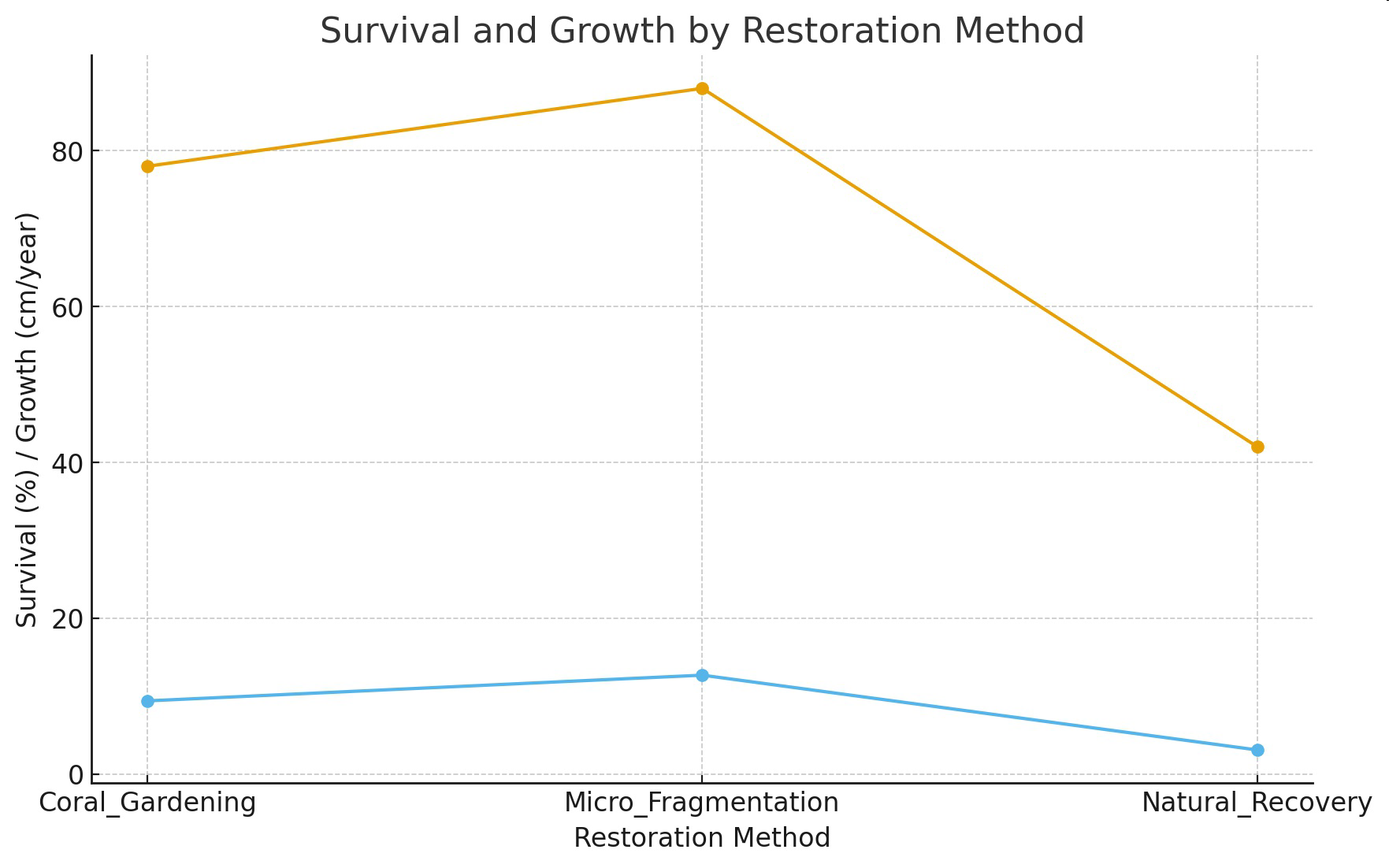
Table 2.
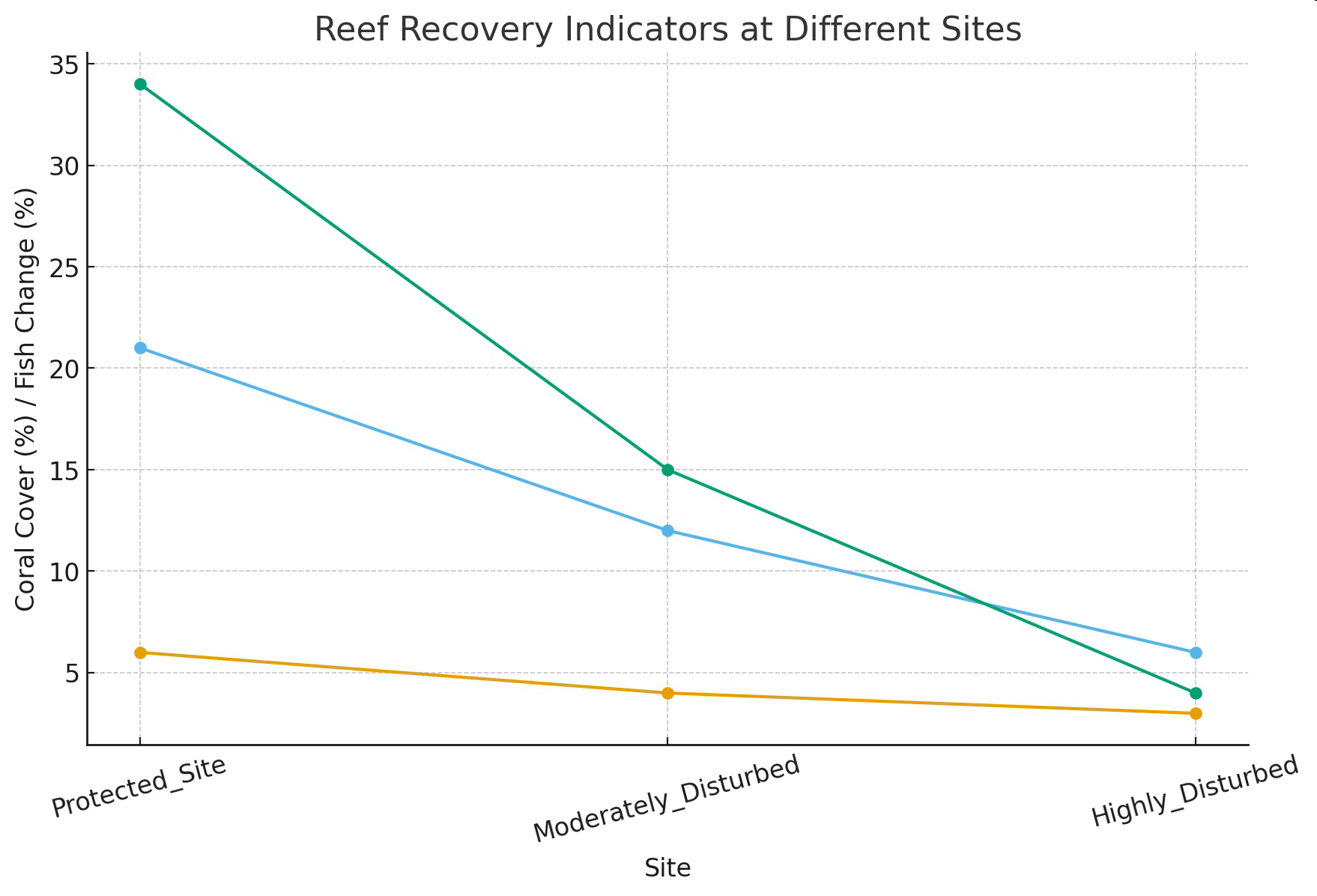
Site | Coral Cover Before % | Coral Cover After % | Fish Abundance Change % |
|---|
Protected Site | 6 | 21 | 34 |
Moderately Disturbed | 4 | 12 | 15 |
Highly Disturbed | 3 | 6 | 4 |
Graph of Information - Figure 2.