Twa kɔ nsɛm atitiriw so
Log in
Sign up for FREE
arrow_back
Laabri

DEAMER QUIZ REMEDIATION 1.1 (4/14/2026)

star
star
star
star
star
Last updated 2 months ago
10 Nsɛmmisa

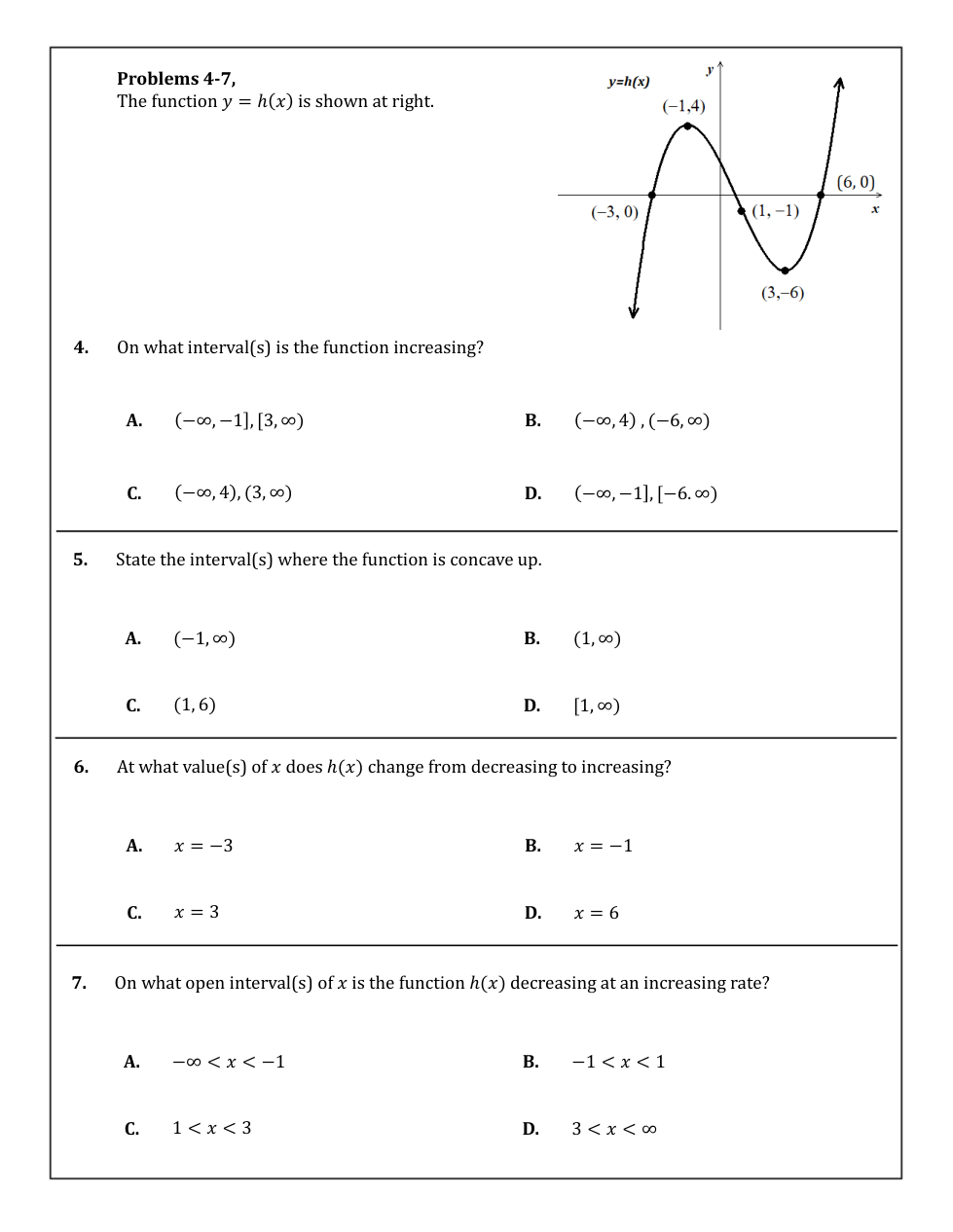
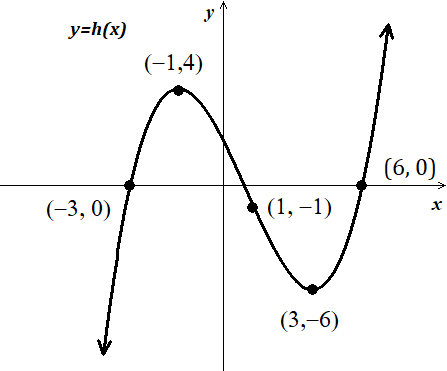
The function $y = h(x)$ is shown at right.

Graph of the function y=h(x) with key points labeled at (-3,0), (-1,4), (1,-1), (3,-6), and (6,0).

1
1
1
1
Asemmisa {{asɛmmisaAhyɛnsode}}
1.

On what interval(s) is the function increasing?

Asemmisa {{asɛmmisaAhyɛnsode}}
2.

State the interval(s) where the function is concave up.

Asemmisa {{asɛmmisaAhyɛnsode}}
3.

At what value(s) of $x$ does $h(x)$ change from decreasing to increasing?

Asemmisa {{asɛmmisaAhyɛnsode}}
4.

On what open interval(s) of $x$ is the function $h(x)$ decreasing at an increasing rate?

1
Asemmisa {{asɛmmisaAhyɛnsode}}
5.

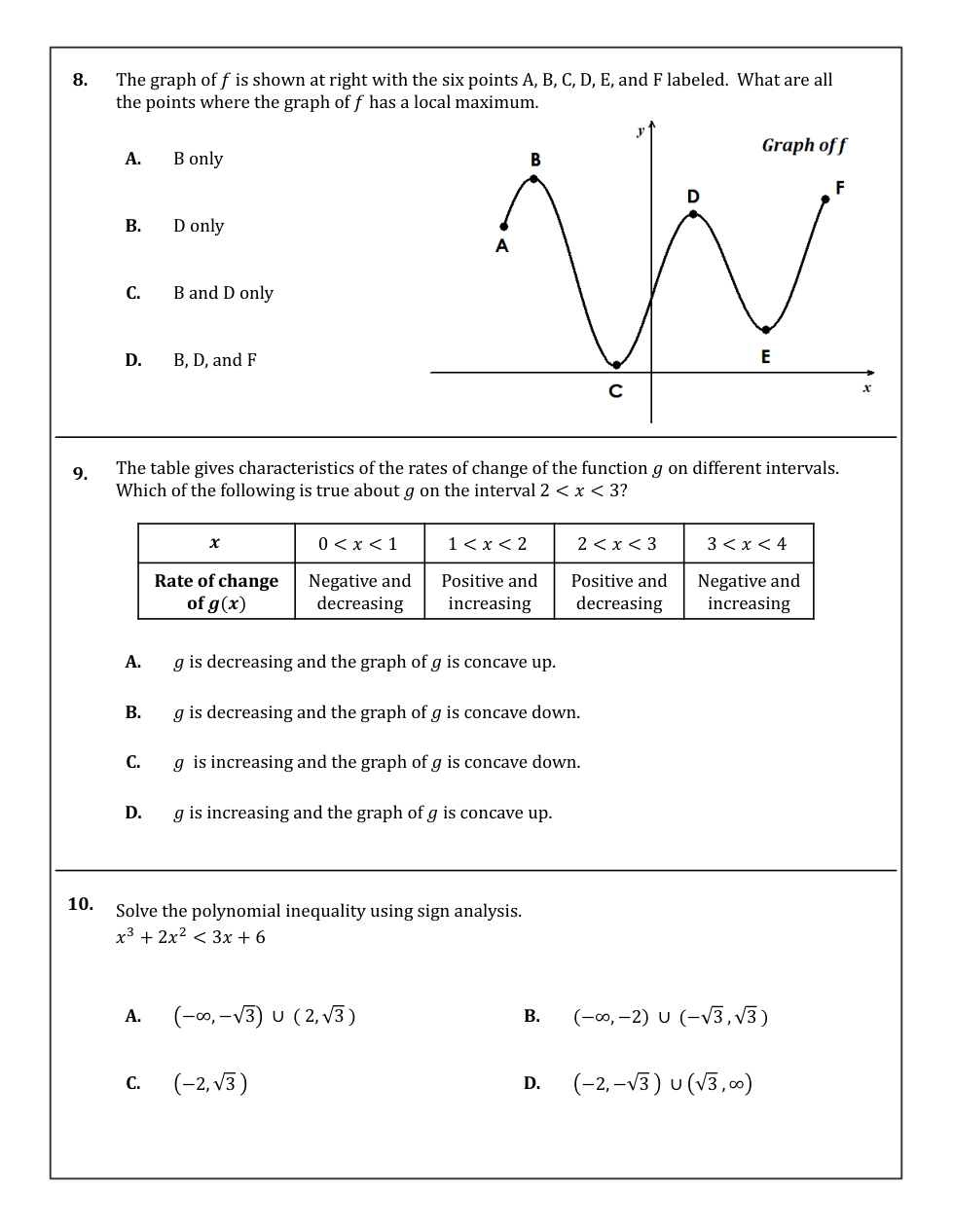
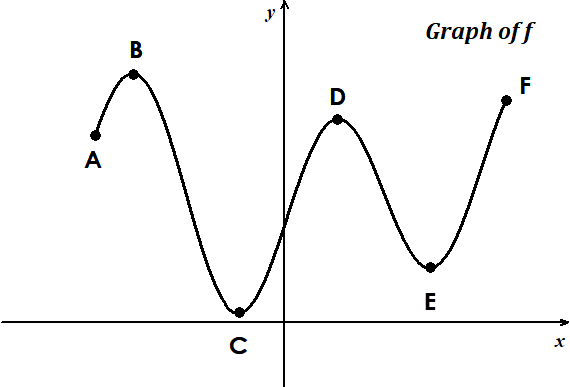
The graph of f is shown at left with the six points A, B, C, D, E, and F labeled. What are all the points where the graph of f has a local maximum. Graph of a function f with labeled points A, B, C, D, E, F
1

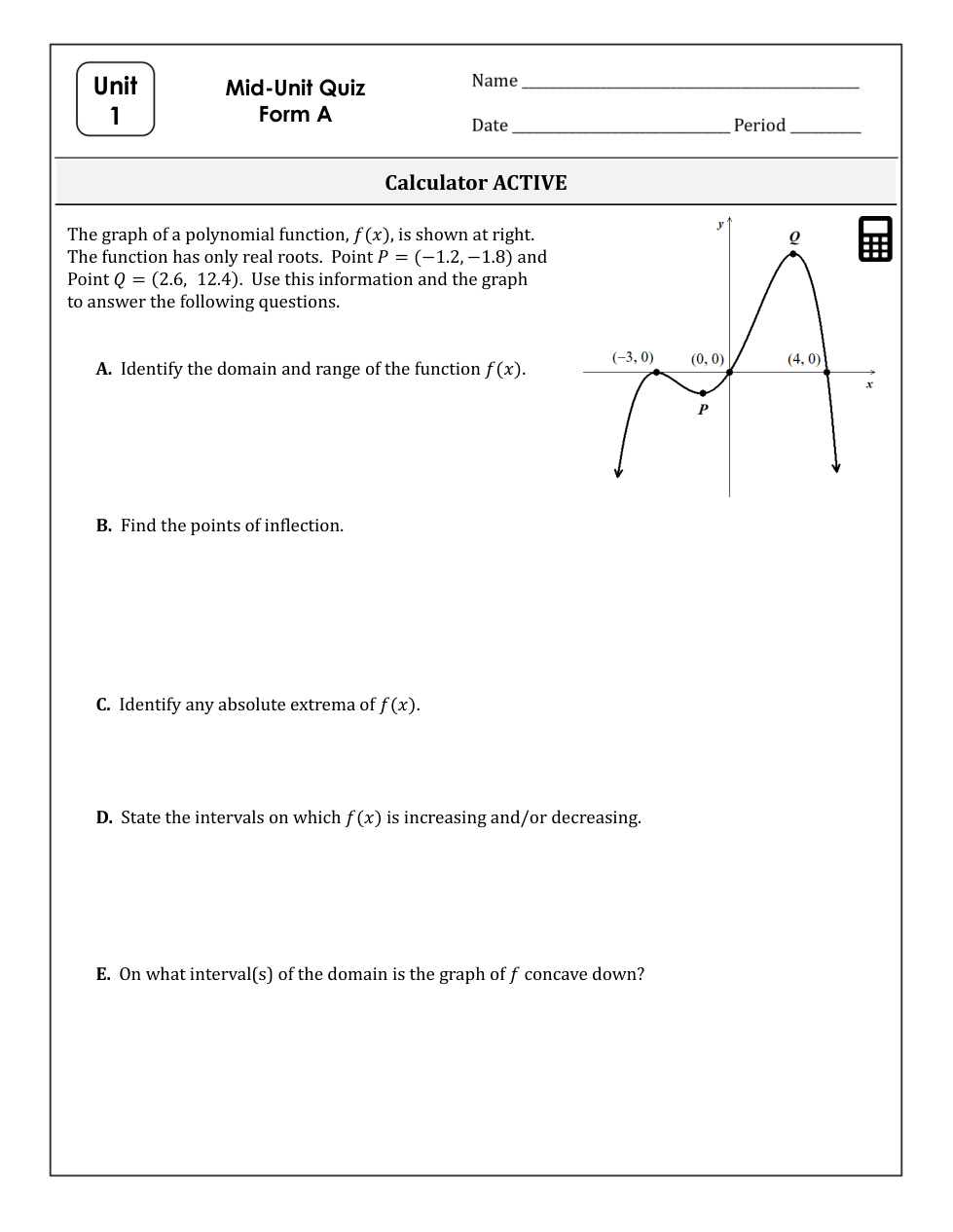
The graph of a polynomial function, $f(x)$, is shown at left.
The function has only real roots. Point $P = (-1.2, -1.8)$ and Point $Q = (2.6, 12.4)$. Use this information and the graph to answer the following questions.

1
Asemmisa {{asɛmmisaAhyɛnsode}}
7.

A. Identify the domain $f(x)$.

1
Asemmisa {{asɛmmisaAhyɛnsode}}
8.

Identify the range of f(x)

1
Asemmisa {{asɛmmisaAhyɛnsode}}
9.

C. Identify any absolute max of $f(x)$, ordered pair.

1
Asemmisa {{asɛmmisaAhyɛnsode}}
10.

D. State the intervals on which $f(x)$ is increasing.

Asemmisa {{asɛmmisaAhyɛnsode}}
6.

The table gives characteristics of the rates of change of the function g on different intervals. Which of the following is true about g on the interval $2 < x < 3$?

x

0 < x < 1

1 < x < 2

2 < x < 3

3 < x < 4

Rate of change of g(x)

Negative and decreasing

Positive and increasing

Positive and decreasing

Negative and increasing