Evolution of Shell-Building Marine Organisms and Changes in Seawater Chemistry
Many marine organisms, including clams, oysters, corals, foraminifera, and some plankton, build shells or skeletons made of calcium carbonate ($CaCO_3$). These structures form when dissolved calcium ions ($Ca^{2+}$) and carbonate ions ($CO_3$) in seawater combine and precipitate as minerals like calcite and aragonite. Over hundreds of millions of years, the ability of organisms to build shells has both responded to changes in seawater chemistry and helped reshape the chemistry of the oceans and atmosphere. This is a clear example of coevolution between Earth’s systems and life.
Diagram 1.
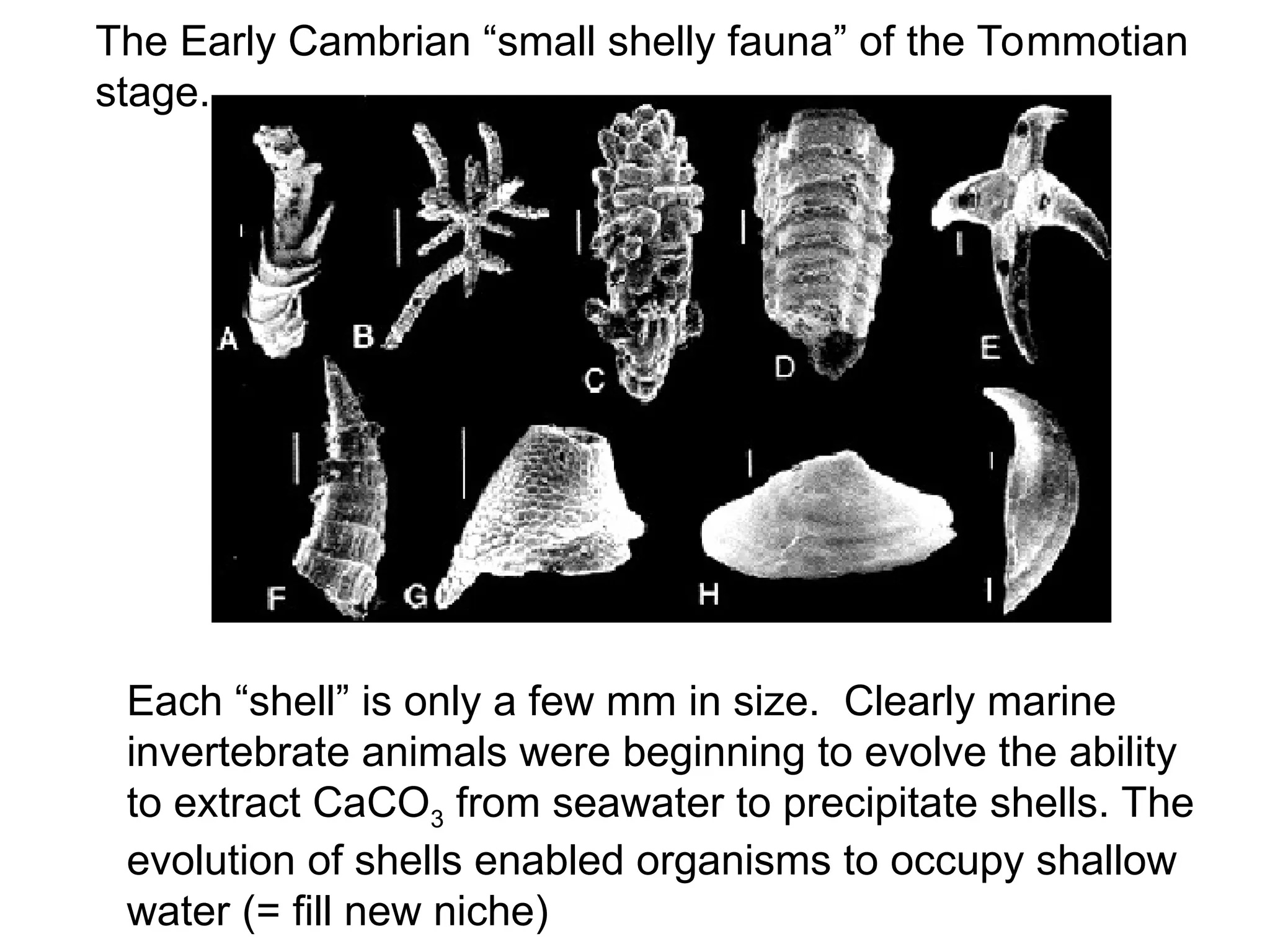
Source: https://www.slideshare.net/slideshow/cambrian-radiation-geologic-time-scale/275037165
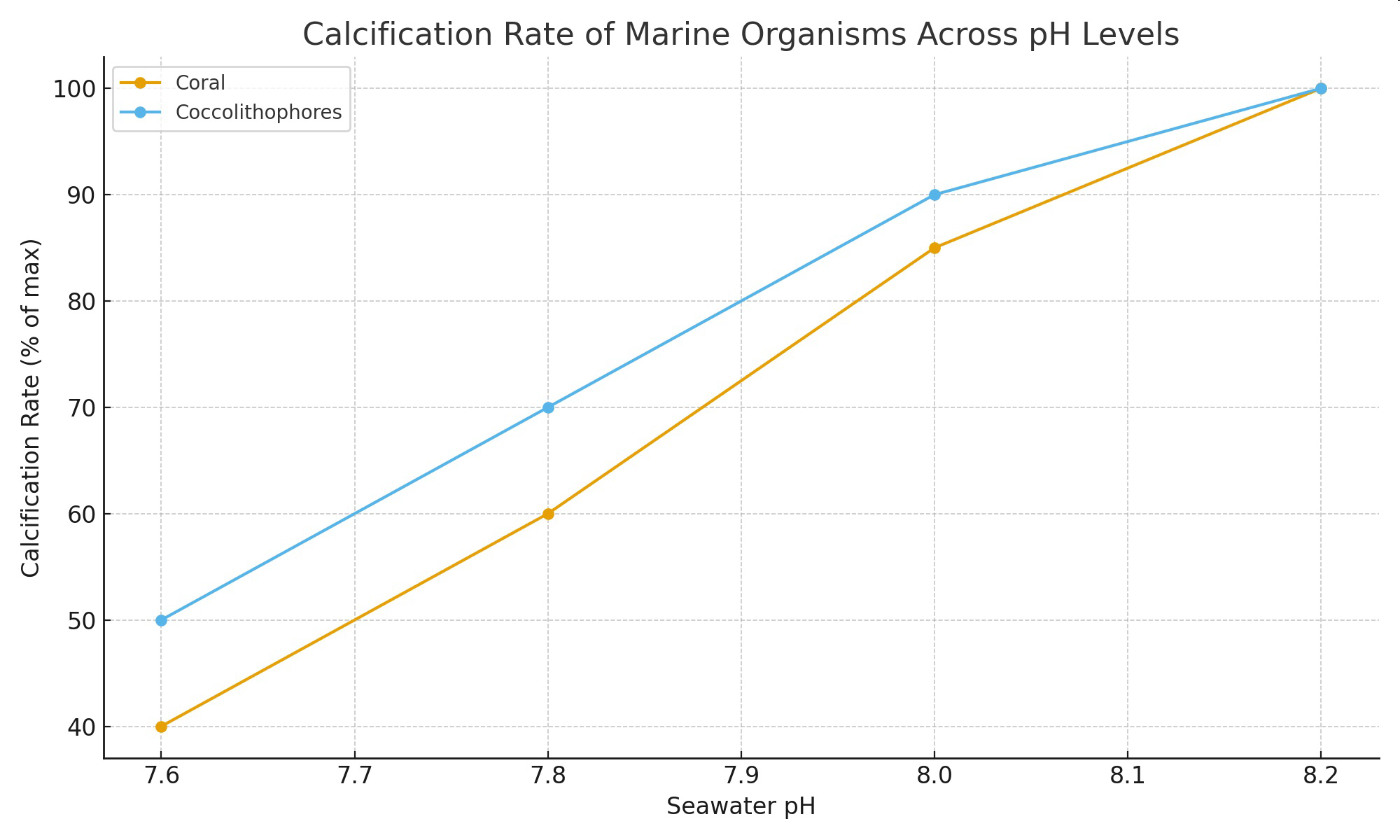
Seawater chemistry is strongly influenced by volcanic outgassing, weathering of rocks on land, and the exchange of $CO_2$ between the atmosphere and ocean. When atmospheric $CO_2$ is high, more $CO_2$ dissolves into the oceans, forming carbonic acid and lowering pH. Lower pH reduces carbonate ion concentration, which can make it harder for organisms to build and maintain shells. At the same time, the burial of shells on the seafloor removes carbon from the short-term carbon cycle and stores it in the geosphere as limestone and other carbonate rocks. This feedback can gradually lower atmospheric $CO_2$ and change climate over geologic time.
Geologists have identified long intervals in Earth’s history called “calcite seas” and “aragonite seas,” when seawater chemistry favored one mineral form of $CaCO_{3}$ over the other. These shifts are controlled by factors such as the ratio of magnesium to calcium in seawater, which is influenced by seafloor spreading rates and hydrothermal circulation. Fossil records show that groups of shell-building organisms have diversified or declined in step with these chemical changes, with some lineages evolving shell mineralogy or structure better suited to the prevailing conditions.
Mass extinction events and rapid climate changes also leave clear signatures in both seawater chemistry and the fossil record of shell-forming organisms. For example, times of rapid ocean acidification are associated with reduced diversity and thinner shells in many groups, while more stable periods often show high diversity and extensive reef building. Over millions of years, the accumulation and burial of shells has built thick sequences of carbonate rock, demonstrating how biological processes modify the geosphere and, indirectly, the atmosphere.
Diagram 2.
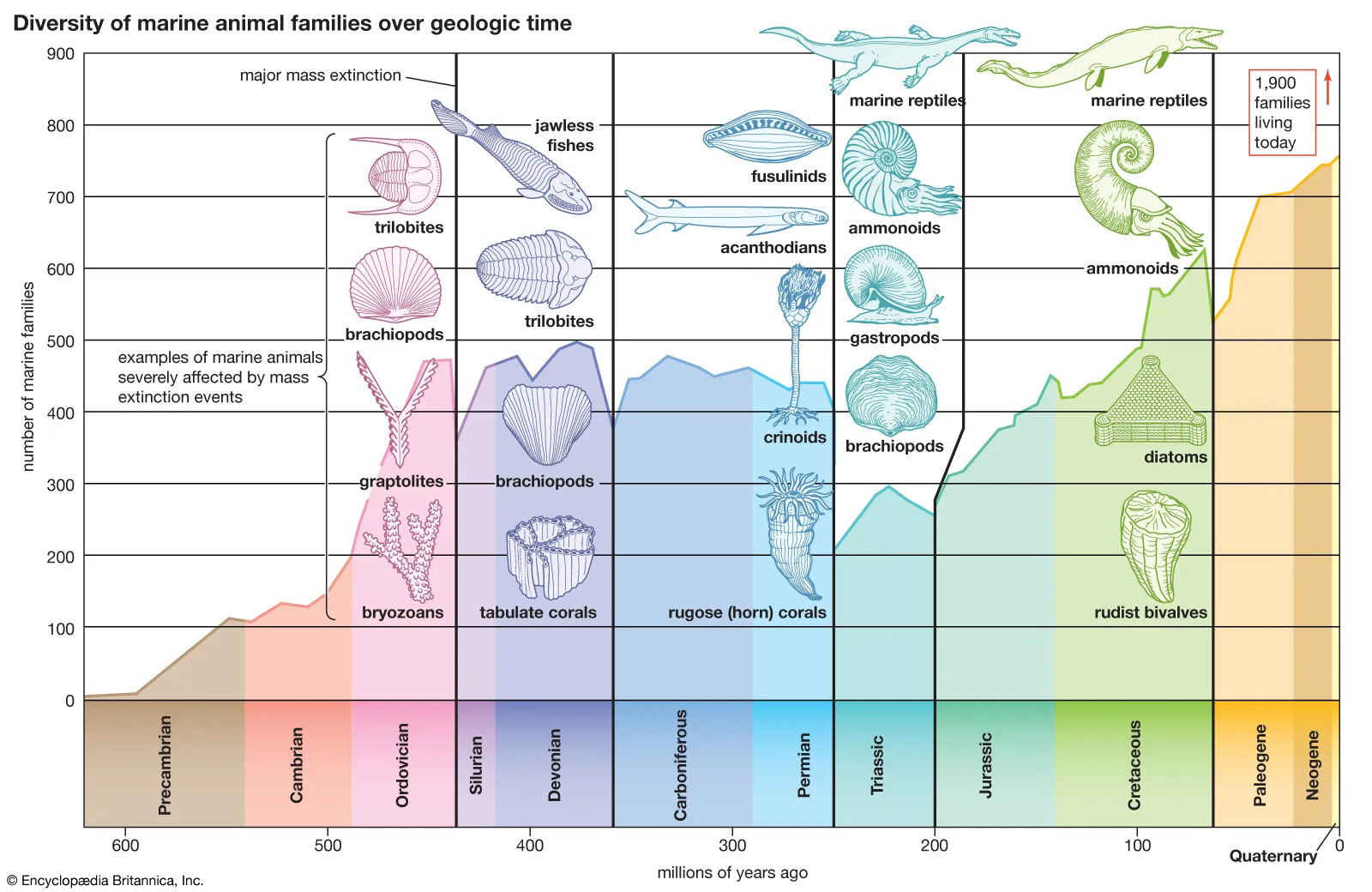 Source: https://www.britannica.com/science/end-Triassic-extinction
Table 1.
Time (million years ago) | Carbonate Ion Concentration (µmol/kg) | Calcifying Taxa Diversity Index |
|---|
500 | 140 | 20 |
400 | 130 | 35 |
300 | 115 | 55 |
200 | 100 | 70 |
100 | 90 | 85 |
0 | 80 | 95 |
Graph of Information - Figure 1.
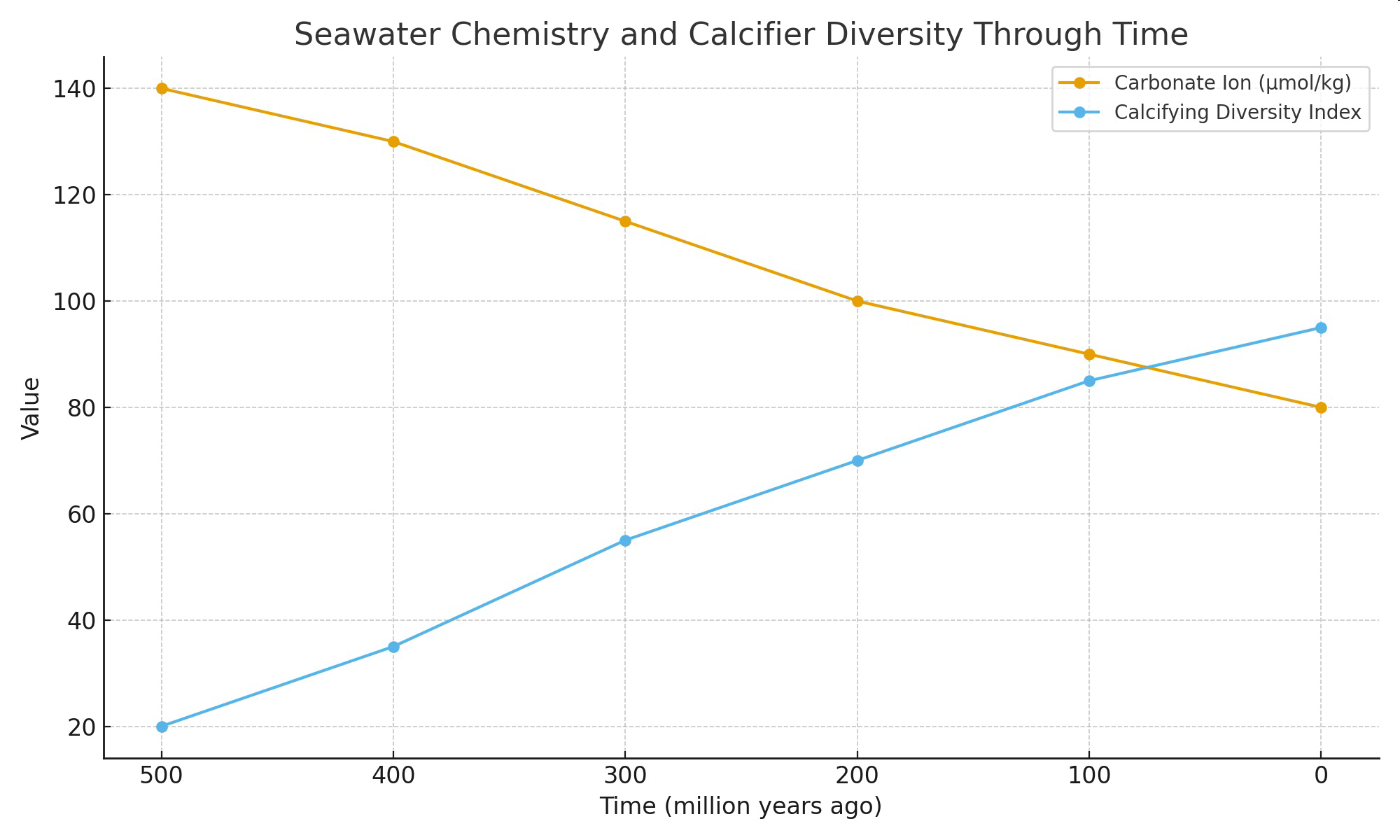
Table 2.
Seawater pH | Calcification Rate to Coral (% of max) | Calcification Rate to Coccolithophores (% of max) |
|---|
7.6 | 40 | 50 |
7.8 | 60 | 70 |
8 | 85 | 90 |
8.2 | 100 | 100 |
Graph of Information - Figure 2.