Formation of Soils by Early Terrestrial Microbes and Plants
When life first emerged onto land around 500 million years ago, Earth’s continents looked very different from today. The land surface consisted mostly of bare rock, loose sediments, and thin mineral crusts. Without true soils, terrestrial ecosystems as we know them - forests, grasslands, and complex food webs - could not yet exist. But the arrival of early terrestrial microbes, fungi, and eventually small land plants changed Earth’s surface forever.
Diagram 1.
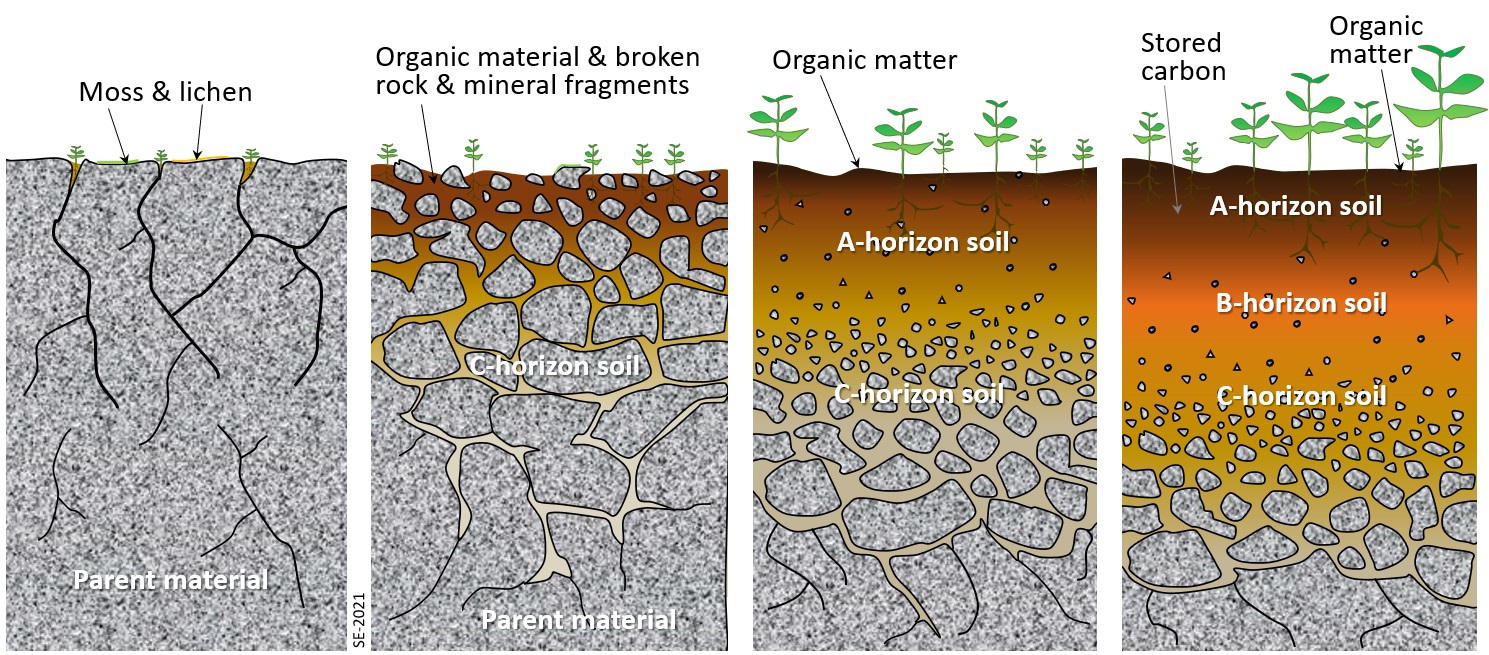 Source:
https://environmental-geology-dev.pressbooks.tru.ca/chapter/soil-formation/
The earliest colonizers were microbial mats and filamentous fungi that grew directly on rock surfaces. These organisms released organic acids that gradually dissolved minerals in bedrock. This process, called biological weathering, freed essential ions such as calcium, magnesium, and phosphorus. Microbial filaments also trapped dust and sediment, helping to form the first thin layers of proto–soil.
Around 470 million years ago, the first land plants - similar to today’s liverworts and mosses - appeared. These plants lacked roots but still accelerated soil formation dramatically. As they spread across moist shorelines and floodplains, they contributed organic matter through decayed tissues, shading of rock surfaces, and providing structure for microbial communities. Their presence also increased carbon cycling on land, as photosynthesis removed CO$_2$ from the atmosphere while burial of plant material stored carbon in sediments.
By 430–400 million years ago, vascular plants evolved roots, which transformed soil development. Roots penetrated rock fractures, expanded water flow into the ground, and supported vast fungal networks called mycorrhizae. These fungal partners greatly increased the rate of mineral weathering. As roots and fungi broke down rock more efficiently, soils became richer, deeper, and more capable of storing carbon.
Geologic evidence - including isotopic signatures, clay mineral abundance, and soil horizon structure - shows that the rise of land plants led to significant atmospheric CO$_2$ drawdown. Weathering of silicate rocks consumes CO$_2$, and the expansion of rooted plants dramatically increased global weathering rates. This coevolution of life and Earth’s systems reshaped the planet: the atmosphere cooled, soil layers thickened, and more complex terrestrial ecosystems flourished.
Diagram 2.
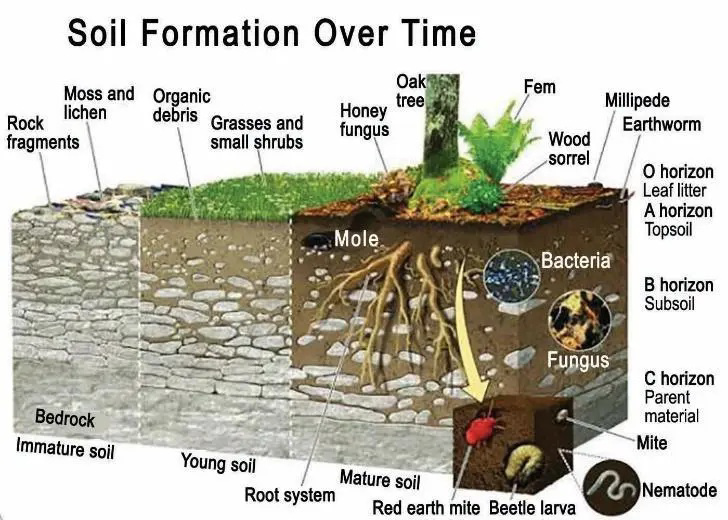 Source: https://compass.rauias.com/geography/soils-classification-factors-formation-processes/
Today’s soils are the product of hundreds of millions of years of interactions between Earth’s geosphere, biosphere, hydrosphere, and atmosphere. Without the earliest microbial and plant colonizers, Earth’s continents would still be rocky, barren landscapes incapable of supporting the diversity of life we see today.
Table 1.
Time (million years ago) | Microbial Mat Abundance Index | Early Plant Biomass Index | Soil Organic Carbon (kg/m ) |
|---|
500 | 90 | 0 | 0.5 |
450 | 75 | 10 | 1.2 |
400 | 40 | 35 | 2.8 |
350 | 10 | 65 | 5.6 |
300 | 0 | 85 | 7.9 |
Graph of Information - Figure 1.
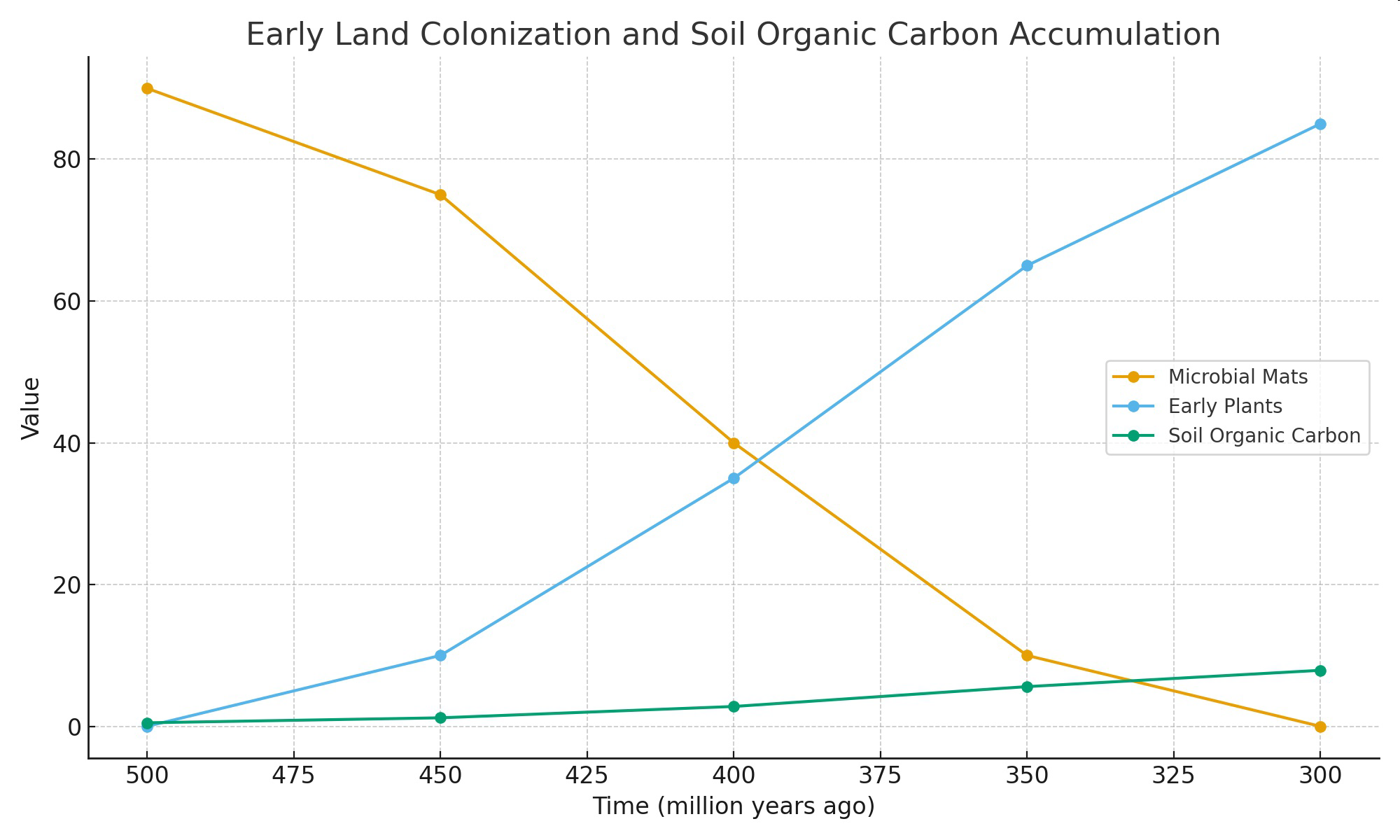
Table 2.
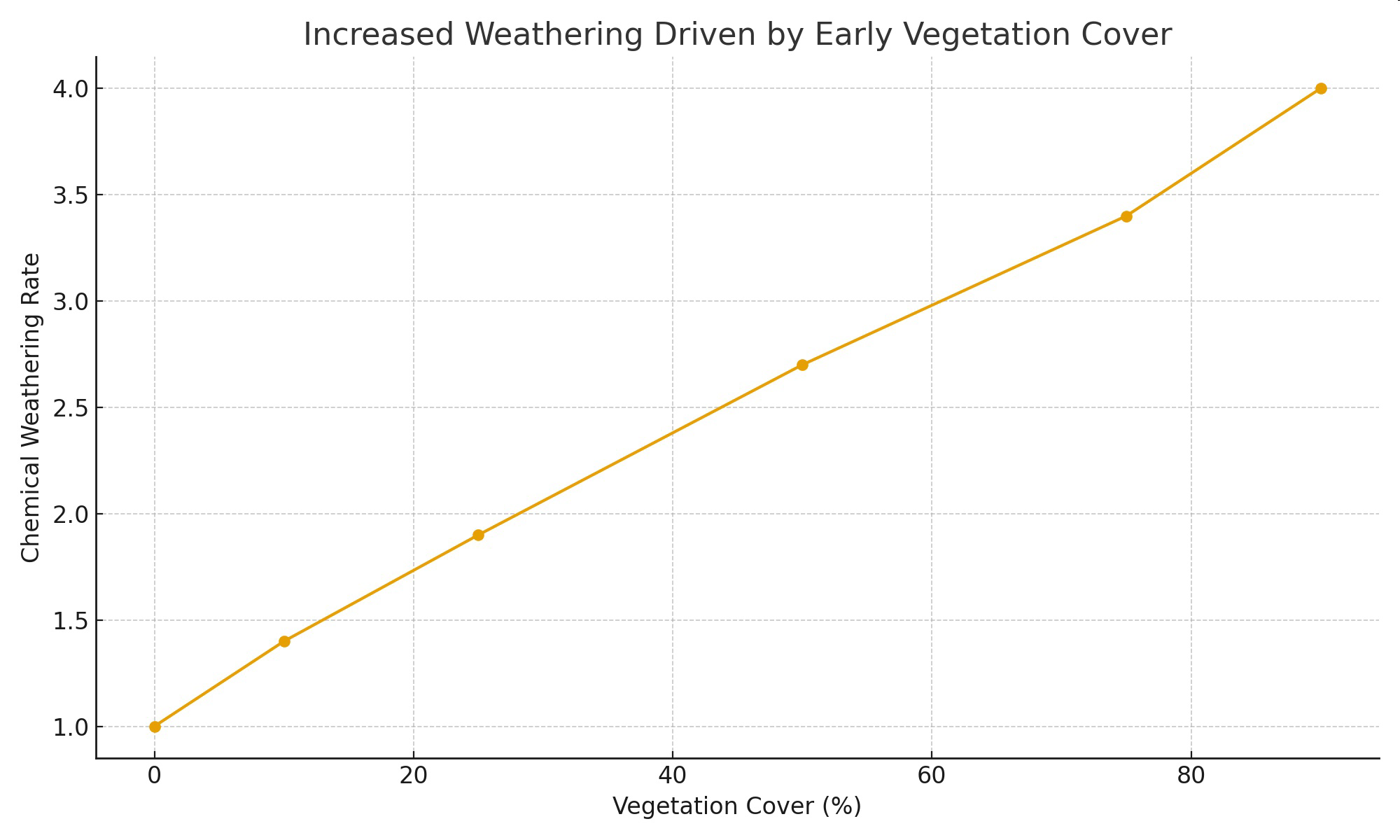
Vegetation Cover (%) | Chemical Weathering Rate (relative units) |
|---|
0 | 1 |
10 | 1.4 |
25 | 1.9 |
50 | 2.7 |
75 | 3.4 |
90 | 4 |
Graph of Information - Figure 2.