Great Lakes Water Levels and Temperature
Key Points
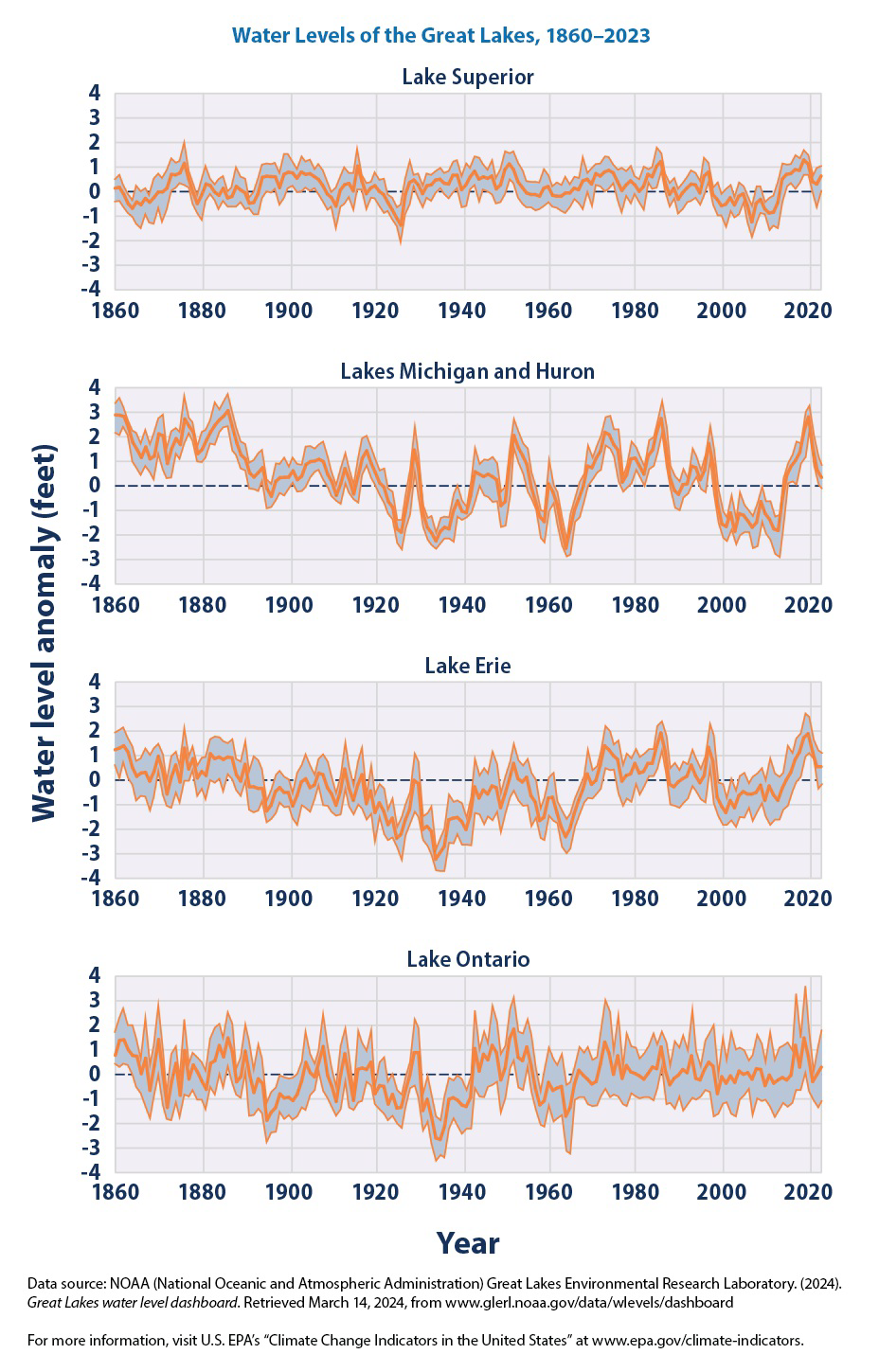
Water levels in the Great Lakes have fluctuated since 1860. Over the last few decades, water levels have declined slightly for most of the Great Lakes (see Figure 1). The past few years, however, have shown notable increases toward the top of the historical range. At the end of 2023, water levels sat slightly above average for all of the Great Lakes.
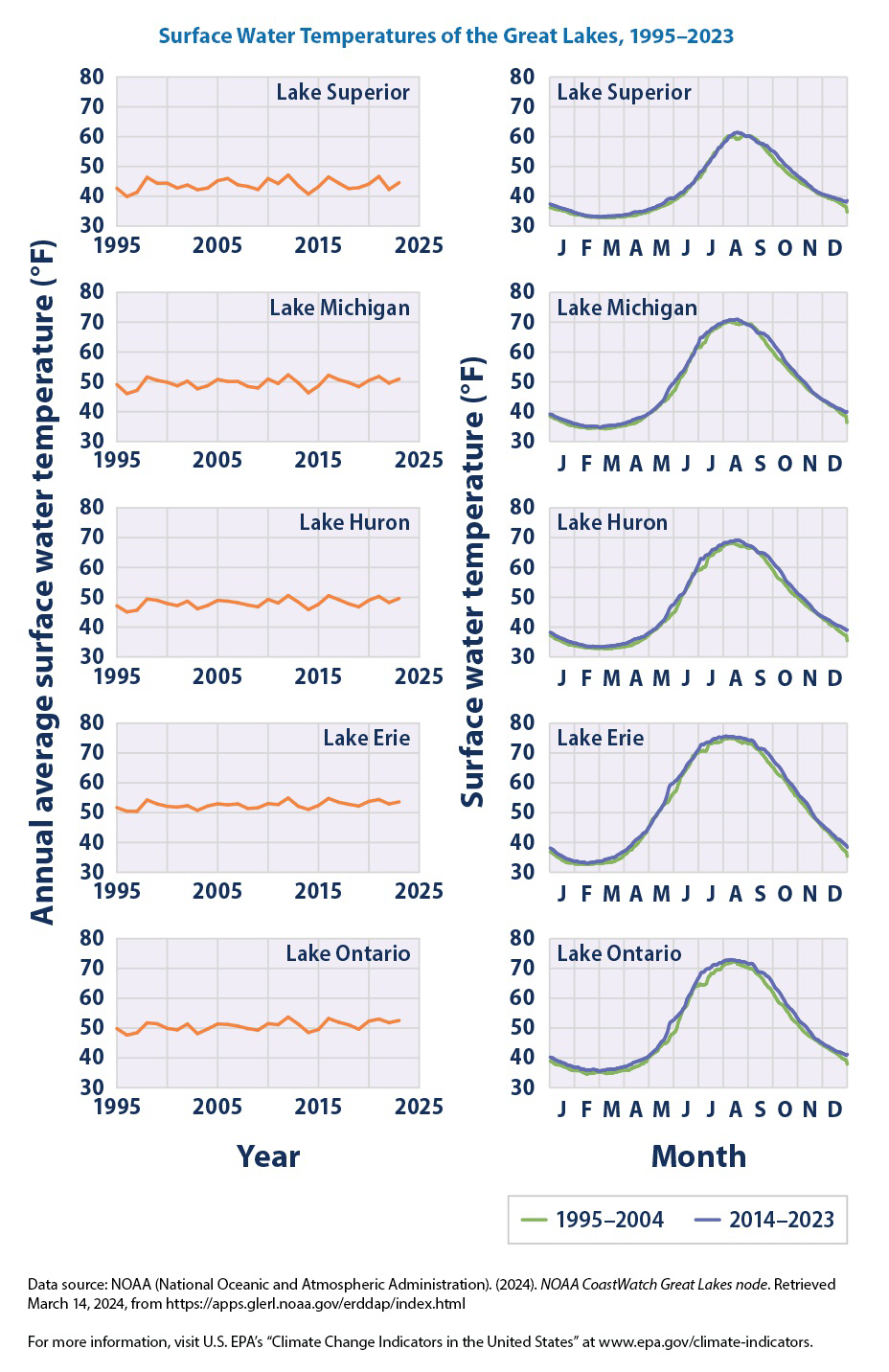
Since 1995, average surface water temperatures have increased slightly for each of the Great Lakes (see Figure 2).
Recent increases in water temperature have mostly been driven by warming during the spring and summer months (see Figure 2). These trends could relate in part to an earlier thawing of winter ice (see the Lake Ice indicator).
Background
The Great Lakes, which are Lake Superior, Lake Michigan, Lake Huron, Lake Erie, and Lake Ontario, form the largest group of freshwater lakes on Earth. These lakes support a variety of ecosystems and play a vital role in the economy of the eight neighboring states and the Canadian province of Ontario, providing drinking water, shipping lanes, fisheries, recreational opportunities, and more.
Water level and water temperature are two important and interrelated indicators of weather and climate change in the Great Lakes. Water level (the height of the lake surface above sea level) is influenced by many factors, including precipitation, snowmelt runoff, drought, evaporation rates, and people withdrawing water for multiple uses. Water temperature is influenced by many factors, too, but most directly by air temperature.
In some recent years, high precipitation has contributed to higher-than-average and sometimes record-breaking water levels in the Great Lakes. In other recent years, warmer surface water temperatures in the Great Lakes have contributed to lower water levels by increasing rates of evaporation and causing lake ice to form later than usual (see the Lake Ice indicator), which extends the season for evaporation. Lower water levels in the Great Lakes forced ships to reduce their cargo tonnage by 5 to 8 percent between 1997 and 2000, which increased shipping costs. Lower water levels can also affect water supplies, the usability of infrastructure such as docks and piers, and shoreline ecosystems.
Scientists who use computer models to simulate future climate change are not sure whether Great Lakes water levels will increase or decrease overall in the future, but they generally agree that there will be larger year-to-year variability, driven by periods of drought and extreme precipitation.
Another possible effect of warmer water, reduced ice cover, and increased evaporation is a corresponding increase in precipitation over nearby land, especially “lake effect” snow (see the Snowfall indicator). Rising water temperatures are also expected to expand the ranges of and give new advantages to some invasive species such as the zebra mussel, and to encourage the growth of certain waterborne bacteria that can make people ill.
Graph of Information - Figure 1.
This figure displays how water levels in each of the Great Lakes have changed since 1860. For each year, the shaded band shows the range of monthly average water levels, and the line in the middle shows the annual average. The graph uses the 1981 to 2010 average as a baseline for depicting change. Choosing a different baseline period would not change the shape of the data over time. Lakes Michigan and Huron are shown together because they are connected at the same water level.
Graph of Information - Figure 2.
This figure shows the average surface water temperatures in each of the Great Lakes, as measured by satellites. The graphs on the left show annual averages for the full time period, while the graphs on the right show how average daily temperatures have changed between two time periods for comparison: 2014–2023 versus
1995–2004.