Growing Degree Days
Key Points
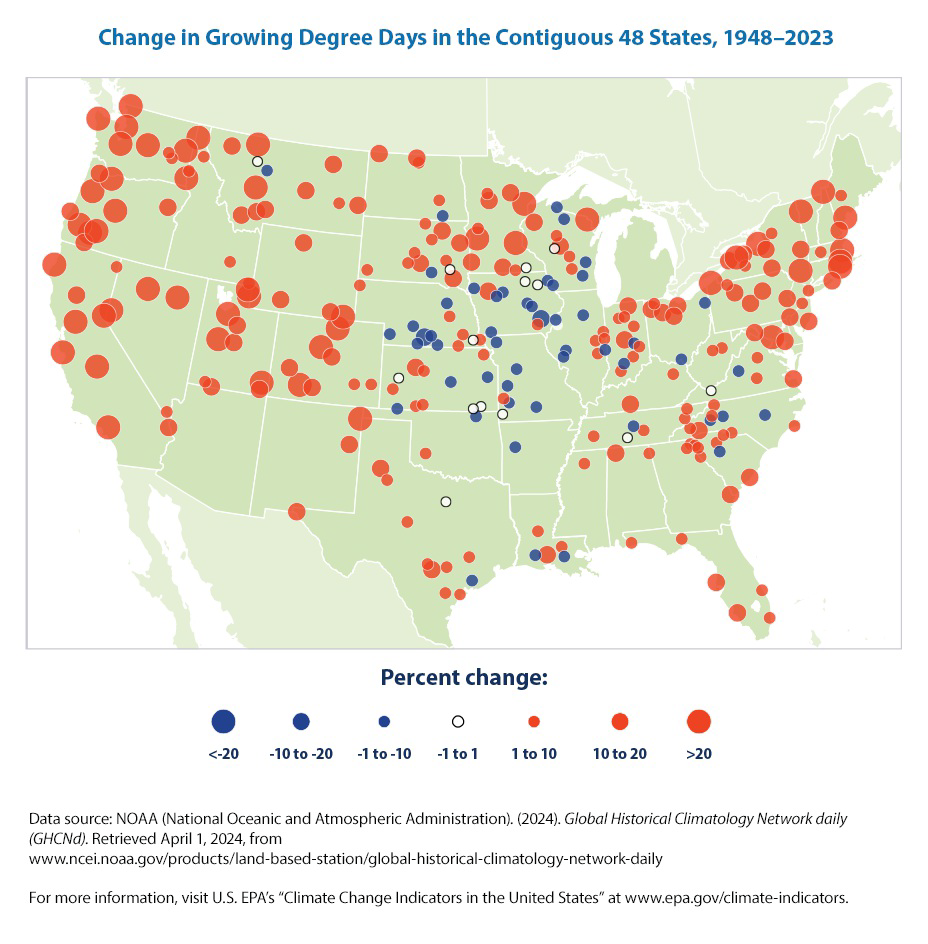
Between 1948 and 2023, the number of growing degree days increased at 221 of the 280 long-term stations measured (79 percent) across the contiguous 48 states (see Figure 1). The average change across all stations represents an increase of about 10 percent.
The largest increases in growing degree days from 1948 to 2023 occurred in the West and the Northeast (see Figure 1). Fifty stations, mostly in the West, have experienced an increase of 20 percent or more.
Because growing degree days are correlated with a longer grass pollen season and an earlier start date for oak and birch pollen seasons, the increased number of growing degree days suggests that the length of grass, oak, and birch pollen season grew between 1948 and 2023 in many parts of the contiguous United States.
Background
Increasing concentrations of atmospheric carbon dioxide and changes in climate - such as increasing temperatures and altered precipitation patterns - are expected to contribute to increases in levels and distribution of plant pollen. Pollen from trees and grasses is a common allergen that can trigger health effects such as allergic rhinitis (“hay fever”) and asthma. In the United States in 2021, 26 percent of adults reported having at least one seasonal allergy. About 8 percent of adults and 6.5 percent of children also reported suffering from asthma, and this population of asthmatics accounts for about 1 million emergency department visits yearly. These health effects lead to economic costs from medical expenses and missed work and school days. Asthma caused an estimated $50 billion in medical expenses and $3 billion in the value of lost work and school days in 2013. Direct medical spending to treat hay fever was estimated at $3.4 billion in 2011.
The timing of pollen seasons is linked to climate trends and variations, including changes in growing degree days - a widely used measure for tracking plant growth and development. As with the Length of Growing Season indicator, growing degree days are based on temperature, because plants typically only grow when the temperature is above a certain minimum. Studies have shown that as growing degree days increase, grass pollen season grows longer and oak and birch pollen seasons begin earlier. Earlier pollen season start dates are associated with a longer pollen season overall. More broadly, growing degree days also affect plant growth, agricultural production, and the spread and impact of plant diseases and pests.
Graph of Information - Figure 1.
This map shows trends in the total number of growing degree days per year at 280 weather stations. The color
and size of the symbols represent percent change between 1948 and 2023, based on the long-term average rate
of change.