Heating and Cooling Degree Days
Key Points
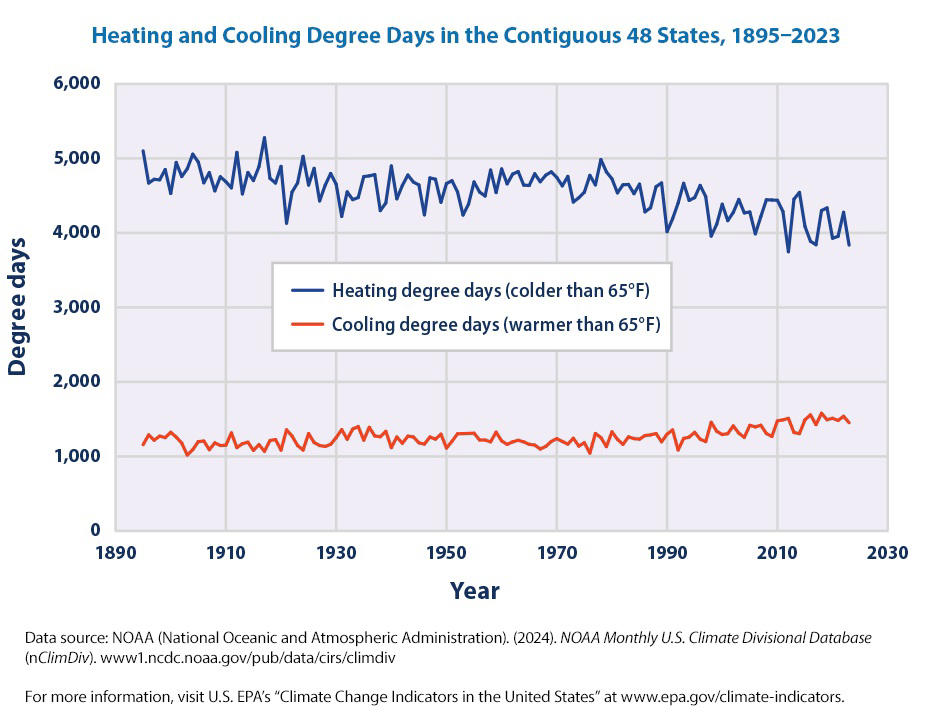
Heating degree days have declined in the contiguous United States, particularly in recent years, as the climate has warmed (see Figure 1). This change suggests that heating needs have decreased overall.
Overall, cooling degree days have increased over the past 100 years. The increase is most noticeable over the past few decades, suggesting that air conditioning energy demand has also been increasing recently (see Figure 1).
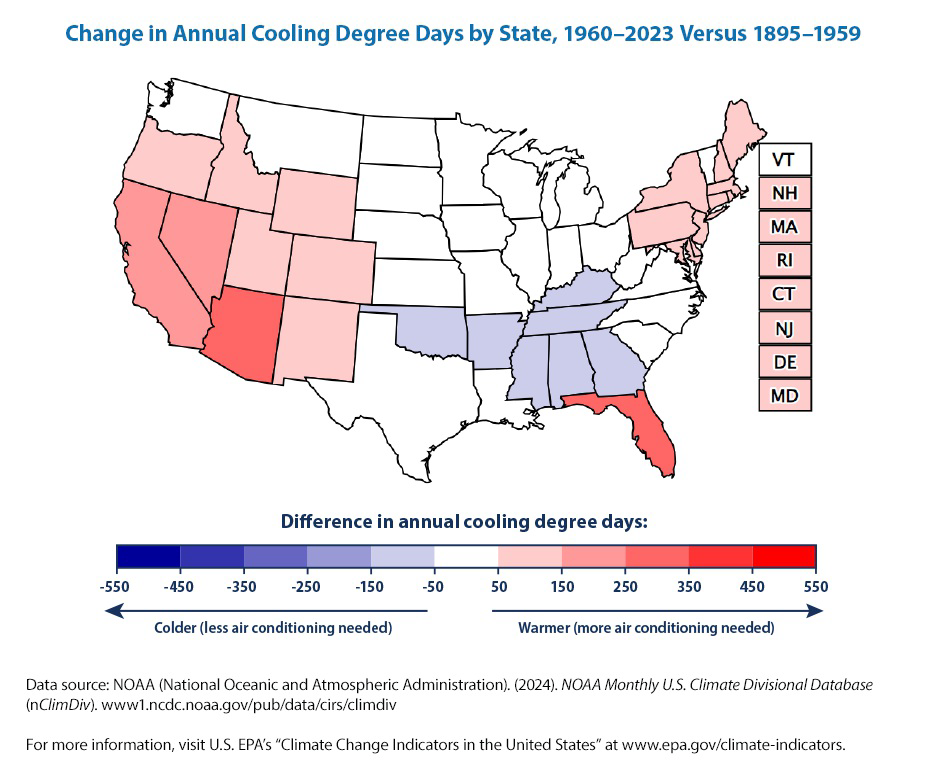
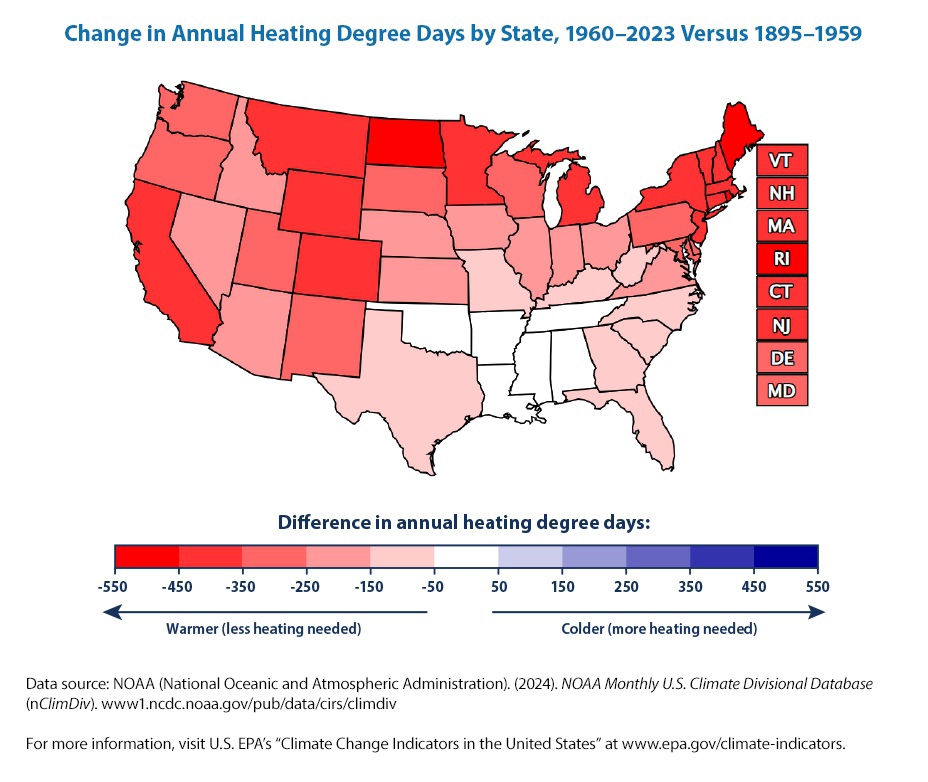
Heating degree days have generally decreased and cooling degree days have generally increased throughout the North and West. The Southeast, with the exception of Florida, has seen the opposite: little change in heating degree days and fewer cooling degree days (see Figures 2 and 3).
Background
Outdoor temperatures can affect daily life in many ways. In particular, temperature affects our health, comfort level, and demand for heating and air conditioning. Collectively, heating and cooling the spaces in which we live accounts for 52 percent of the energy that American households use every year. As climate change contributes to an increase in average temperatures, an increase in unusually hot days, and a decrease in unusually cold days (see the U.S. and Global Temperature and High and Low Temperatures indicators), the overall demand for heating is expected to decline and the demand for cooling is expected to increase.
One way to measure the influence of temperature change on energy demand is using heating and cooling degree days, which measure the difference between outdoor temperatures and a temperature that people generally find comfortable indoors. These measurements suggest how much energy people might need to use to heat and cool their homes and workplaces, thus providing a sense of how climate change could affect people’s daily lives and finances.
Graph of Information - Figure 1.
This figure shows the average number of heating and cooling degree days per year across the contiguous 48 states.
Map of Information - Figure 2.
This map shows how the average number of heating degree days per year has changed in each state over time.
The map was created by comparing the first 65 years of available data (1895–1959) with the most recent 64
years (1960–2023). “Warmer” colors indicate an increase in temperatures between the two periods, leading to
less of a need to turn on the heat—that is, fewer heating degree days. “Cooler” colors indicate a decrease in
temperatures, leading to more of a need to turn on the heat—that is, more heating degree days.
Map of Information - Figure 3.
This map shows how the average number of cooling degree days per year has changed in each state over time.
The map was created by comparing the first 65 years of available data (1895–1959) with the most recent 64
years (1960–2023). “Warmer” colors indicate an increase in temperatures between the two periods, leading to
more demand for air conditioning - that is, more cooling degree days. “Cooler” colors indicate a decrease in
temperatures, leading to less demand for air conditioning—that is, fewer cooling degree days.