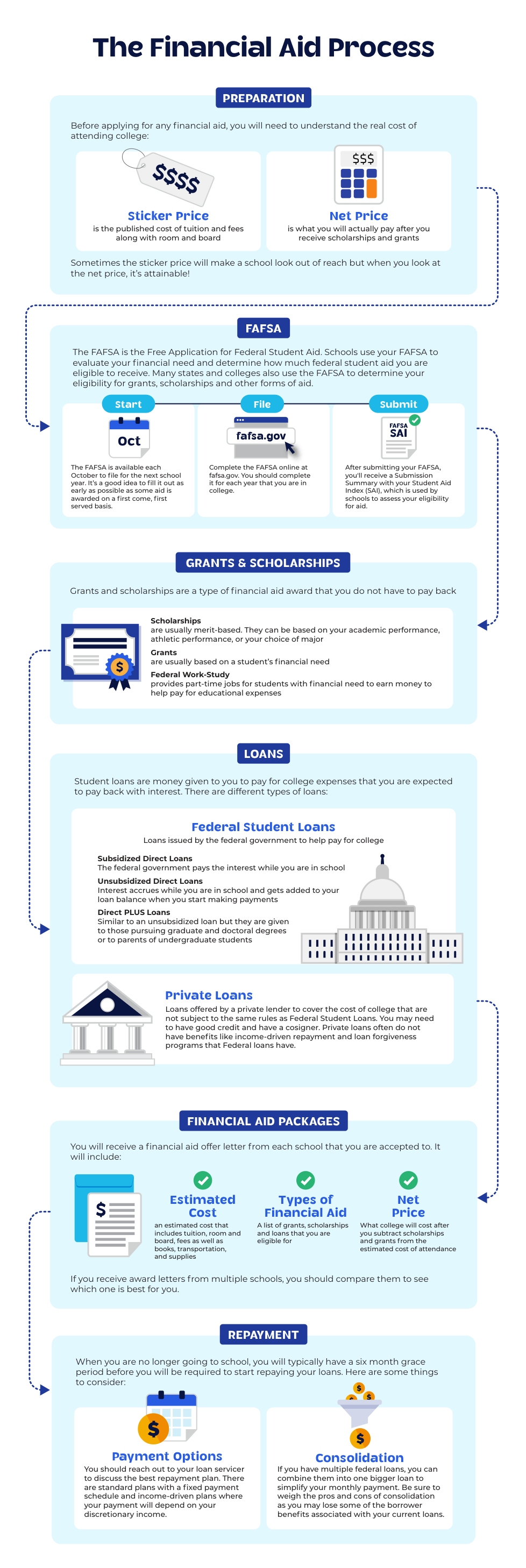
Learning ObjectivesStudents will be able to:
| National Standards for Personal Financial Education Spending
|
Learning ObjectivesStudents will be able to:
| National Standards for Personal Financial Education Spending
|

It is recommended that you carefully compare all of the financial aid offers you receive. Would you automatically pick the school that offers the most financial aid? Why or why not?
What are some other factors that would make you consider attending a college even if it doesn’t offer the most financial aid? It’s ok if these aren’t all related to finances.
All of the following are key components of your financial aid offer EXCEPT…
Your college’s cost of attendance is $12,000, you will be receiving $5,000 in scholarships and grants, and you plan on taking out $6,000 in student loans. What is your net price?
When accepting financial aid, you will likely have to do all of the following EXCEPT…
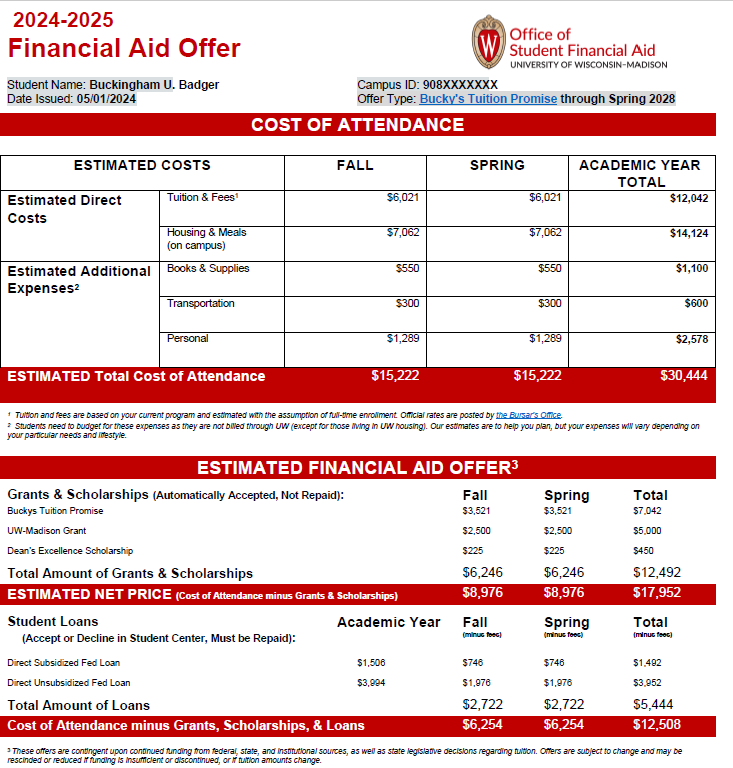
What is the estimated annual Total Cost of Attendance?
What are the estimated annual indirect costs of attending this college (ie. books & supplies, transportation, and personal costs)?
How much of the offered annual aid would Buckingham Badge not need to pay back?
Which financial aid package options would be reduced by fees (deducted from each loan distribution)?
Fill in the blanks: _____________________ - grants and scholarships = ______________________.
Imagine Buckingham Badger is comparing this offer from UW-Madison with one from Lawrence University with a net price of $15,200. Which offer has a lower net price?
Assume Buckingham Badger decides to take out all the federal student loans offered. They continue to take out the same amount each year and make no payments. How much student loan debt will they have after 4 years?
Which sentence is TRUE?
After accounting for grants, scholarships, and loans, how much will Buckingham Badger still have remaining to pay for their first year of college?
Which value gives the BEST estimate of how much you’ll end up paying for a year of college?