Invasive Zebra Mussels Reducing Native Species in a Lake
Zebra mussels (Dreissena polymorpha) are one of the most ecologically disruptive aquatic invasive species in North America. After arriving in the Great Lakes through ballast water discharge, they spread rapidly into inland lakes. Their invasion alters biodiversity at multiple scales—from microscopic plankton communities to entire fish populations. Because zebra mussels dramatically restructure both biotic and abiotic conditions, they provide an excellent real-world example.
Zebra mussels reproduce quickly and reach extremely high densities, sometimes exceeding tens of thousands of individuals per square meter. As filter feeders, they remove large quantities of plankton from the water column. This filtering activity increases water clarity - an abiotic change - but simultaneously reduces plankton biomass, which is a foundational biotic resource for many aquatic organisms. Reduced plankton availability directly affects native mussels, larval fish, and other species that depend on plankton for food.
Native mussels, many of which are already sensitive to habitat loss and pollution, are particularly affected. Zebra mussels attach to their shells, weighing them down and preventing them from feeding or moving. Over time, native mussel abundance and species richness sharply decline. Mathematical data often show reductions of 70–95% in native mussel populations after invasion.
Changes in abiotic conditions cascade through the ecosystem. As zebra mussels increase water clarity, more sunlight reaches the lake bottom. This promotes the growth of aquatic plants, which can change fish habitat structure. Some fish species decline due to reduced plankton, while others benefit from increased vegetation. These shifts alter species composition in ways that can be observed at both local (nearshore) and whole-lake scales.
Long-term datasets reveal clear relationships: increasing zebra mussel density corresponds with declining native mussel richness, reduced plankton biomass, decreasing planktivorous fish abundance, and increasing water clarity. These patterns show how invasive species can fundamentally reshape ecosystem biodiversity. Mathematical representations help reveal which factors are strongest, how they interact, and how populations change across space and time.
Diagram 1.
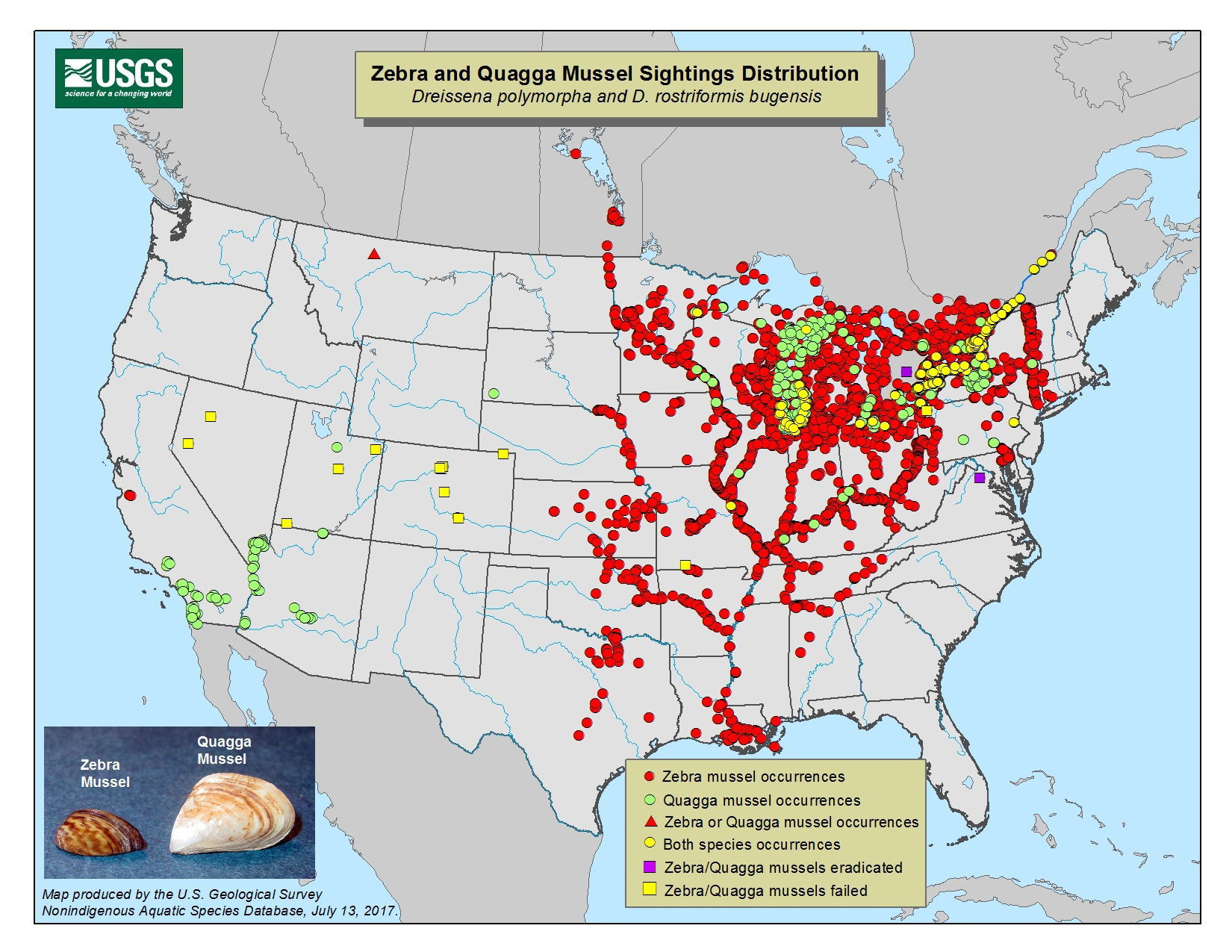 Source: https://invasivemusselcollaborative.net/about/mussel-facts/
Diagram 2.

Diagram 3.
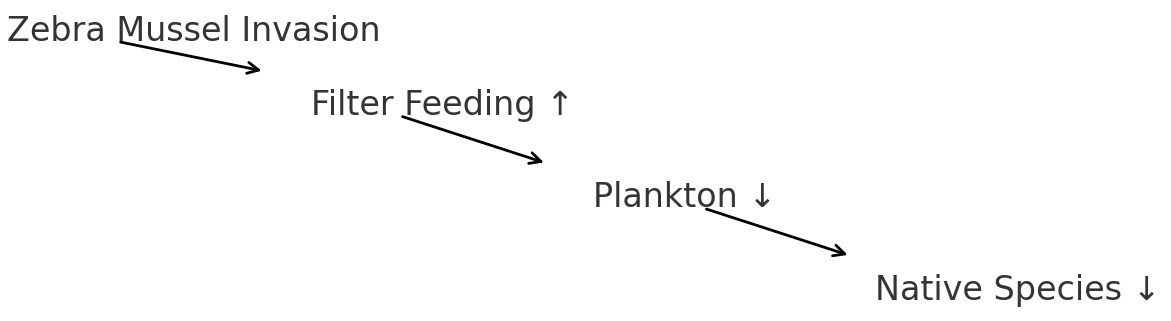
Table 1.
Zebra Mussel Density m | Native Mussel Richness | Plankton Biomass mg/L |
|---|
0 | 12 | 4.8 |
50 | 9 | 3.9 |
150 | 6 | 2.7 |
300 | 3 | 1.6 |
500 | 1 | 1 |
Graph of Information - Figure 1.
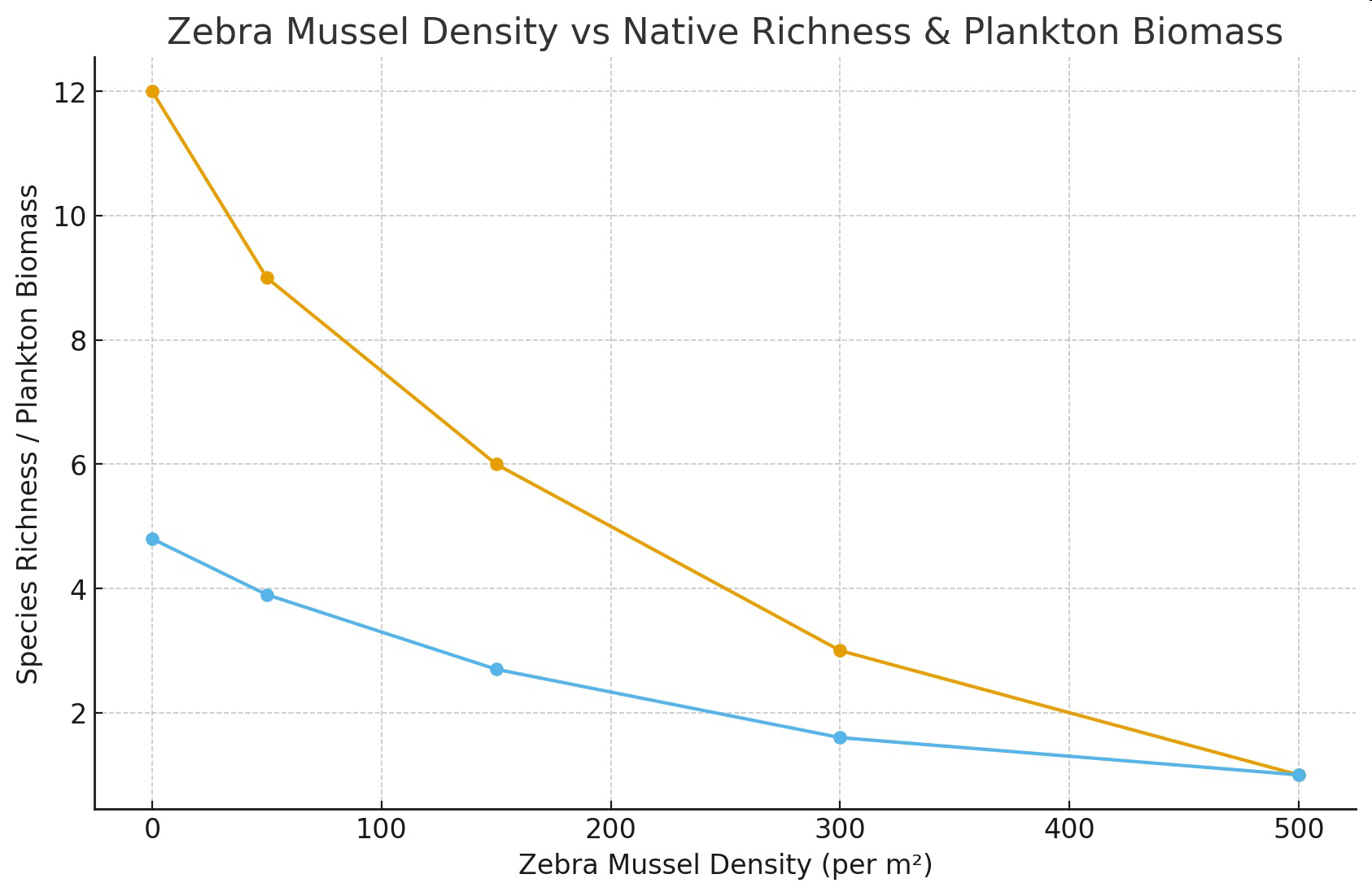
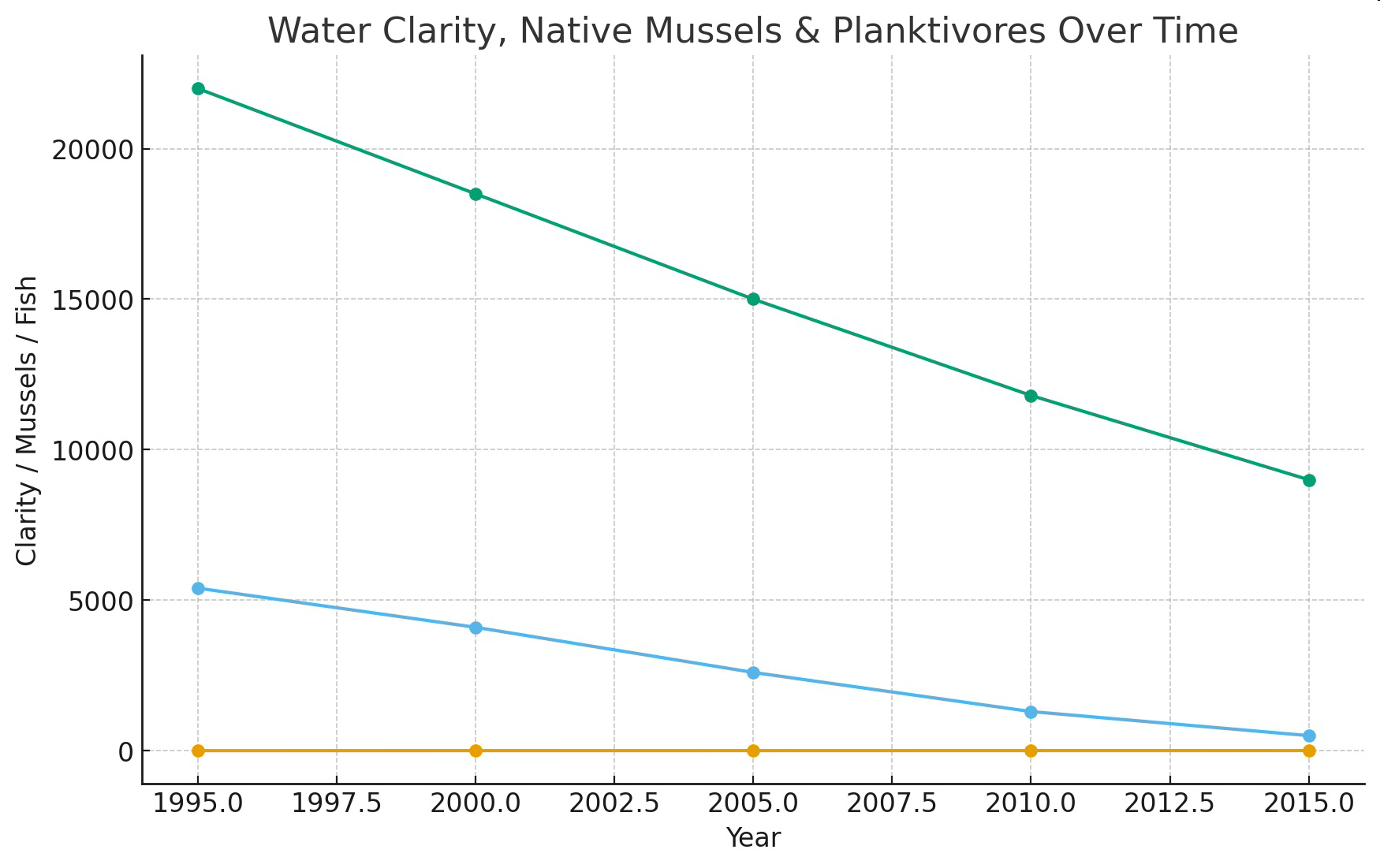
Table 2.
Year | Water Clarity m | Native Mussel Abundance | Planktivore Fish Abundance |
|---|
1995 | 1.2 | 5400 | 22000 |
2000 | 1.8 | 4100 | 18500 |
2005 | 2.4 | 2600 | 15000 |
2010 | 3.1 | 1300 | 11800 |
2015 | 3.9 | 500 | 9000 |
Graph of Information - Figure 2.