Leaf and Bloom Dates
Key Points
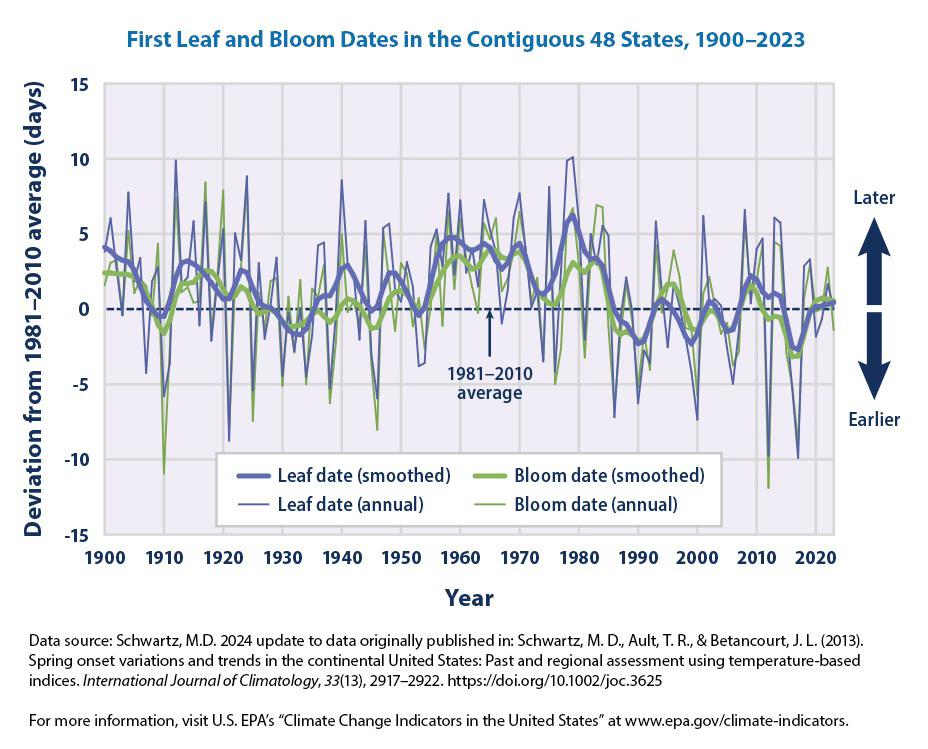
First leaf and bloom dates in lilacs and honeysuckles in the contiguous 48 states show a great deal of year-to-year variability, which makes it difficult to determine whether a statistically meaningful change has taken place. In the last few decades, however, earlier start dates for these springtime events appear more prevalent (Figure 1).
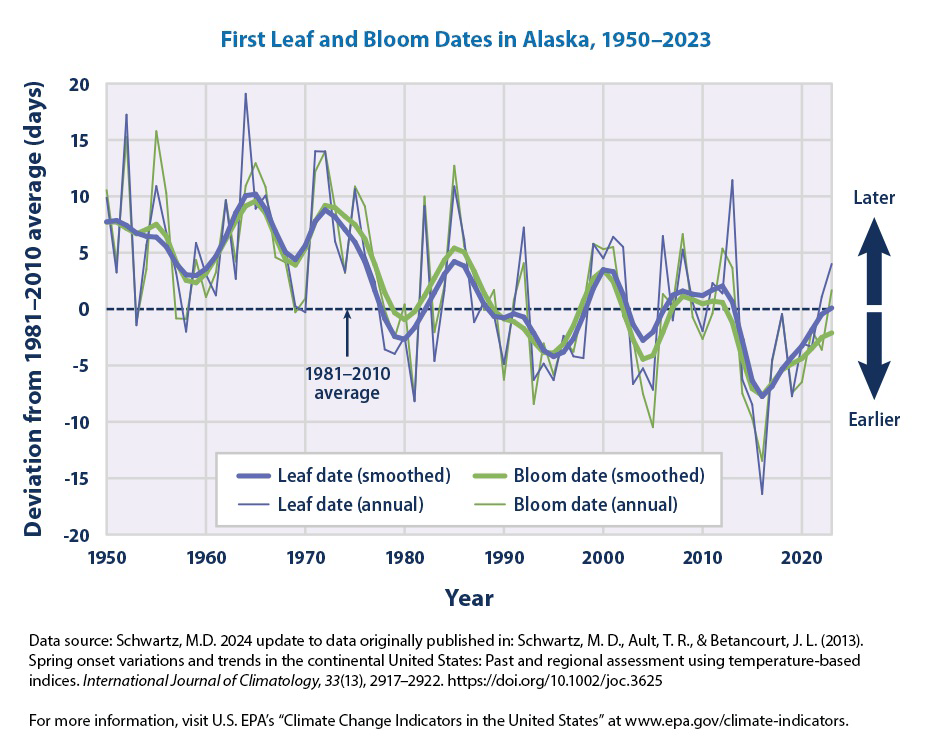
While first leaf and bloom dates in Alaska show a great deal of year-to-year variability, start dates for these springtime events appear to be trending earlier over the last few decades (Figure 2). This change is statistically significant.
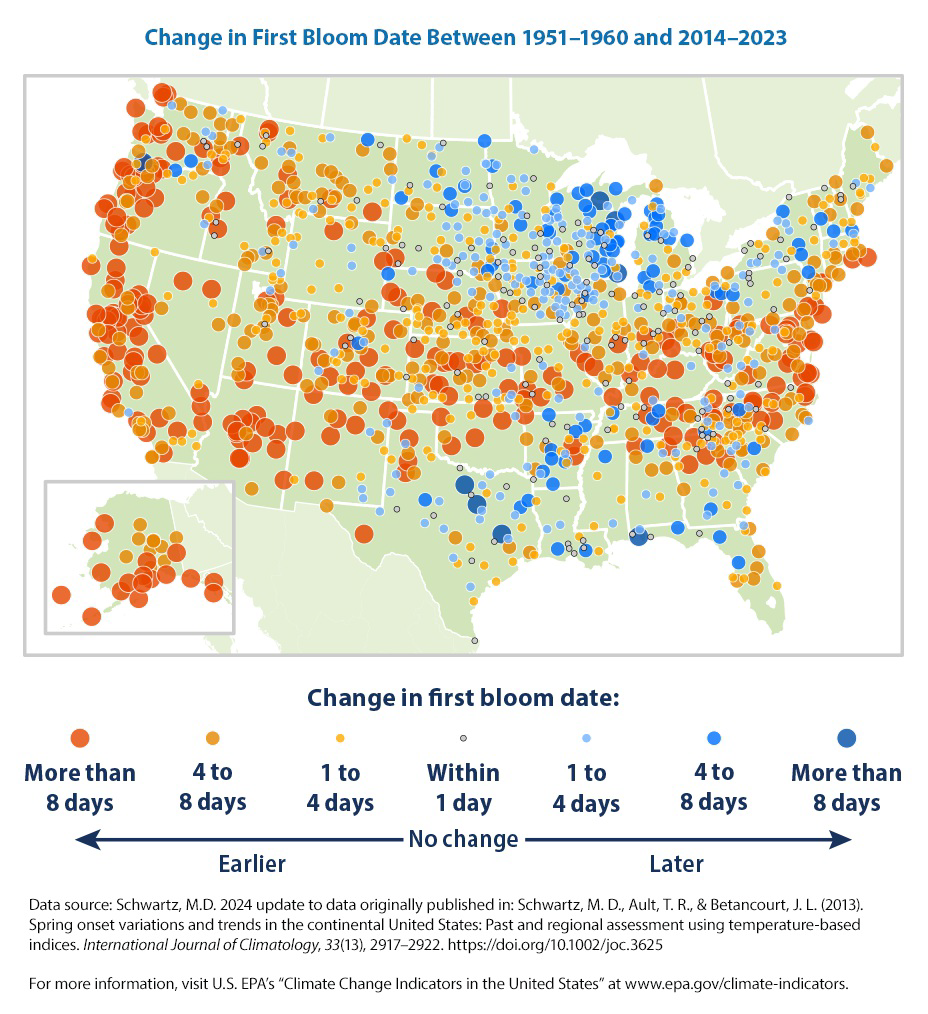
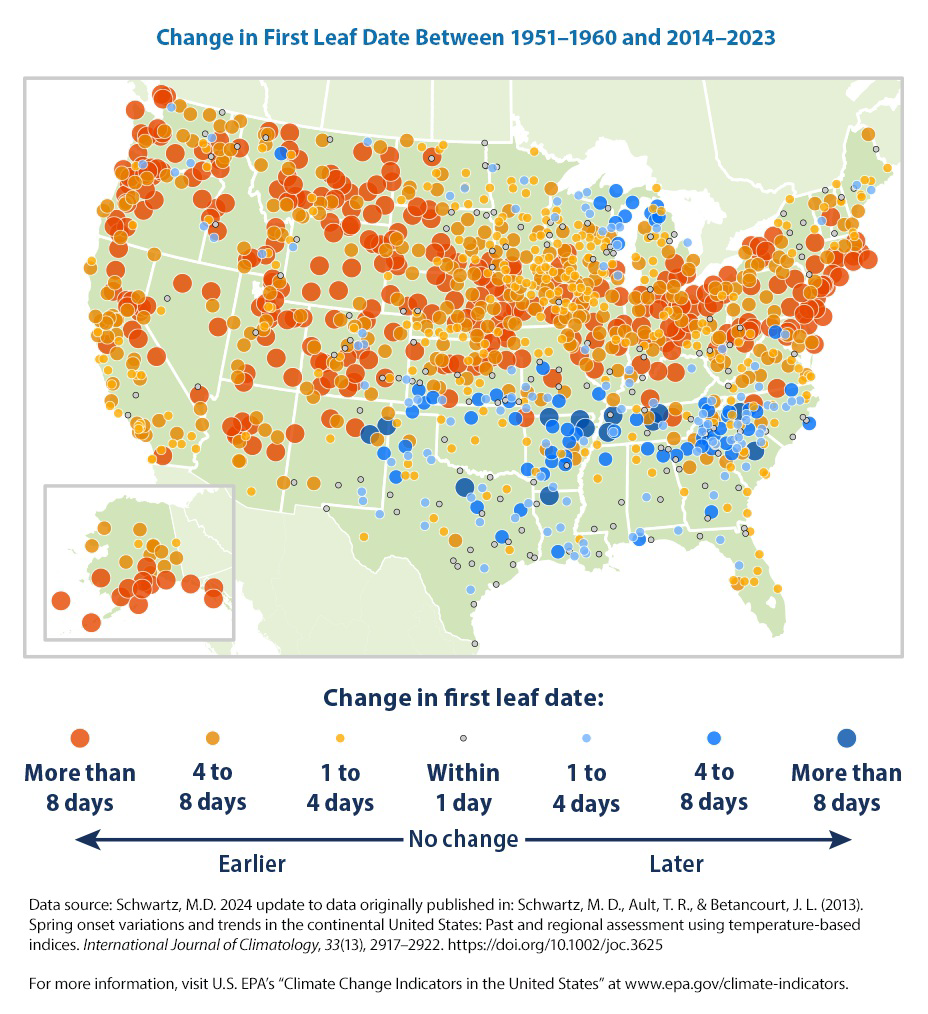
In general, leaf and bloom events are happening earlier throughout most of the contiguous 48 states and in Alaska but later in much of the South and part of the Upper Midwest (Figures 3 and 4). This observation is consistent with many of the regional differences in temperature change shown by the U.S. and Global Temperature indicator.
The patterns in this indicator are consistent with those found in other studies. For example, a study of vegetation in U.S. national parks also noted earlier leaf and bloom dates in Alaska and the northern and western portions of the contiguous 48 states. Other studies (e.g., Schwartz et al., 2006) have looked at trends in leaf and bloom dates across all of North America and the entire Northern Hemisphere. These studies have also found a trend toward earlier spring events - some more pronounced than the trends seen in just the contiguous 48 states.
Background
The timing of natural events, such as flower blooms and animal migration, is influenced by a combination of environmental factors, including temperature, light, rainfall, and humidity. Phenology is the study of such important seasonal events. Phenological events are influenced by a combination of environmental factors, including temperature, light, rainfall, and humidity. Different plant and animal species respond to different cues.
Scientists have very high confidence that the earlier arrival of spring events is linked to recent warming trends in global climate. Disruptions in the timing of these events can have a variety of impacts on ecosystems and human society. For example, an earlier spring might lead to longer growing seasons, more abundant invasive species and pests, and earlier and longer allergy seasons. Unusually warm weather in late winter can create a “false spring” that triggers the new growth of plants to begin too early, leaving them vulnerable to any subsequent frosts.
Because of their close connection with climate, the timing of phenological events can be used as an indicator of the sensitivity of ecological processes to climate change. Two particularly useful indicators of the timing of spring events are the first leaf dates and the first bloom dates of lilacs and honeysuckles, which have an easily monitored flowering season, a relatively high survival rate, and a large geographic distribution. The first leaf date in these plants relates to the timing of events that occur in early spring, while the first bloom date is consistent with the timing of later spring events, such as the start of growth in forest vegetation.
Graph of Information - Figure 1.
This figure shows modeled trends in lilac and honeysuckle first leaf dates and first bloom dates across the contiguous 48 states, using the 1981 to 2010 average as a baseline. Positive values indicate that leaf growth and blooming began later in the year, and negative values indicate that leafing and blooming occurred earlier. The
thicker lines were smoothed using a nine-year weighted average. Choosing a different long-term average for comparison would not change the shape of the data over time.
Graph of Information - Figure 2.
This figure shows modeled trends in lilac and honeysuckle first leaf dates and first bloom dates across Alaska, using the 1981 to 2010 average as a baseline. Positive values indicate that leaf growth and blooming began later in the year, and negative values indicate that leafing and blooming occurred earlier. The thicker lines were smoothed using a nine-year weighted average. Choosing a different long-term average for comparison would
not change the shape of the data over time.
Graph of Information - Figure 3.
This figure shows modeled trends in lilac and honeysuckle first leaf dates at weather stations across the contiguous 48 states and Alaska. This map compares the average first leaf date for two 10-year periods.
Graph of Information - Figure 4.
This figure shows modeled trends in lilac and honeysuckle first bloom dates at weather stations across the contiguous 48 states and Alaska. This map compares the average first bloom date for two 10-year periods.