Marine Species Distribution
Key Points
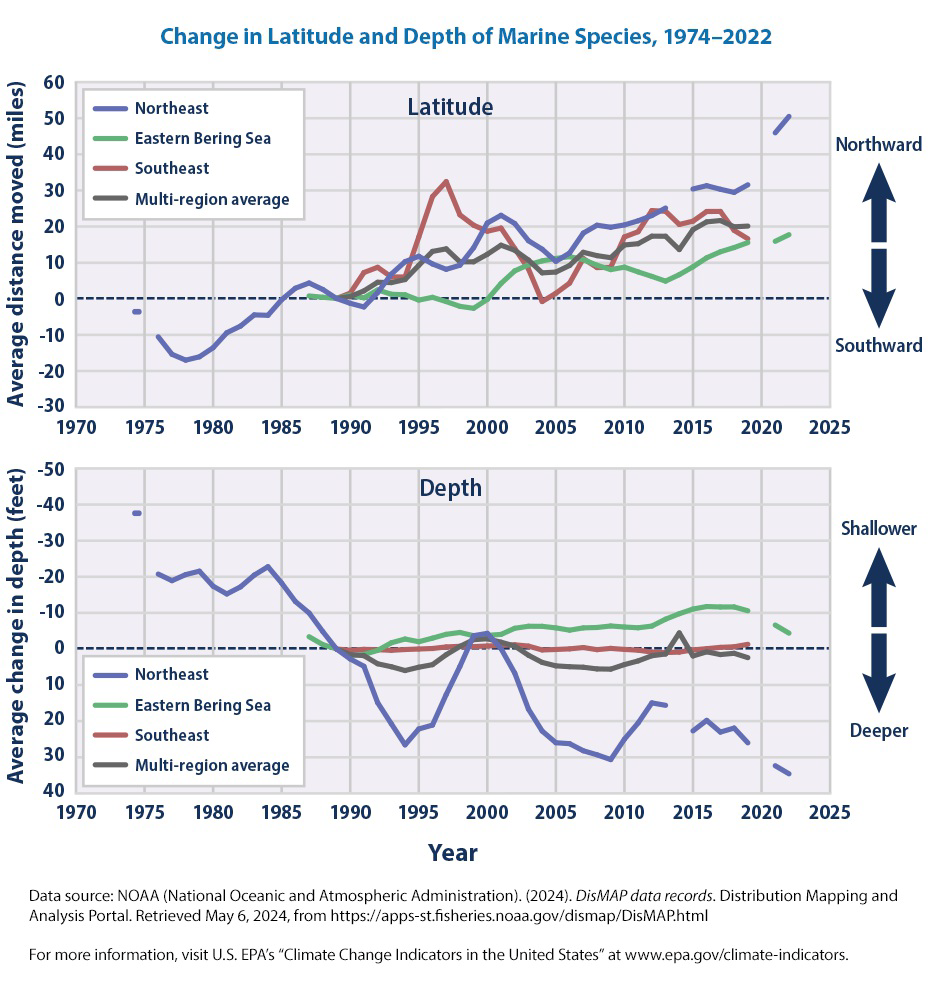
The average center of biomass for 157 marine fish and invertebrate species shifted northward by nearly 17 miles between 1989 and 2019 (Figure 1). These species also moved an average of 0.6 feet deeper.
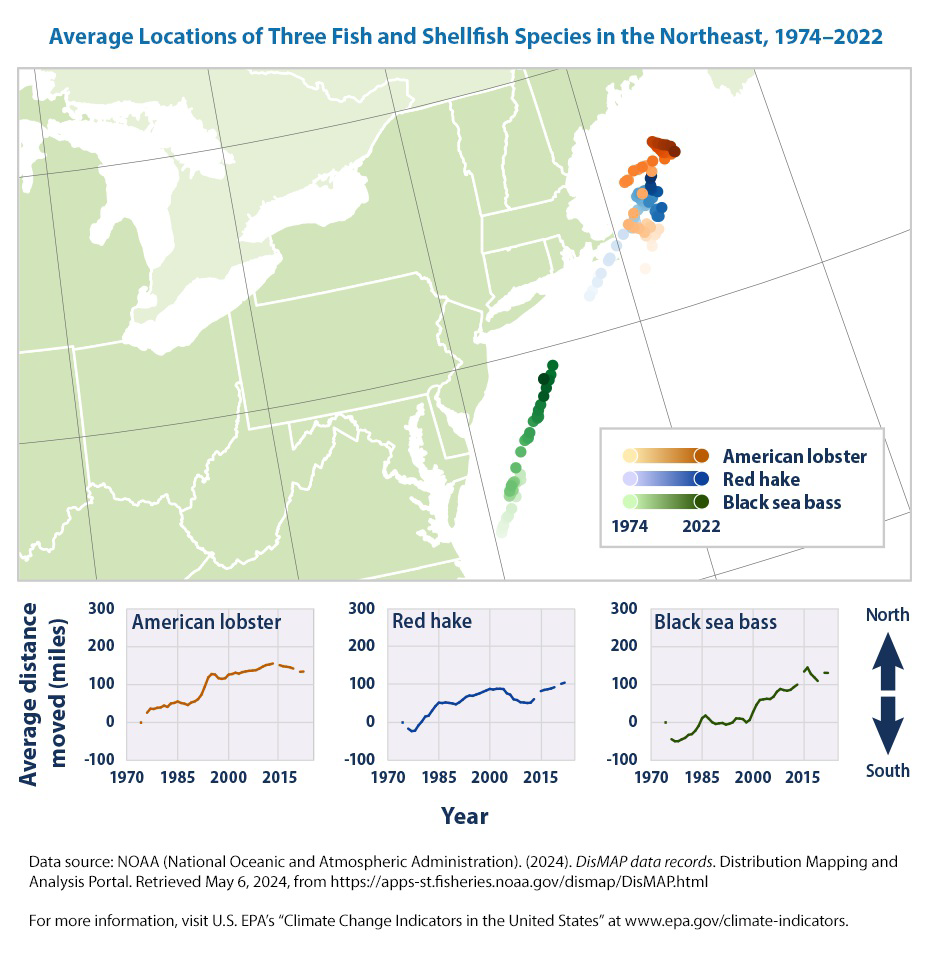
In waters off the northeastern United States, several economically important species have shifted northward since the 1970s (Figure 2). The three species shown in Figure 2 (American lobster, red hake, and black sea bass) have moved northward by an average of 145 miles.
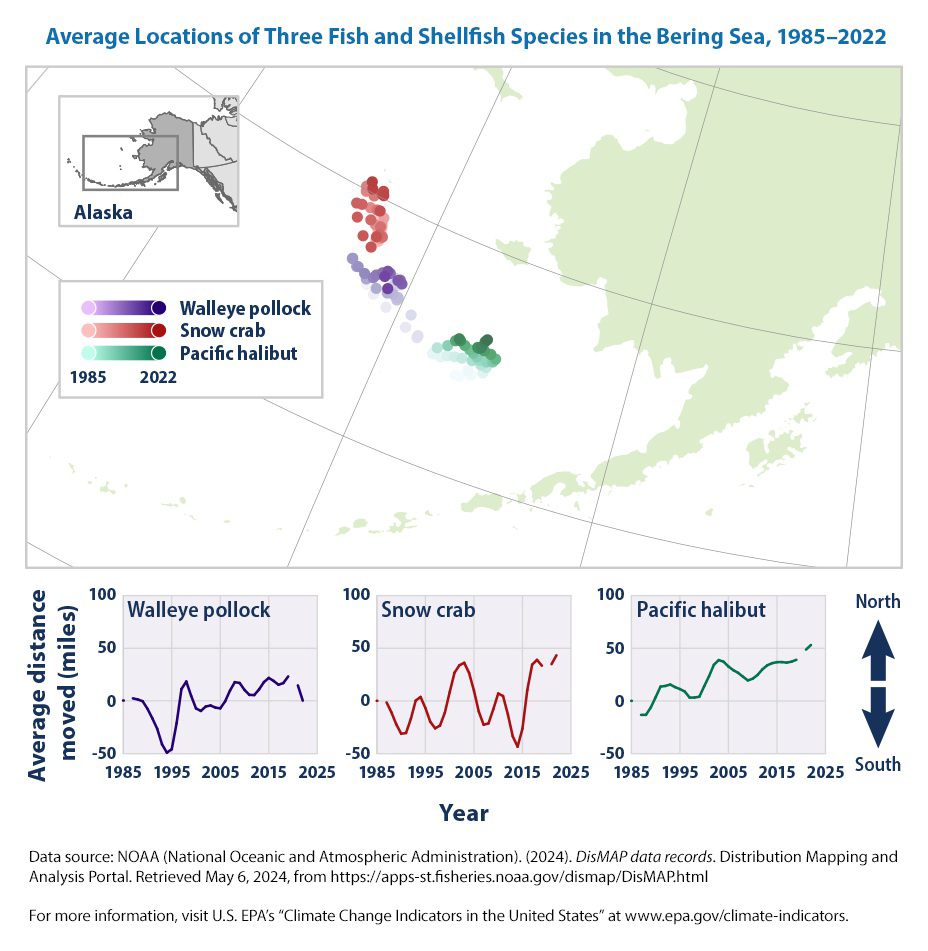
In the Bering Sea, walleye pollock, snow crab, and Pacific halibut have generally shifted away from the coast since the 1980s (Figure 3). They have also moved northward by an average of 41 miles.
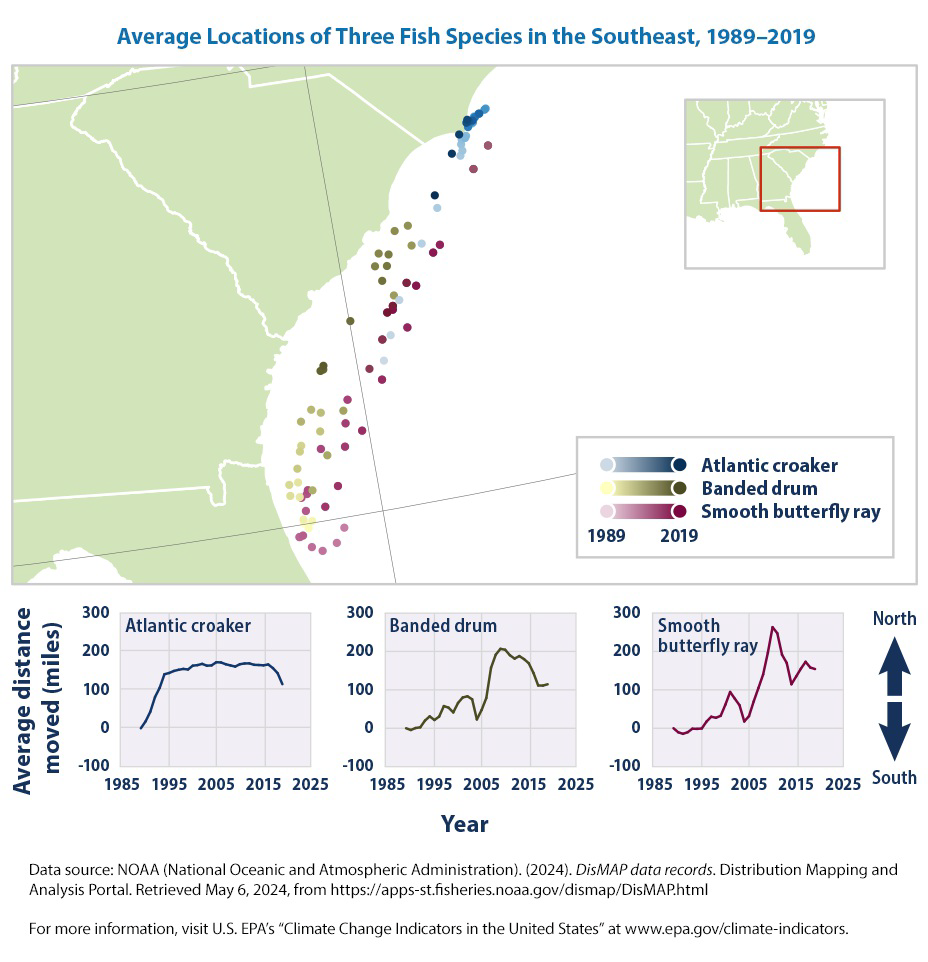
In waters off the southeastern United States, several species have shifted northward since the late 1980s (Figure 4). The three species shown in Figure 4 (Atlantic croaker, banded drum, and smooth butterfly ray) have moved northward by an average of 169 miles.
Background
Changes in water temperature can affect the environments where fish, shellfish, and other marine species live. Certain fish species naturally migrate in response to seasonal temperature changes, moving northward or to deeper, cooler waters in the summer and migrating back during the winter. As climate change causes the oceans to become warmer year-round, however, populations of some species may adapt by shifting away from areas that have become too warm and toward areas that were previously cooler. Along U.S. coasts, this means a shift northward or to deeper waters that may have a more suitable temperature. As smaller prey species shift their habitats, larger predator species may follow them.
Marine species represent a particularly good indicator of warming oceans because they are sensitive to climate and because they have been studied and tracked for many years. Fish are especially mobile, and they may shift their location more easily than species on land because they face fewer physical barriers. Also, many marine species, especially fish, do not have fixed nesting places or dwellings that might otherwise compel them to stay in one place. Populations of many marine species have been measured consistently for several decades across various types of ocean habitats. Tracking data from many species is useful because if a change in behavior or distribution occurs across a large range of species, it is more likely the result of a more systematic or common cause.
The movement of species based on their preferred temperature conditions can affect commercial and recreational fisheries, with implications for fisheries management and the economy of communities that rely on fisheries. Climate-related fishery losses have already resulted in billions of dollars of lost catch in recent years, directly harming jobs, livelihoods, and local culture. Temperature-driven changes in suitable habitats are expected to continue in the future.
Graph of Information - Figure 1.
These graphs show the annual change in latitude (movement in miles) and depth (feet) of 41 marine species along the Northeast coast, 58 in the eastern Bering Sea, and 58 along the Southeast coast. The multi-region average consists of 157 unique species. Changes in the centers of biomass have been aggregated across all
species and by region. For each region, the change in latitude and change in depth are set at zero for a base year, 1989.
Graph of Information - Figure 2.
This map shows the annual centers of biomass for three species in the northeastern United States from 1974 to
2022. Dots are shaded from light to dark to show change over time.
Graph of Information - Figure 3.
This map shows the annual centers of biomass for three species in the eastern Bering Sea from 1985 to 2022. Dots are shaded from light to dark to show change over time.
Graph of Information - Figure 4.
This map shows the annual centers of biomass for three species in the southeastern United States from 1989 to
2019. Dots are shaded from light to dark to show change over time.