Schooling Behavior in Small Fish Reduces Predation Risk
Many small fish species - such as sardines, anchovies, herrings, and minnows - form large, coordinated schools that move together as a single, fluid unit. Schooling is a classic example of a group behavior that enhances both individual and species survival. When individuals swim alone, they are far more vulnerable to predators such as tuna, dolphins, seabirds, or larger fish. But when hundreds or thousands of individuals move in a synchronized group, predators struggle to single out and capture individual fish.
Schooling enhances survival through three key mechanisms. First is the confusion effect, in which rapid, synchronized movement and flashing scales make it difficult for predators to visually lock onto a single target. Second is the dilution effect, meaning that even if a predator attacks, the probability that any one individual is consumed decreases as group size increases. Third, schools can perform collective evasive maneuvers, such as tightening into a ball or splitting suddenly, which reduces predator success.
Group behavior also impacts feeding efficiency and reproductive success. In large schools, individuals spend less time scanning for predators and more time feeding. Many schooling species rely on filter-feeding or locating patchy food resources. When a predator approaches, fish on the outer edge detect it first and send a wave of directional movement through the group. This rapid communication increases the time individuals can allocate to feeding, allowing them to maintain higher energy reserves.
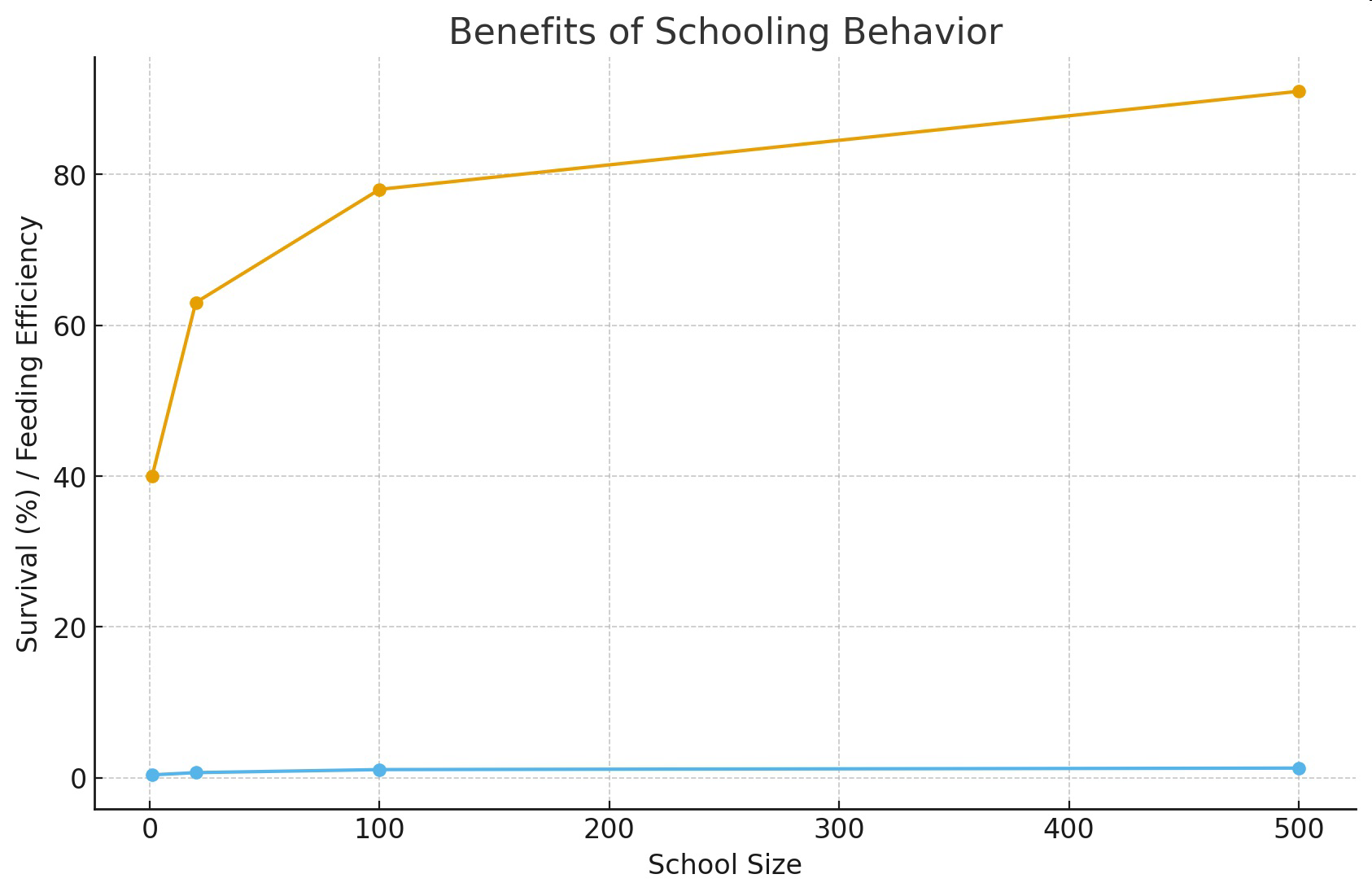
Researchers use mathematical and observational data to evaluate schooling effectiveness. Metrics include predator attack frequency, predator success rate, school size, survival percentage, and feeding efficiency. Data consistently show that as school size increases, survival and feeding efficiency both rise. These improvements influence reproductive success: individuals with higher energy reserves produce more viable offspring, and populations with widespread schooling behavior tend to be more stable.
Schooling is an evolved behavior that improves fitness and ensures that species can maintain stable populations even in environments with abundant predators.
Diagram 1.
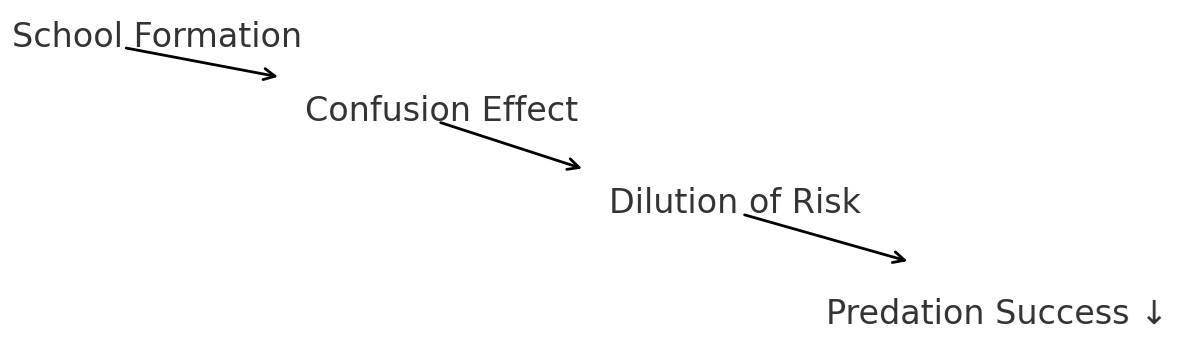
Table 1.
Group Type | Predator Attacks | Successful Attacks |
|---|
Solitary | 30 | 18 |
Small School | 28 | 10 |
Medium School | 26 | 5 |
Large School | 25 | 2 |
Graph of Information - Figure 1.
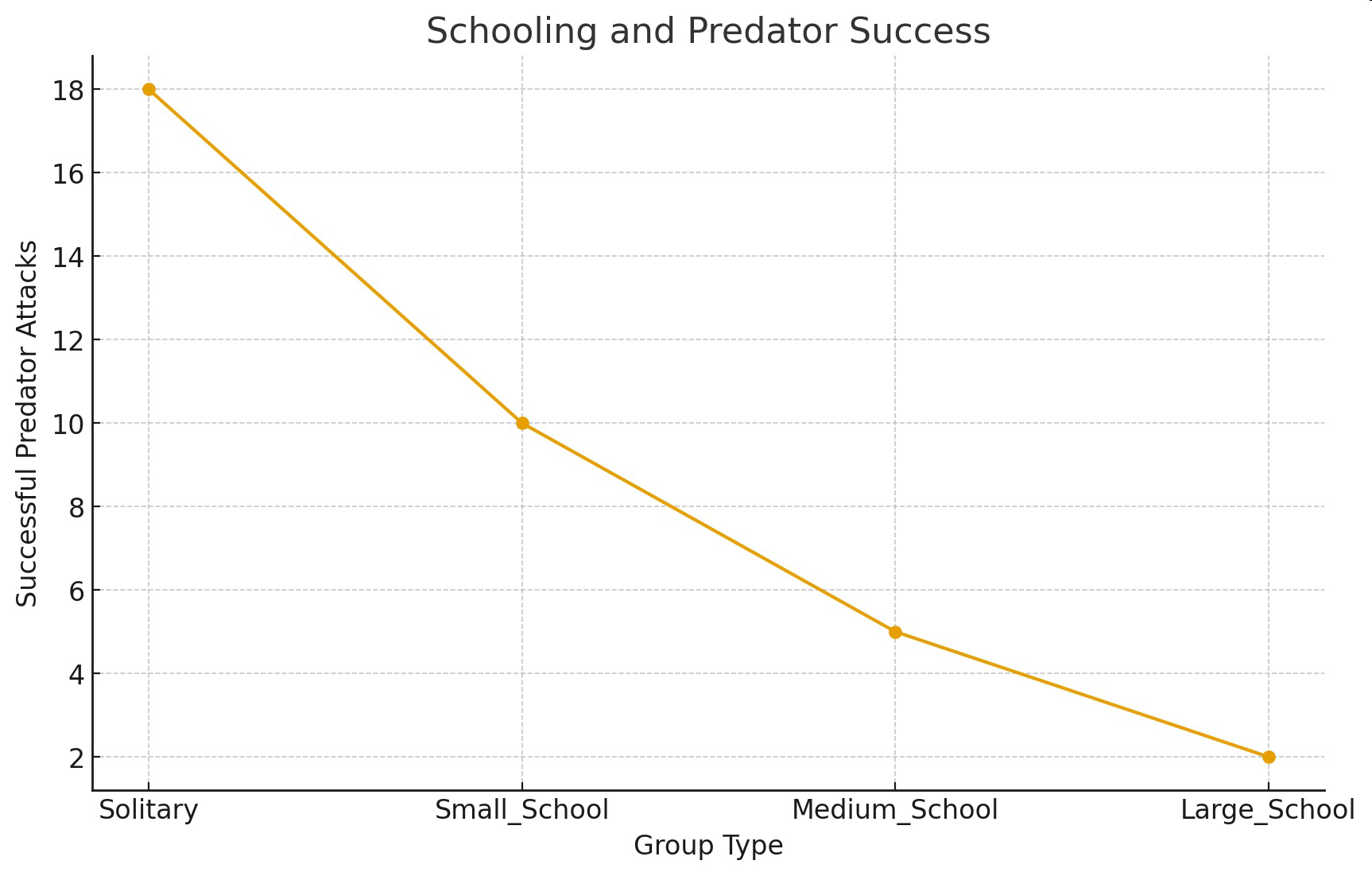
Diagram 2.
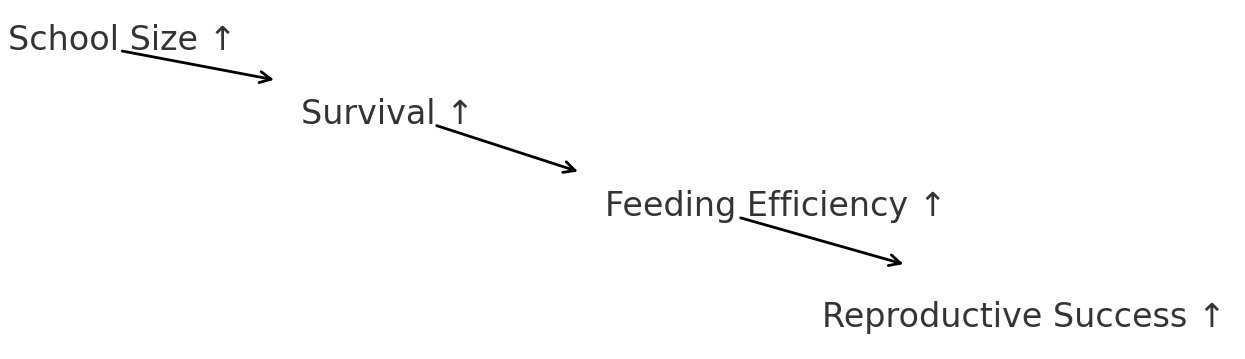
Table 2.
School Size | Survival Rate % | Feeding Efficiency Index |
|---|
1 | 40 | 0.4 |
20 | 63 | 0.7 |
100 | 78 | 1.1 |
500 | 91 | 1.3 |
Graph of Information - Figure 2.