The Great Oxygenation Event (GOE) and the Rise of Aerobic Life
About 2.4 billion years ago, Earth experienced one of the most dramatic environmental transformations in its history: the Great Oxygenation Event (GOE). Before this time, Earth’s atmosphere contained almost no free oxygen $O_{2}$. The dominant life forms were simple, anaerobic microorganisms - organisms that did not require oxygen to survive. This changed when early cyanobacteria, through photosynthesis, began releasing oxygen as a waste product. At first, this oxygen reacted rapidly with dissolved iron in the oceans, forming banded iron formations that are still visible in rocks today. Once the available iron was used up, free oxygen began accumulating in seawater and eventually entered the atmosphere.
Diagram 1.
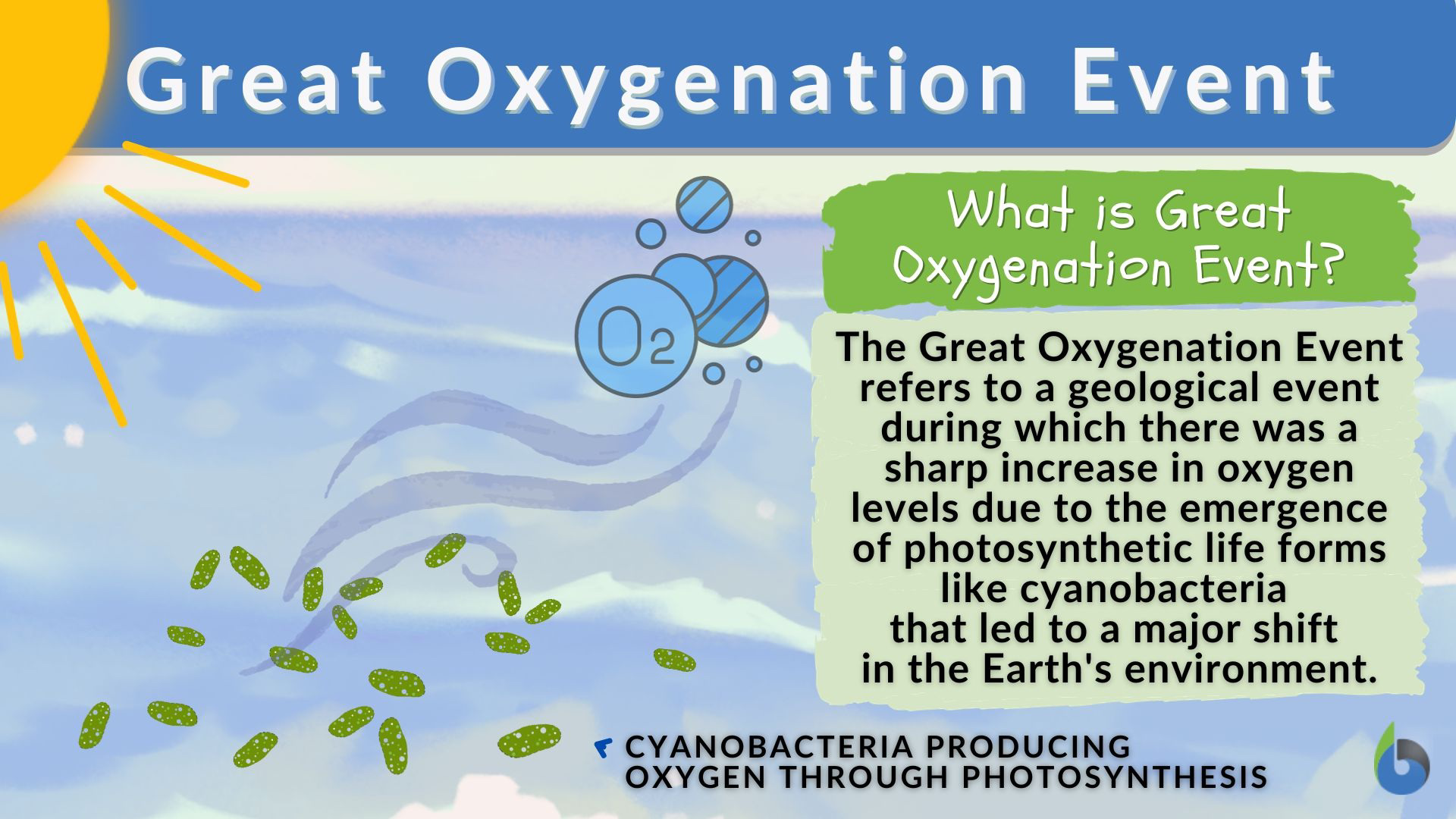 Source: https://www.biologyonline.com/dictionary/great-oxygenation-event
This rising oxygen level fundamentally altered Earth’s systems. Many anaerobic species could not tolerate oxygen, leading to widespread extinctions - sometimes called the “oxygen crisis.” But for other organisms, oxygen opened the door to new metabolic pathways. Aerobic respiration, which uses oxygen to break down molecules for energy, is much more efficient than anaerobic processes. This increase in available energy allowed for greater biological complexity and set the stage for multicellular life.
The GOE also triggered major changes in Earth’s geosphere and climate. Increased atmospheric oxygen reacted with methane, a powerful greenhouse gas, decreasing its concentration. This likely contributed to planet-wide glaciation events (“Snowball Earth”) that reshaped Earth’s climate system. At the same time, oxygen combined with UV radiation in the atmosphere to form ozone $O_{3}$, creating a protective layer that would later allow life to colonize shallower waters and eventually land.
Evidence for the GOE comes from many scientific fields: geology (iron formations and sulfur isotopes), atmospheric science (models of gas composition), and biology (genetic and fossil evidence for early oxygen-producing organisms). Together, these data sets show a clear coevolution of Earth’s systems and life. Life changed the atmosphere, and the atmosphere changed life in return - including which organisms survived, diversified, or went extinct.
Diagram 2.
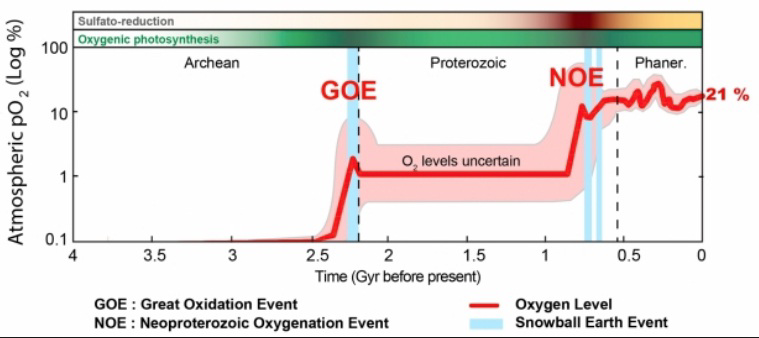
Source: https://nephicode.blogspot.com/2017/08/what-do-we-know-about-noahs-flood-part-i.html
Today, aerobic organisms - including humans - depend on the oxygen-rich atmosphere shaped by ancient microbes. The GOE remains an iconic example of how biological evolution and Earth system processes are linked across time.
Table 1.
Time (billion years ago) | Atmospheric O$_2$ (%) |
|---|
3 | 0.001 |
2.8 | 0.002 |
2.6 | 0.005 |
2.45 | 1 |
2.3 | 4 |
2 | 10 |
Graph of Information - Figure 1.
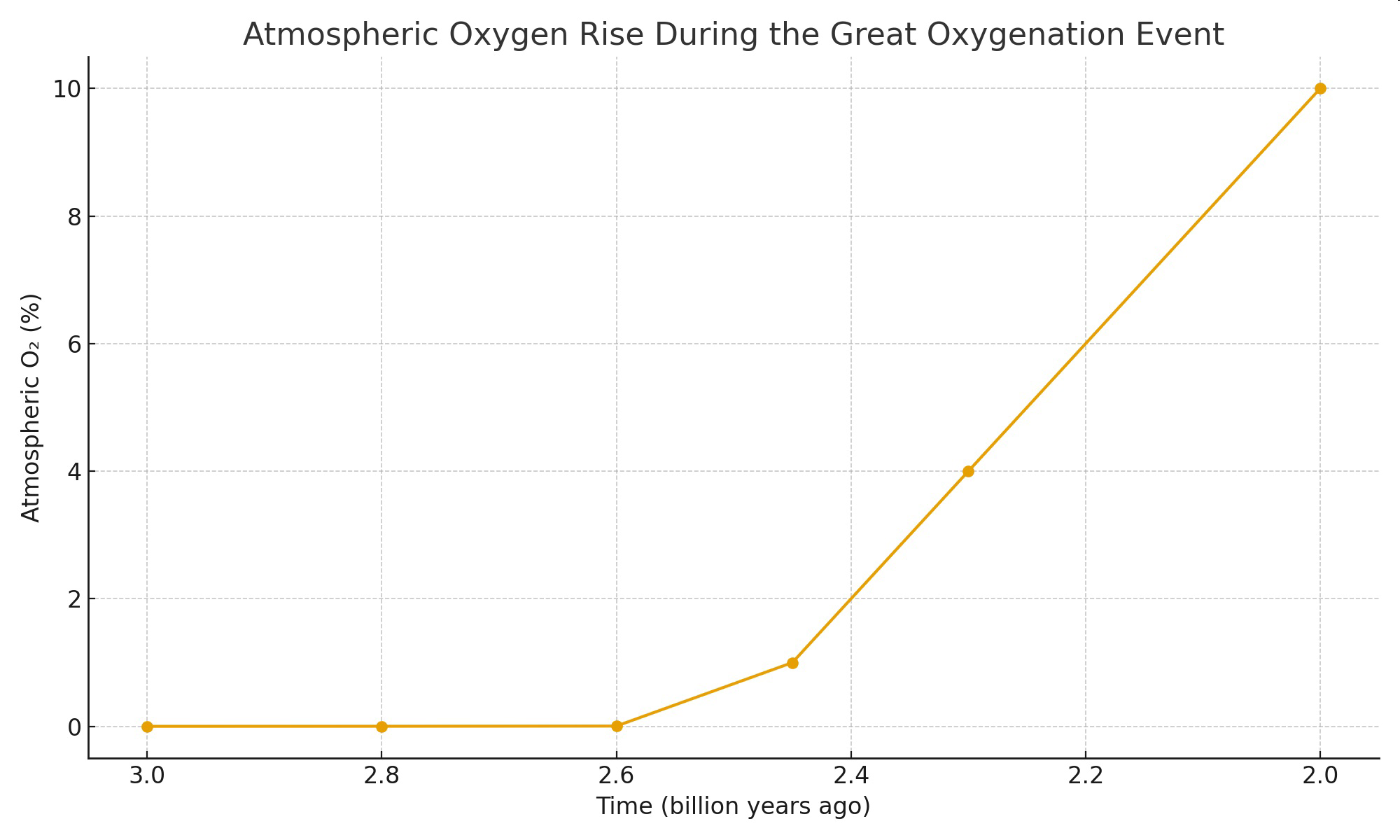
Table 2.
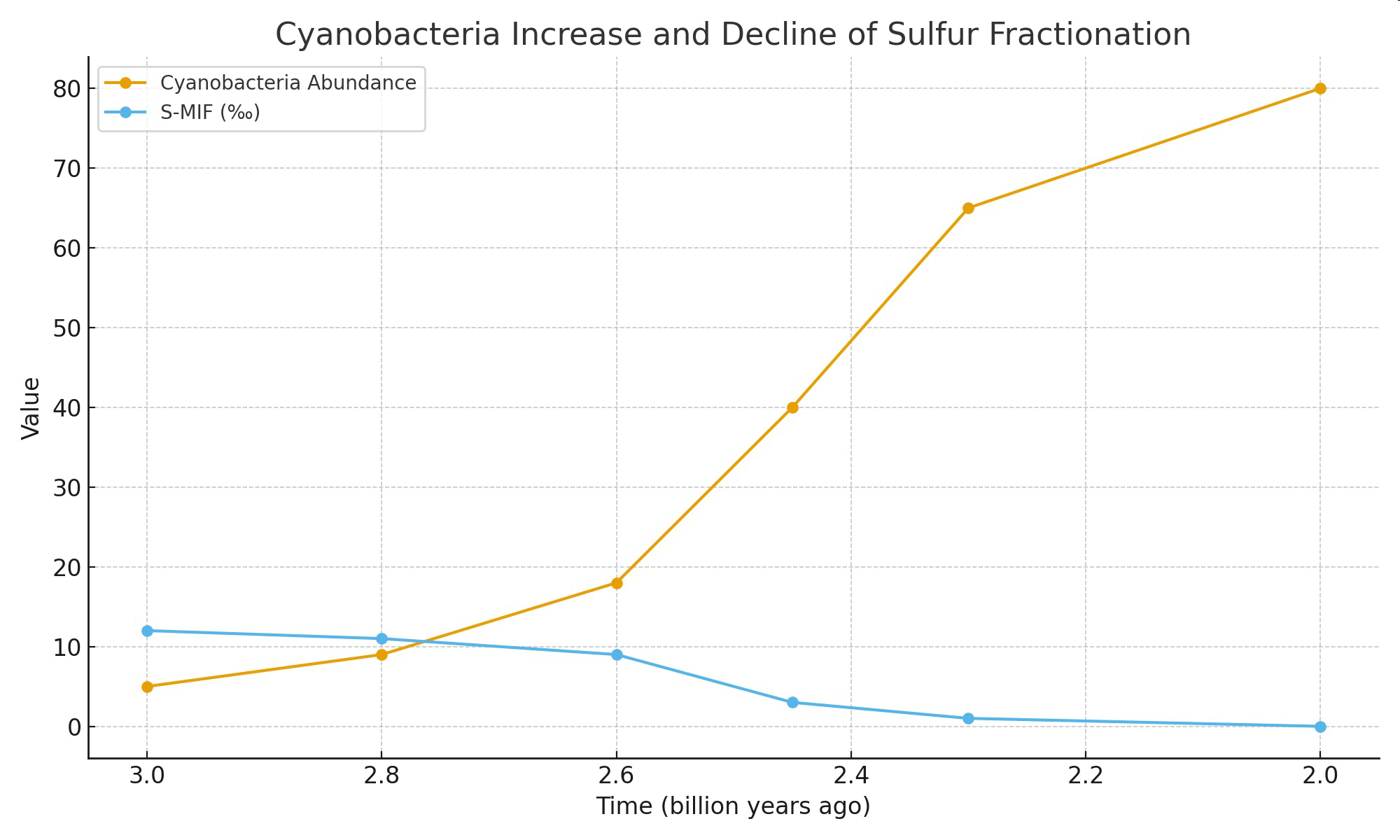
Time (billion years ago) | Cyanobacteria Abundance Index | Mass-Independent Sulfur Fractionation (%) |
|---|
3 | 5 | 12 |
2.8 | 9 | 11 |
2.6 | 18 | 9 |
2.45 | 40 | 3 |
2.3 | 65 | 1 |
2 | 80 | 0 |
Graph of Information - Figure 2.