Wildfires
Key Points
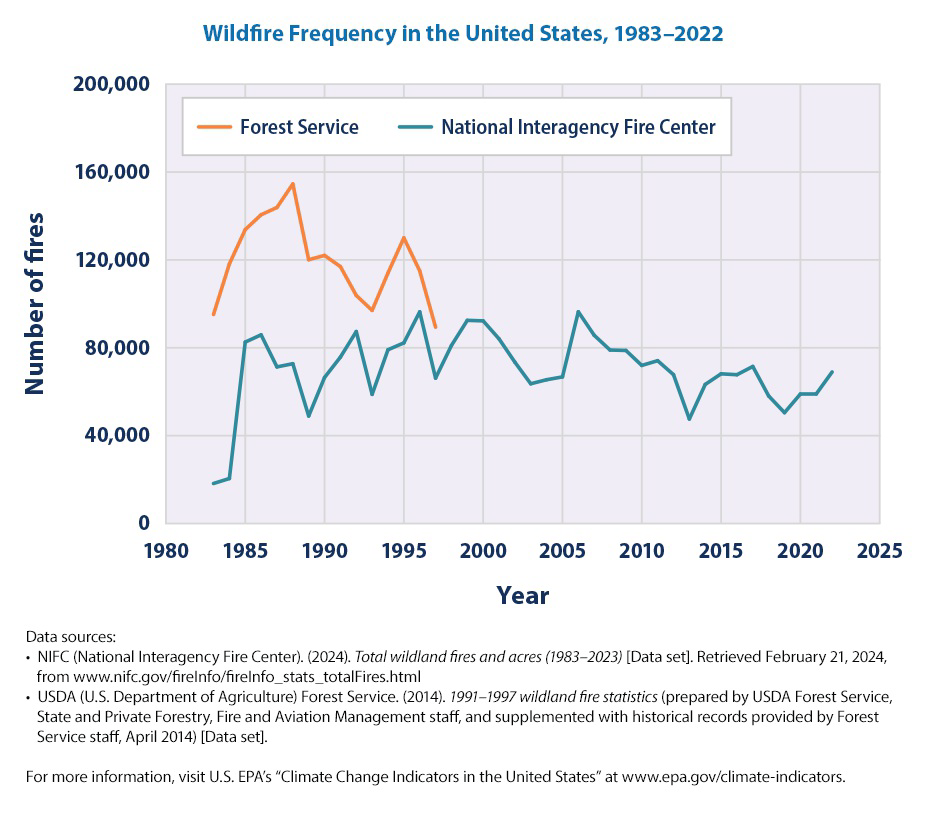
Since 1983, the National Interagency Fire Center has documented an average of approximately 70,000 wildfires per year (Figure 1). Compiled data from the Forest Service suggest that the actual total may be even higher for the first few years of nationwide data collection that can be compared. The data do not show an obvious trend during this time.
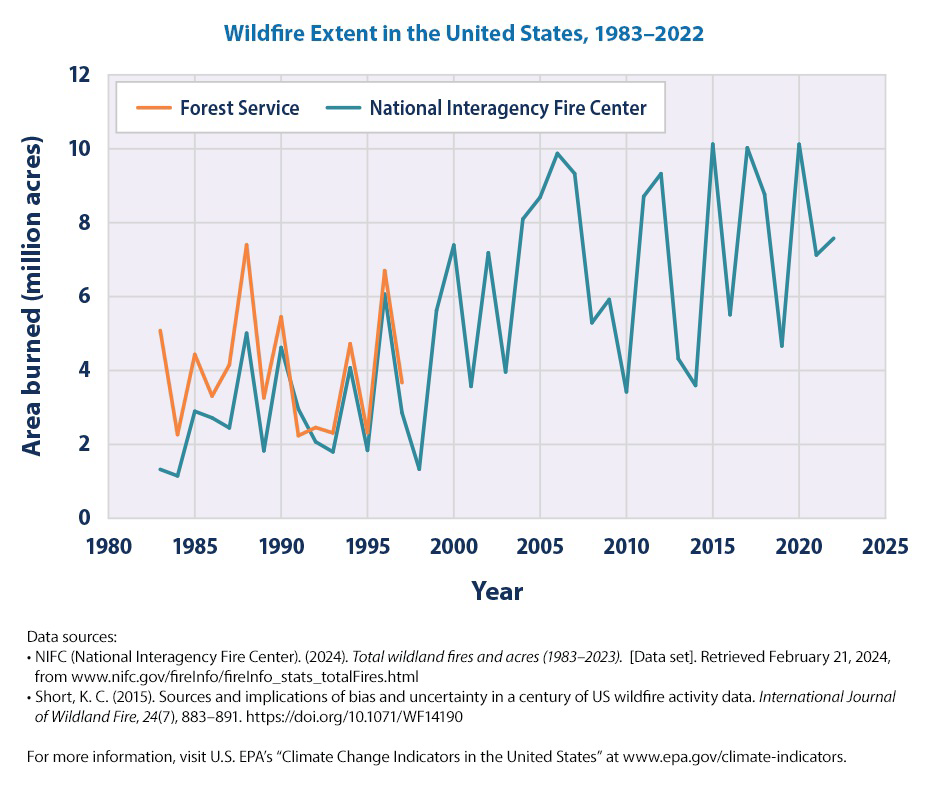
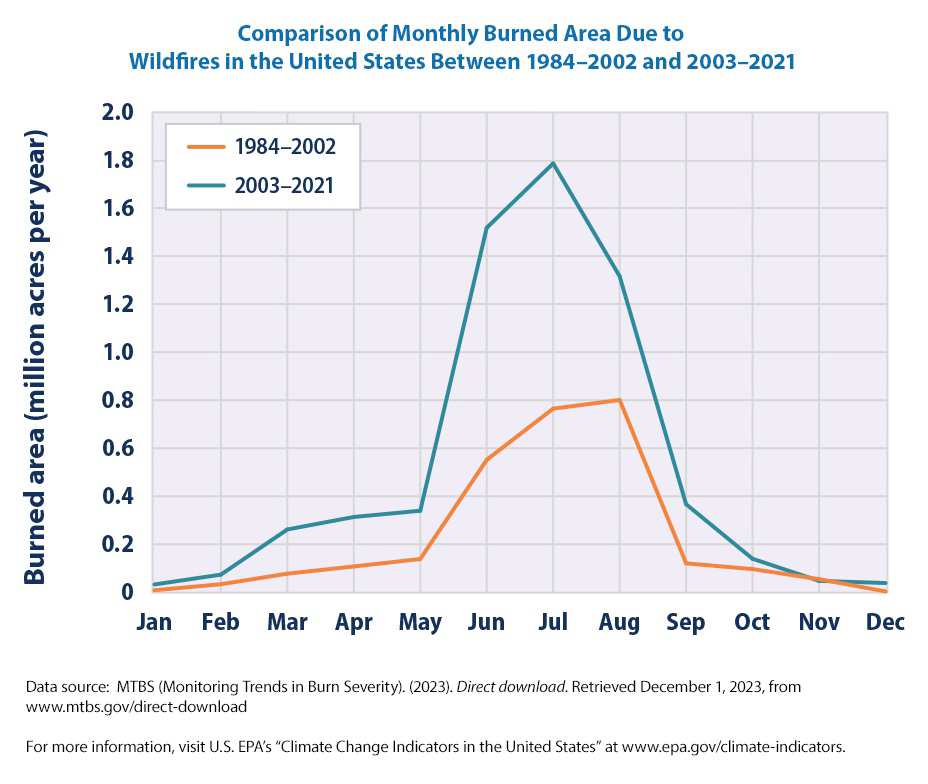
The extent of area burned by wildfires each year appears to have increased since the 1980s. According to National Interagency Fire Center data, of the 10 years with the largest acreage burned, all have occurred since 2004, including the peak years in 2015 and 2020 (Figure 2). This period coincides with many of the warmest years on record nationwide (see the U.S. and Global Temperature indicator). The largest increases have occurred during the spring and summer months (Figure 6).
The late 1990s were a period of transition in certain climate cycles that tend to shift every few decades. This shift - combined with other ongoing changes in temperature, drought, and snowmelt -may have contributed to warmer, drier conditions that have fueled wildfires in parts of the western United States.
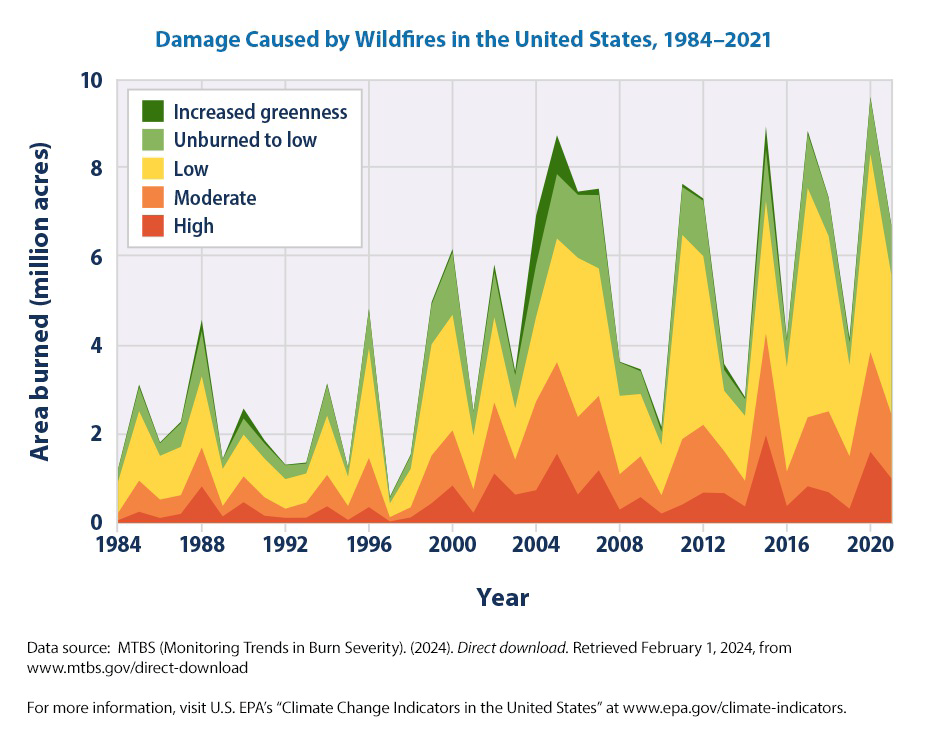
Of the total area burned each year from 1984 to 2021, the proportion of burned land suffering severe damage has ranged from 5 to 22 percent (see the "high" category in Figure 3).
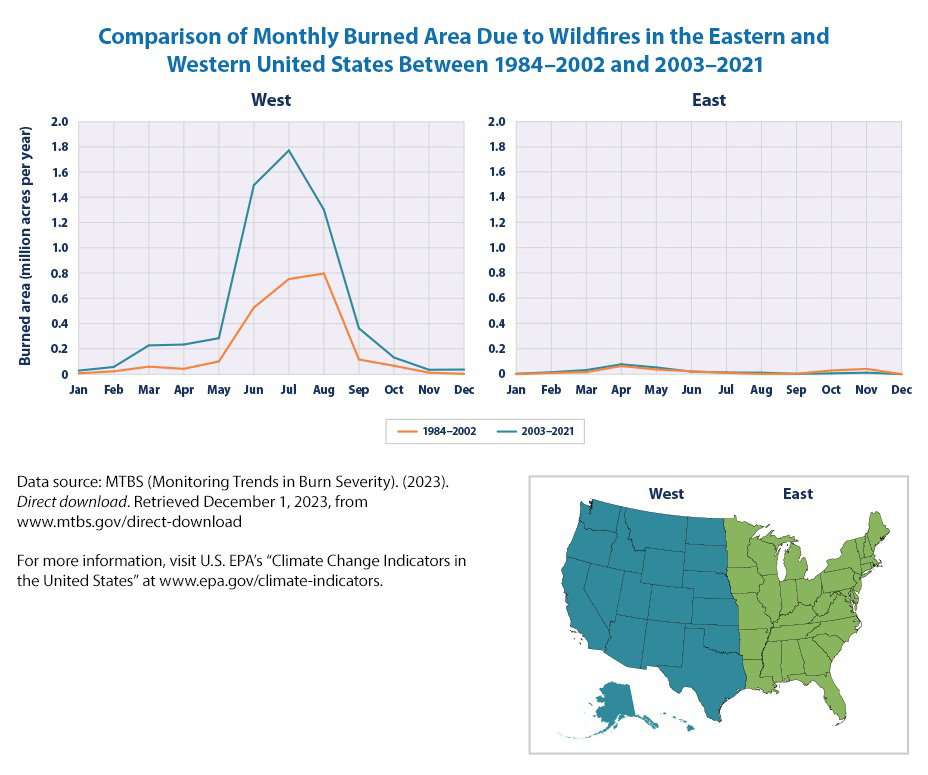
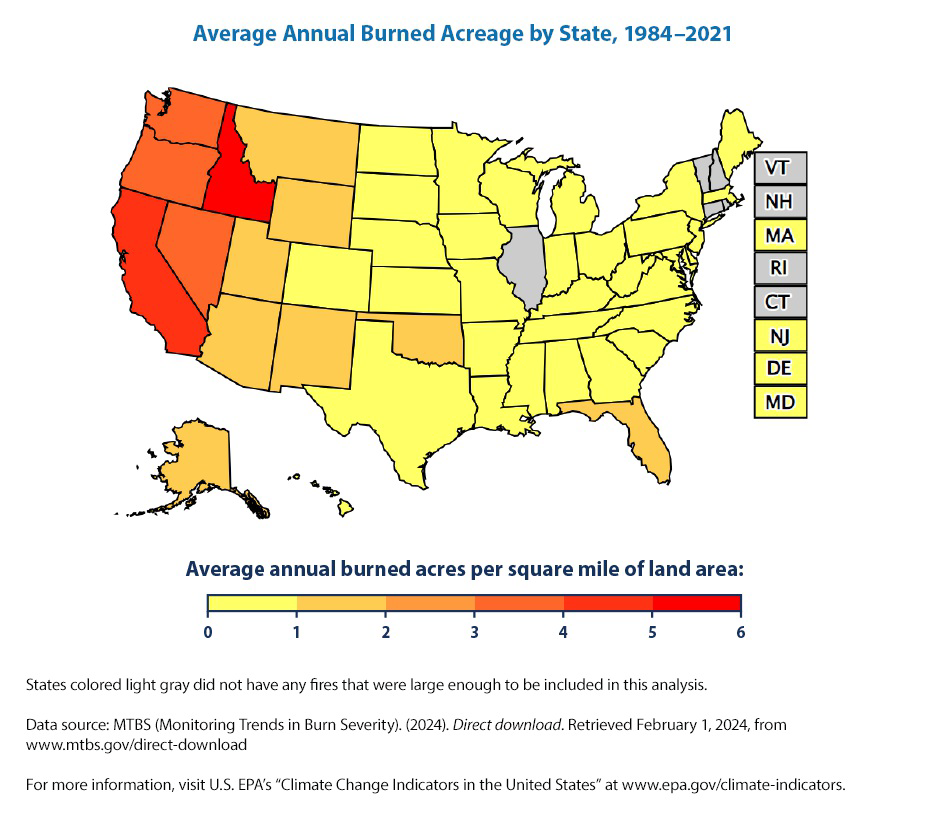
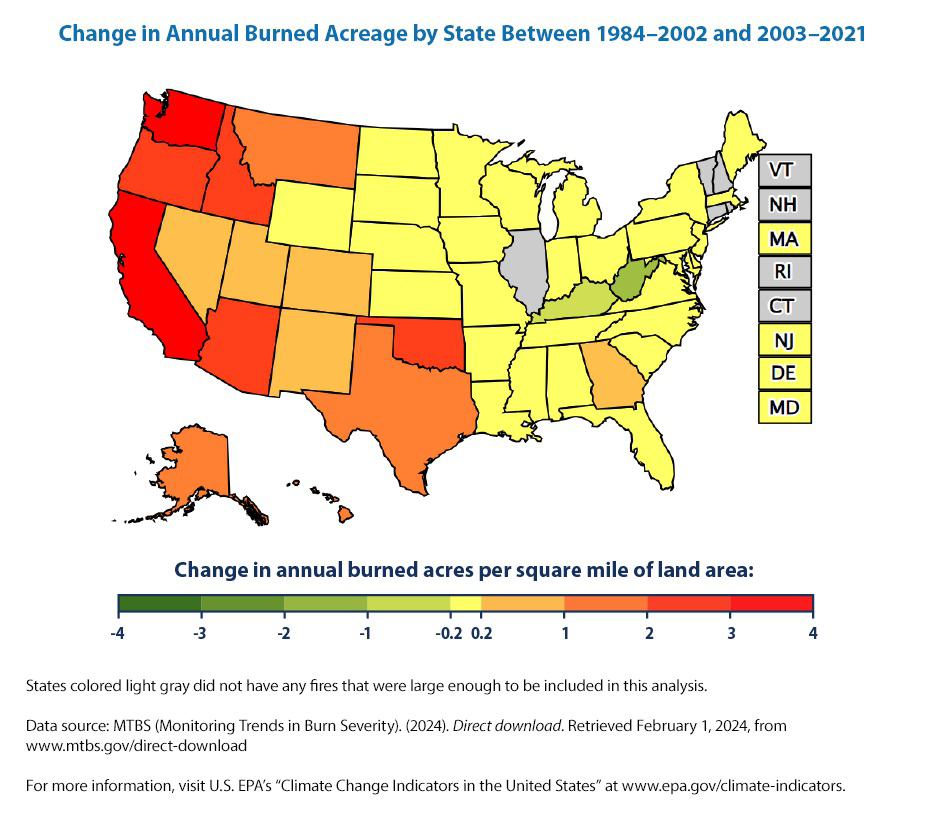
Land area burned by wildfires varies by state. Fires burn more land in the western United States than in the East, and parts of the West and Southwest show the largest increase in burned acreage between the first half of the period of record in Figures 4 and 5 (1984–2002) and the second half (2003–2021) (Figure 5). Burned acreage in the West has increased noticeably in nearly every month of the year (Figure 7).
The peak of the U.S. wildfire season is occurring earlier (Figure 6). In 1984–2002, burned area peaked in August. More recently, it has peaked in July. An average of 1.8 million acres burned in July of each year from 2003 to 2021.
Background
Together, forests, shrubland, and grassland cover more than half of the land area in the United States. These ecosystems are important resources, both environmentally and economically. Although wildfires occur naturally and play a long-term role in the health of these ecosystems, changing wildfire patterns threaten to upset the status quo. Multiple studies have found that climate change has already led to an increase in wildfire season length, wildfire frequency, and burned area. The wildfire season has lengthened in many areas due to factors including warmer springs, longer summer dry seasons, and drier soils and vegetation. Similarly, climate change threatens to increase the frequency, extent, and severity of fires through increased temperatures and drought. Earlier spring melting and reduced snowpack result in decreased water availability during hot summer conditions, which in turn contributes to an increased wildfire risk, allowing fires to start more easily and burn hotter. These trends of longer wildfire seasons and larger wildfire size are predicted to continue as more frequent and longer droughts occur. In addition to climate change, other factors - land use, large-scale insect infestation, fuel availability (including invasive species such as highly flammable cheatgrass), and management practices, including fire suppression - play an important role in wildfire frequency and intensity. All of these factors influencing wildfires vary greatly by region and over time, as do precipitation, wind, temperature, vegetation types, and landscape conditions. Therefore, understanding changes in fire characteristics requires long-term records, a regional perspective, and consideration of many factors.
Wildfires have the potential to harm property, livelihoods, and human health. Fire-related threats are increasing, especially as more people live in and near forests, grasslands, and other natural areas. According to the National Oceanic and Atmospheric Administration, between 1980 and 2023 the United States had 22 wildfire events that individually caused more than $1 billion in damage; 18 of those have occurred since 2000. Over the past few decades, the United States has routinely spent more than $1 billion per year to fight wildfires, including $3.5 billion in 2022. These efforts have resulted in the deaths of hundreds of firefighters. Even in communities far downwind, wildfire smoke has been directly linked to poor air quality that can lead to significant health effects and costs to society (emergency department visits, hospital admissions, and deaths, often due to respiratory ailments).
Beyond the human and societal impacts, wildfires also affect the Earth’s climate. Forests in particular store large amounts of carbon. When they burn, they immediately release carbon dioxide into the atmosphere, which in turn contributes to climate change. After burning, forests also release carbon dioxide more gradually through decomposition.
Graph of Information - Figure 1.
This figure shows the total number of wildfires per year from 1983 to 2022. These totals include all reported
wildfires, which can be as small as just a few acres. The two lines represent two different reporting systems;
though the Forest Service stopped collecting statistics (orange line) in 1997 and will not update them, those
statistics are shown here for comparison.
Graph of Information - Figure 2.
This figure shows annual wildfire-burned area (in millions of acres) from 1983 to 2022. The two lines represent
two different reporting systems though the Forest Service stopped collecting statistics (orange line) in 1997 and is not planning to update them, those statistics are shown here for comparison.
Graph of Information - Figure 3.
This figure shows the distribution of acreage burned by large wildfires, based on the level of damage caused to
the landscape - a measure of wildfire severity. Large wildfires are defined as fires with an area larger than 1,000
acres in the western United States and 500 acres in the eastern United States. The total acreage shown in Figure
3 is slightly less than the total in Figure 2 because Figure 3 is limited to large fires and because a few areas did
not have sufficient satellite imagery to allow damage to be assessed.
Graph of Information - Figure 4.
This map shows the average number of acres burned in each state per year as a proportion of that state’s total
land area. Darker-shaded states have the largest proportion of acreage burned. For reference, there are 640 acres in a square mile; therefore, an average burned area of 6.4 acres per square mile would mean that fires burned 1 percent of a state’s total land area. States that did not have any fires that were large enough to be included in this analysis are shaded gray.
Graph of Information - Figure 5.
This map shows how the number of acres burned in each state as a proportion of that state’s total land area has changed over time, based on a simple comparison between the first half of the available years (1984–2002) and the second half (2003–2021). For reference, there are 640 acres in a square mile; therefore, a change of 6.4 acres per square mile would mean that burned area increased by 1 percent of a state’s total land area. States that did not have any fires that were large enough to be included in this analysis are shaded gray. Click on a state to reveal the trend in a line graph.
Graph of Information - Figure 6.
This figure compares the annual distribution of burned area due to wildfires in the United States between the first half of the period of measurement (1984–2002) and the second half (2003–2021).
Graph of Information - Figure 7.
This figure compares the annual distribution of burned area due to wildfires in the eastern and western United States between the first half of the period of measurement (1984–2002) and the second half (2003–2021).