Decomposition and Nutrient Cycling in a Temperate Forest Ecosystem
Diagram 1.
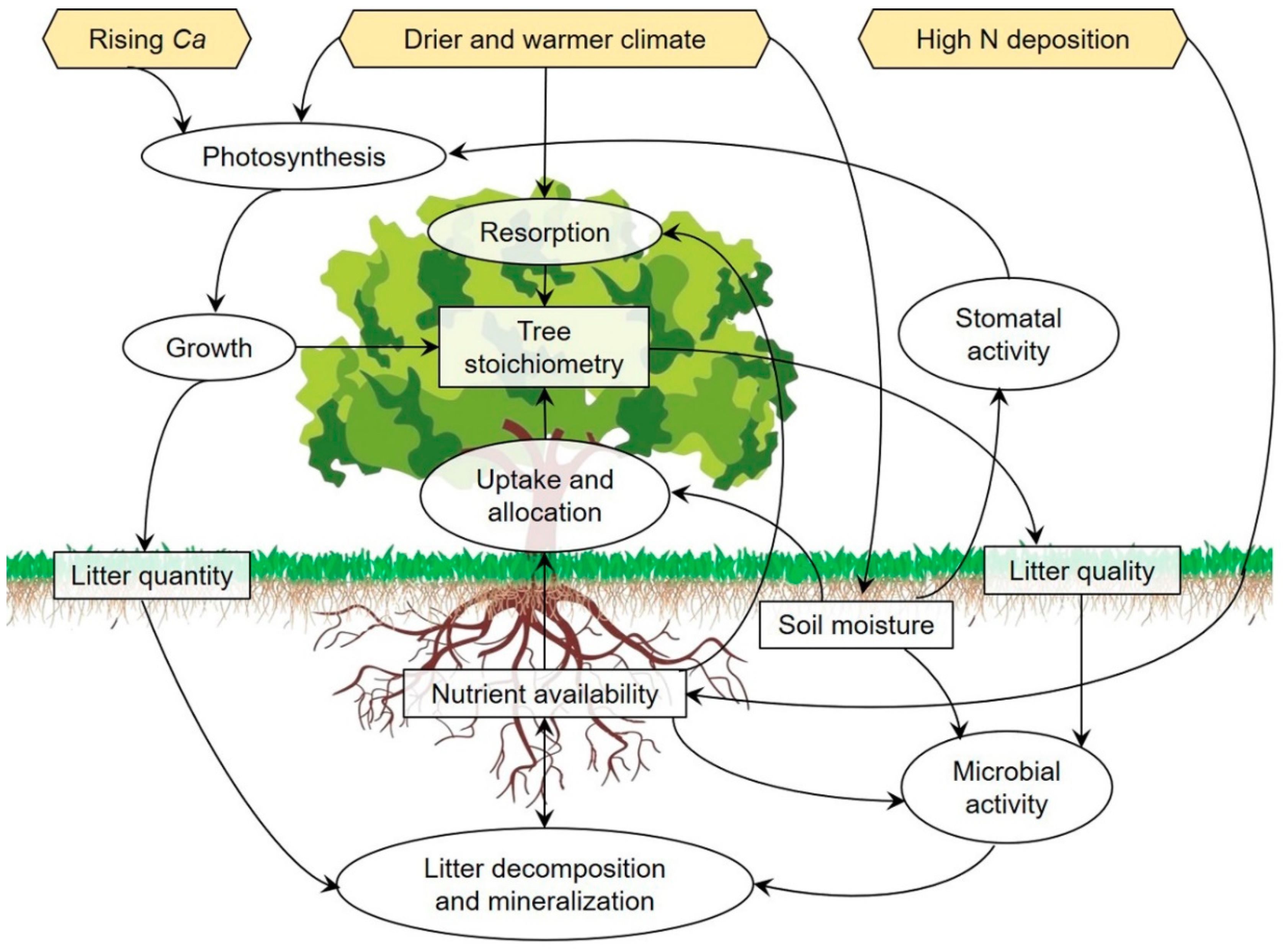 Source:
https://maryjane-kgibson.blogspot.com/2022/04/what-effect-do-abiotic-cycles-have-on.html
Temperate forests rely on a continuous cycle of decomposition and nutrient return to maintain productivity. When leaves fall from trees in autumn, they accumulate as leaf litter across the forest floor. This
dead organic material represents a large reservoir of stored energy and matter, but it is not yet available for use by plants. The transformation of leaf litter into usable nutrients occurs through decomposers - fungi, bacteria,
and detritivores - that break down complex organic molecules through enzymatic activity and respiration.
Mathematical patterns in decomposition rates and nutrient availability reveal how matter cycles and how energy flows through this system.
Decomposition rates vary depending on temperature, moisture, microbial abundance, and litter chemistry. In forests with low soil moisture, decomposition proceeds slowly, leaving a large percentage of mass
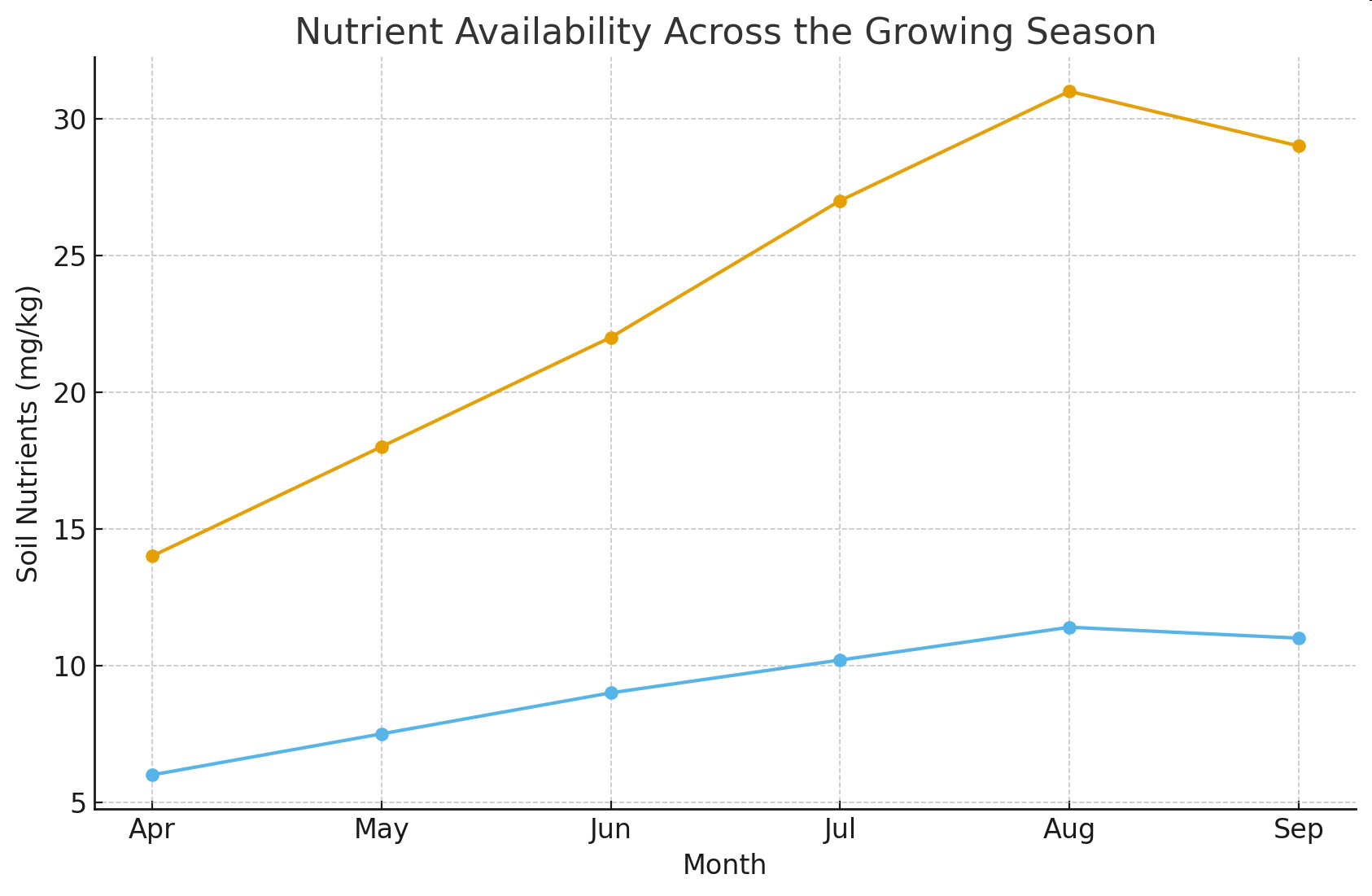
remaining after several months. In contrast, higher moisture levels accelerate microbial activity, leading to faster mass loss. These patterns can be quantified using decay curves that reflect exponential decreases in mass over time. As decomposers break down litter, they release nutrients such as nitrogen and phosphorus back into the soil, increasing nutrient concentrations as the growing season progresses.
Matter moves through several linked stages: from leaf litter to decomposers to soil nutrients to plant roots back into living biomass. This matter cycling pathway is mathematically reflected in the rising concentrations of nitrogen and phosphorus between April and August as decomposition progresses. Although matter cycles continuously, the flow of energy is unidirectional. Decomposers use the chemical energy stored in leaf litter to fuel metabolism, releasing CO2 and heat. This energy cannot be reused by plants; instead, plants must rely on sunlight to create new energy-rich molecules.
The datasets illustrate these relationships. Leaf litter shows predictable mass-loss curves under different moisture conditions, while soil nutrients rise in a pattern that matches increased microbial activity. These relationships demonstrate that mathematical representations - such as decay curves, rate comparisons, and
nutrient accumulation graphs - can be used to support claims about matter cycling and energy flow in forest
ecosystems.
Together, the patterns in decomposition and nutrient availability demonstrate a core principle of ecology: energy flows and diminishes, while matter cycles through ecosystems in predictable, quantifiable ways.
Diagram 2.
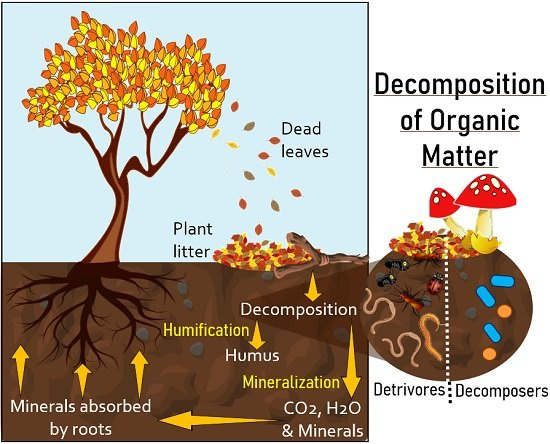 Source: https://biologyreader.com/organic-matter-decomposition.html
Table 1.
Day | Mass Remaining 20pct | Mass Remaining 40pct | Mass Remaining 60pct |
|---|
0 | 100 | 100 | 100 |
20 | 88 | 82 | 76 |
40 | 74 | 64 | 56 |
60 | 63 | 50 | 39 |
80 | 52 | 38 | 28 |
100 | 45 | 30 | 20 |
Graph of Information - Figure 1.
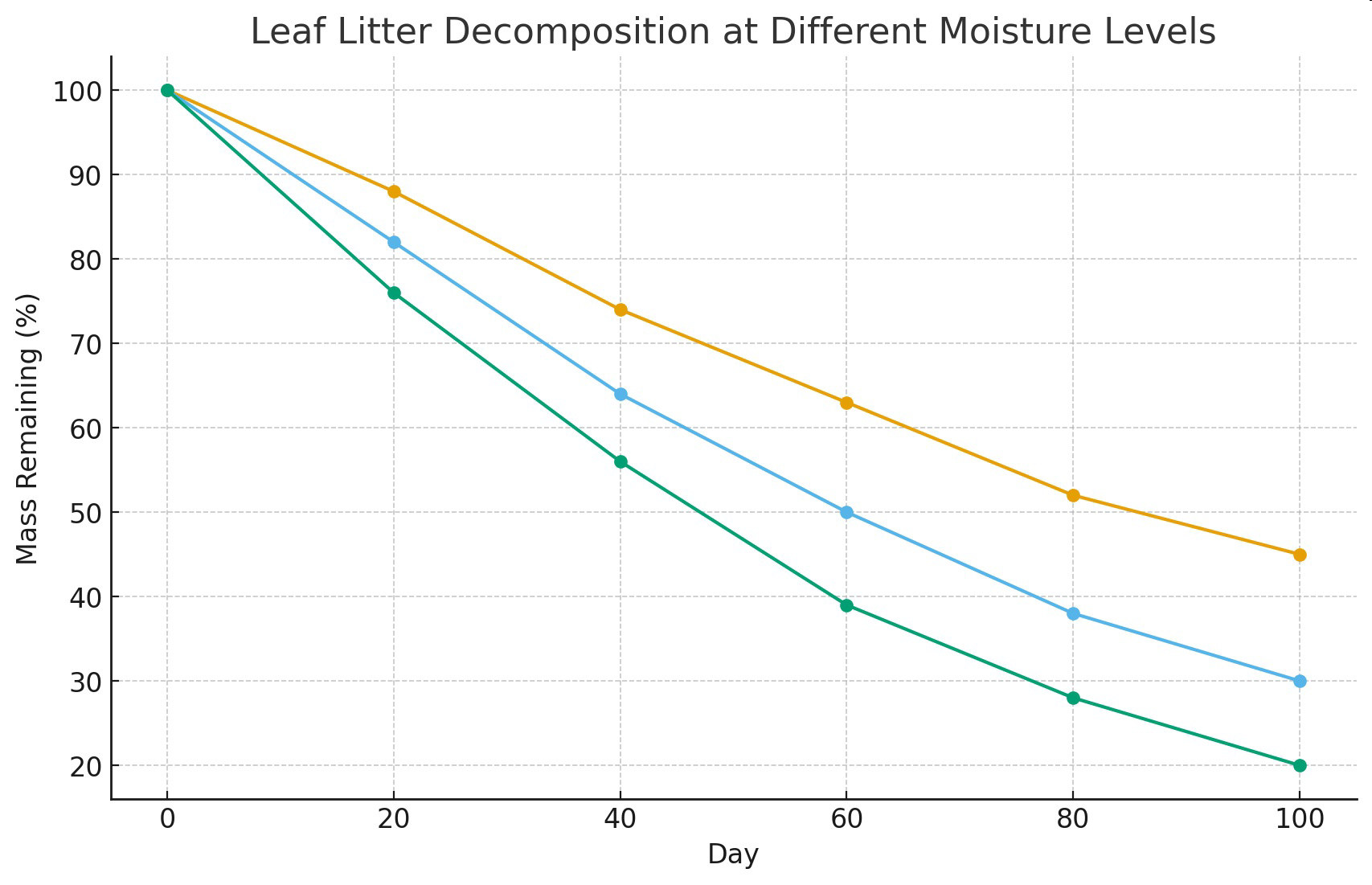
Diagram 3.
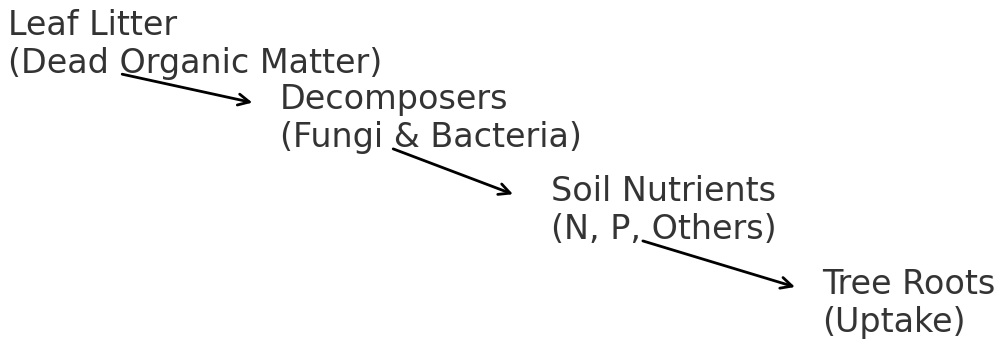
Table 2.
Month | Soil Nitrogen mg/kg | Soil Phosphorus mg/kg |
|---|
Apr | 14 | 6 |
May | 18 | 7.5 |
Jun | 22 | 9 |
Jul | 27 | 10.2 |
Aug | 31 | 11.4 |
Sep | 29 | 11 |
Graph of Information - Figure 2.