How Oxygen Consumption Supports ATP Production During Endurance Exercise
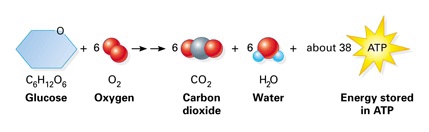
When an athlete begins running, cycling, or swimming at a steady pace, the body rapidly increases its use of aerobic cellular respiration. This process takes place inside mitochondria and involves breaking chemical bonds in glucose and oxygen molecules to form new bonds in carbon dioxide and water. The rearrangement of these atoms releases usable energy in the form of ATP. This flow of energy is essential for continuous muscle contractions during endurance activities.
During aerobic respiration, the six-carbon glucose molecule enters pathways such as glycolysis and the citric acid cycle. Enzymes break C–H and C–C bonds, releasing electrons that transfer energy to carrier molecules (NADH and FADH). These electrons then move through the electron transport chain, where oxygen acts as the final electron acceptor. When oxygen binds with electrons and hydrogen ions, new O–H bonds form, creating water. This bond formation is tightly linked to ATP production.
As exercise intensity increases, muscle cells require more ATP per minute. To keep up with this demand, athletes breathe faster and deeper, bringing in more oxygen. Heart rate also rises to deliver oxygen more efficiently to the muscles. The more oxygen absorbed and delivered, the more glucose can be oxidized, and the more ATP is produced. This is why oxygen consumption ($\text{VO}_2$) is one of the best indicators of aerobic fitness.
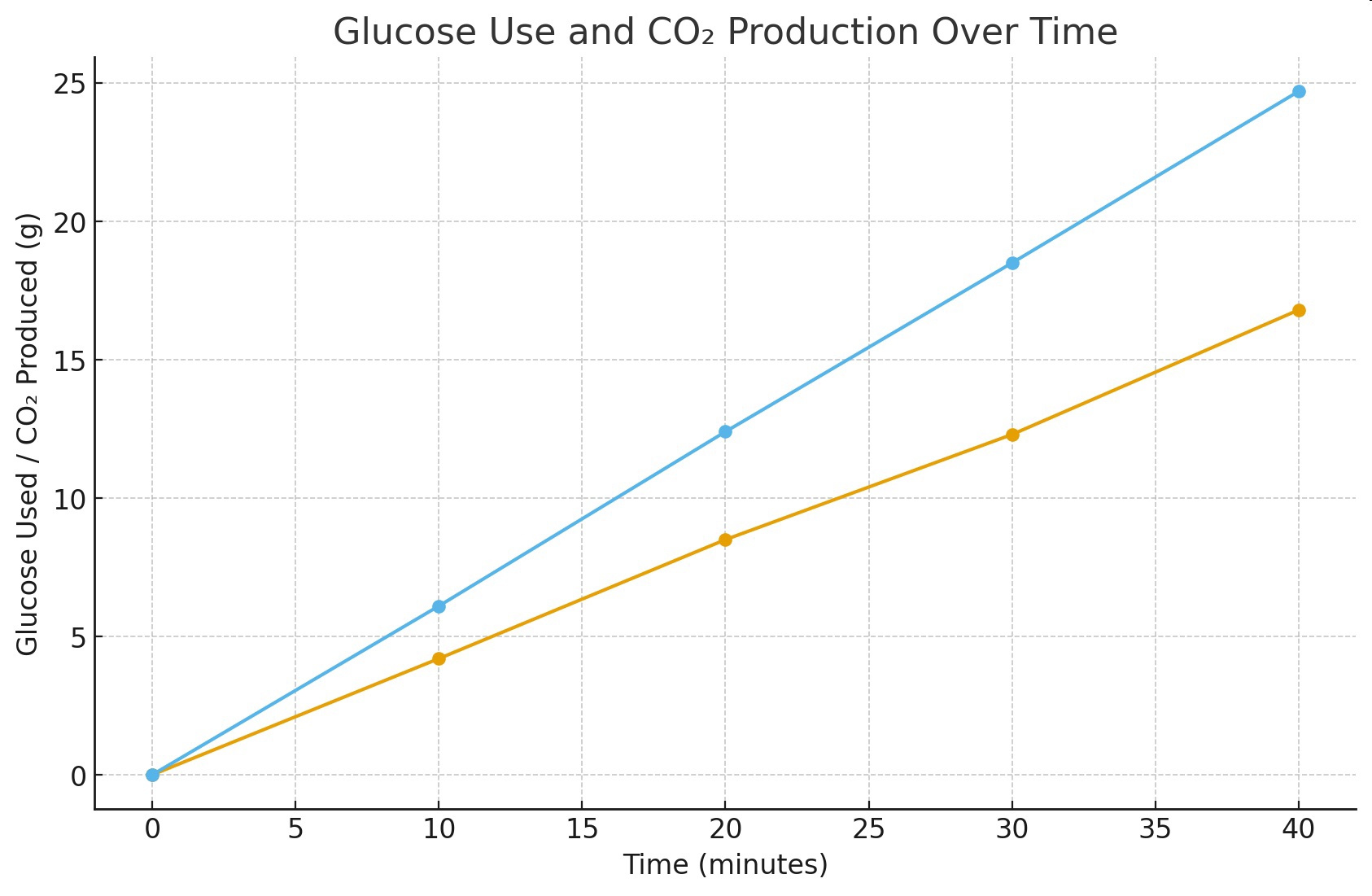
The chemical transformations occurring during aerobic respiration also produce carbon dioxide. As more glucose molecules are broken down, more $\text{CO}_2$ is formed from newly created C=O bonds. This $\text{CO}_2$ diffuses into the blood and is exhaled through the lungs. Thus, both oxygen uptake and $\text{CO}_2$ output increase steadily with exercise intensity.
Athletes with high aerobic fitness levels - such as marathon runners - have greater mitochondrial density, stronger cardiac output, and higher $\text{VO}_2 \text{ max}$. These traits allow them to carry out more aerobic respiration per minute, releasing more energy and sustaining activity for longer periods.
Diagram 1.
 Source:
utori.com/en/story/cellular-respiration--6WvJyqXruTC2CceDaqoTWNga
Table 1.
Exercise Intensity (% max) | Oxygen Consumption (mL/kg/min) | ATP Production (mmol ATP/min) |
|---|
20 | 12 | 8 |
40 | 22 | 15 |
60 | 32 | 23 |
80 | 45 | 32 |
100 | 60 | 40 |
Graph of Information - Figure 1.
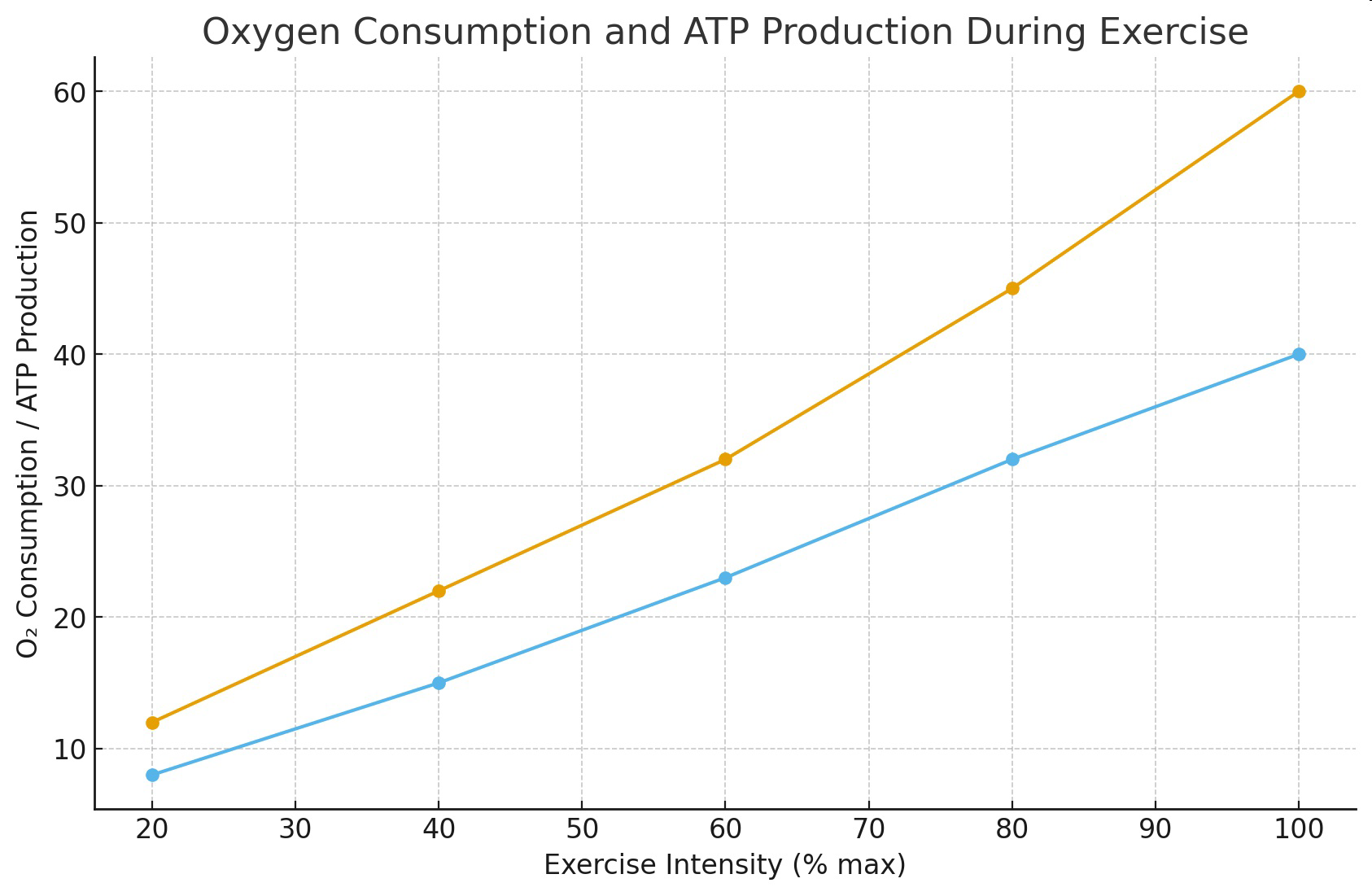
Table 2.
Time (minutes) | Glucose Used (g) | CO2 Produced (g) |
|---|
0 | 0 | 0 |
10 | 4.2 | 6.1 |
20 | 8.5 | 12.4 |
30 | 12.3 | 18.5 |
40 | 16.8 | 24.7 |
Graph of Information - Figure 2.