How Yeast Use Aerobic Cellular Respiration to Release Energy During Bread Dough Rising
Bread dough rises thanks to the metabolic activity of yeast, single-celled fungi that break down sugars and release carbon dioxide. During the early stages of dough proofing - before oxygen runs out - yeast rely on aerobic cellular respiration, a chemical process that breaks bonds in glucose and oxygen molecules and forms new bonds in carbon dioxide and water. This process releases energy in the form of $ATP$, which yeast use to fuel growth and reproduction.
When yeast first encounter the dough environment, oxygen is still present because it is trapped between flour particles and has been incorporated during kneading. Yeast cells take up glucose from flour starches, and enzymes begin breaking $C–H$ and $C–C$ bonds. As glucose molecules are oxidized, electrons move through the yeast’s electron transport chain, where oxygen acts as the final electron acceptor. New bonds form when oxygen combines with hydrogen ions to produce water, and carbon atoms form new double bonds with oxygen to create carbon dioxide gas.
These chemical bond rearrangements release significant energy. Yeast capture this energy in $ATP$ molecules, which they use to synthesize proteins, repair membranes, and divide. As yeast populations grow, more glucose is broken down and more $CO_2$ is released. This $CO_2$ becomes trapped in the dough’s gluten network, causing the dough to expand and rise.
As oxygen becomes depleted inside the dough, yeast gradually shift from aerobic respiration to fermentation. Fermentation produces much less $ATP$ because it does not involve the electron transport chain or oxygen-dependent bond formation in water. But during the early, oxygen-rich stage, aerobic respiration dominates and generates the energy yeast need to multiply quickly.
Diagram 1.
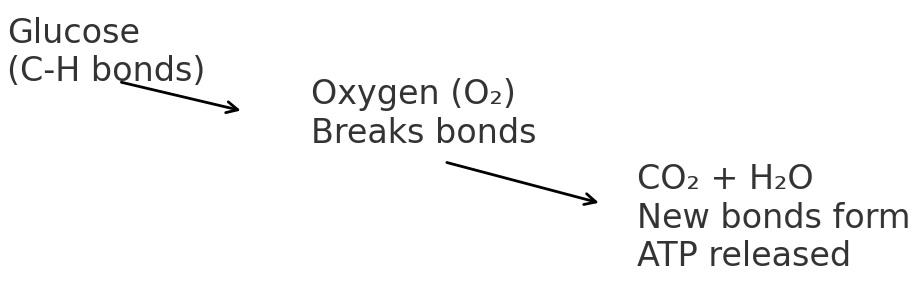
Table 1.
Time (minutes) | Oxygen Consumption (mL O$_2$/g/hr) | ATP Production (mmol ATP/g/hr) |
|---|
0 | 0 | 0 |
15 | 1.8 | 4.5 |
30 | 3.6 | 9.2 |
45 | 5.1 | 13.8 |
60 | 5.8 | 15.1 |
90 | 6 | 15.4 |
Graph of Information - Figure 1.
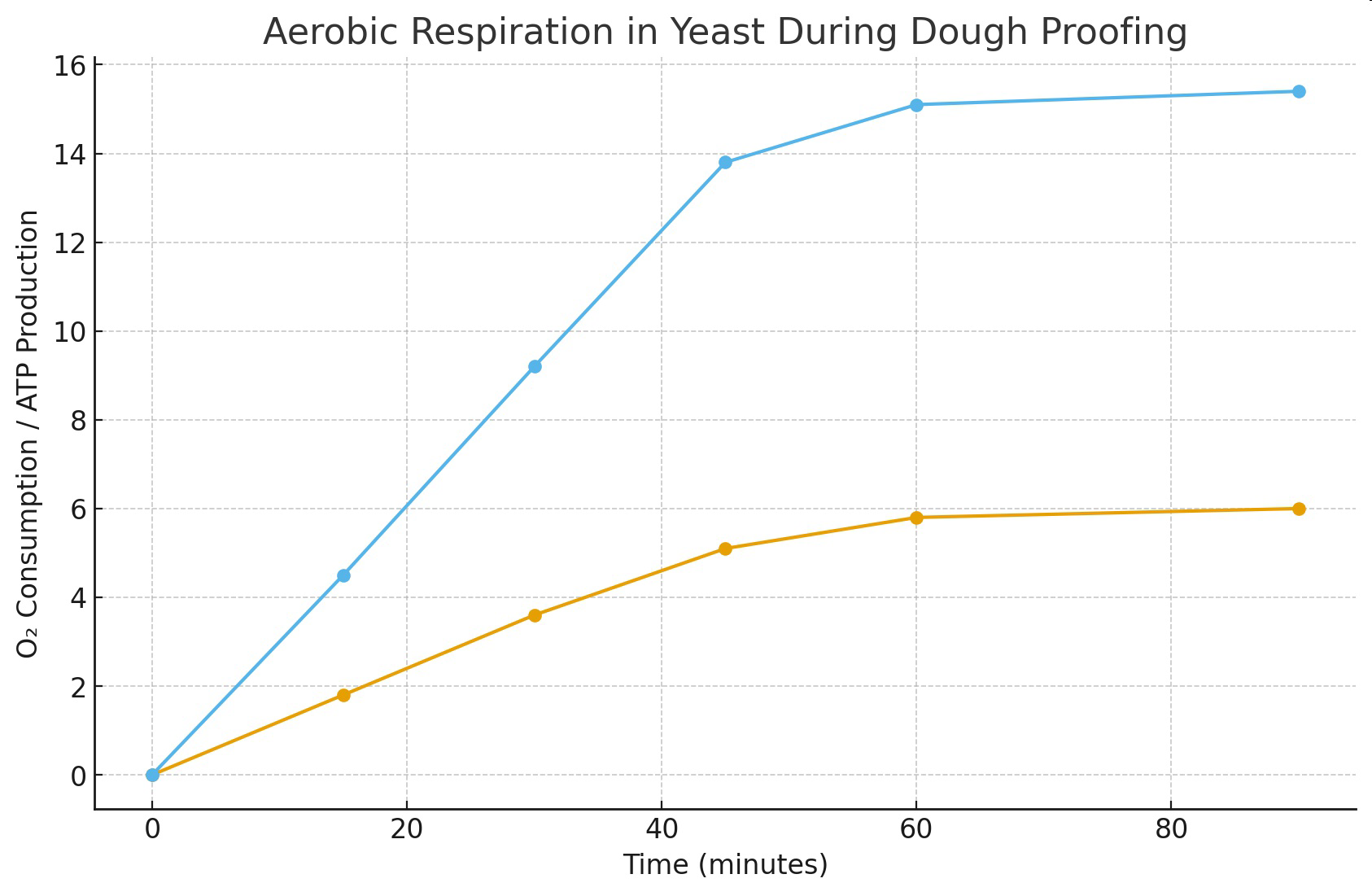
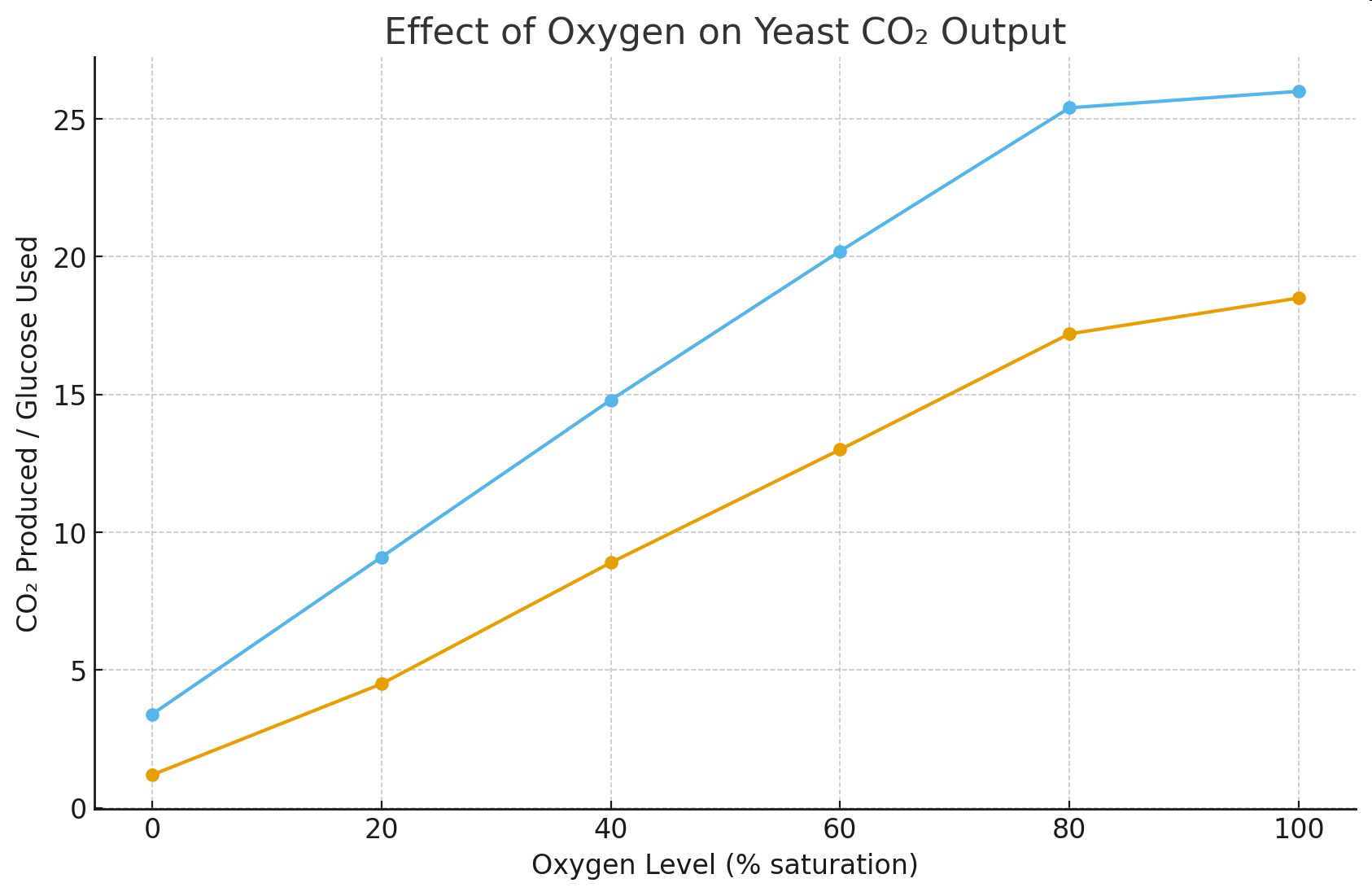
Table 2.
Oxygen Level (% saturation) | CO$_2$ Produced (mg CO$_2$/hr) | Glucose Used (mg/hr) |
|---|
0 | 1.2 | 3.4 |
20 | 4.5 | 9.1 |
40 | 8.9 | 14.8 |
60 | 13 | 20.2 |
80 | 17.2 | 25.4 |
100 | 18.5 | 26 |
Graph of Information – Figure 2.