Twa kɔ nsɛm atitiriw so
Log in
Sign up for FREE
arrow_back
Laabri

Post-Lab: Physiology Research Institute [2026]

star
star
star
star
star
Last updated 2 months ago
7 Nsɛmmisa

You need your digital Lab Notebook with your group's results and the shared whole-class data document from the in-class "Physiology Research Institute" lab!

This post-lab is an individual assignment. It is due by 8 AM on Wed/Thur (4/22 - 4/23).

Section 1: Respiratory Analysis
Ɛhia
0.7
Ɛhia
0.5
Ɛhia
0.5
Section 1: Somatosensory Investigation
Ɛhia
0.7
Ɛhia
0.5
Section 3: Stimulus-Response Assessment
Ɛhia
0.5
Ɛhia
1

Read through the information below, and use what you learn to help you answer the next few questions!

As you've recently learned, our bodies monitor the pH of our blood to determine when to increase or decrease our breathing rate. Remember, the higher the concentration of CO2 in our blood, the lower the pH level of our blood (in other words, the more acidic it becomes).

Hyperventilation

This refers to rapid, deep breathing. When you hyperventilate, you exhale more CO2 than your body produces during that time. Because the hemoglobin throughout your blood is usually almost fully saturated (all holding as much oxygen as they can) at any given time point, the overall effect of hyperventilating means you sharply decrease the amount of CO2 in your blood without significantly changing the levels of O2 in your blood.

Hypoventilation

This refers to breathing less. The way we simulated this was to breath at a normal rate, but breath into a bag. By breathing in a bag, you are rebreathing air that has a much high concentration of CO2 and much lower concentration of O2 than the typical air you breathe. The result is a significant increase in the concentration of CO2 in your bloodstream.

Asemmisa {{asɛmmisaAhyɛnsode}}
1.
Asemmisa {{asɛmmisaAhyɛnsode}}
2.

Did you group's experimental results match these expected results? Did your class period's experimental results match these expected results?

Briefly summarize your group's results and the class period's results. Explain whether they match the expected results. Finally, describe specific sources of "error" in the experiment - why might some groups NOT get the expected results?

Your response should be 3-4 full sentences.

Asemmisa {{asɛmmisaAhyɛnsode}}
3.

The image below is a screenshot from a university's rec center website. It shows a specific section they've included in the "Aquatics" part of the site.
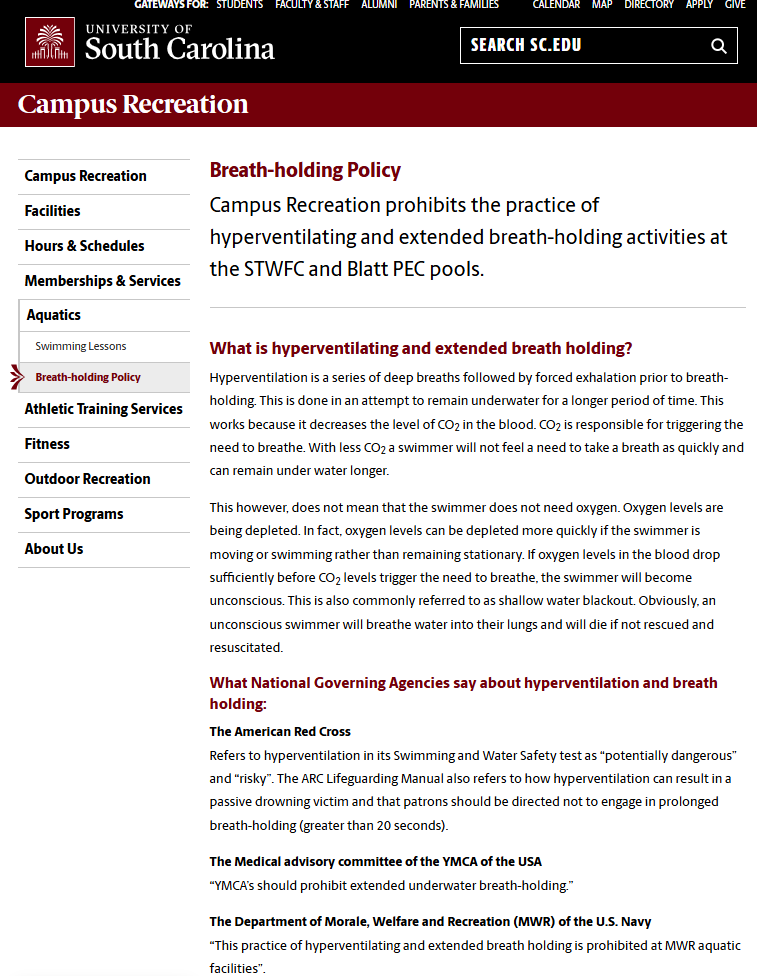
Why do you think they've chosen to create this "Breath-holding Policy", and why would official governing agencies have specific things to say about the dangers of breath-holding, as shown at the bottom of this screenshot?

Write at least 2-3 full sentences explaining both why someone might WANT to hyperventilate before participating in some sort of aquatic activity and why that would be dangerous.
Read through the information below, and use what you learn to help you answer the next few questions!

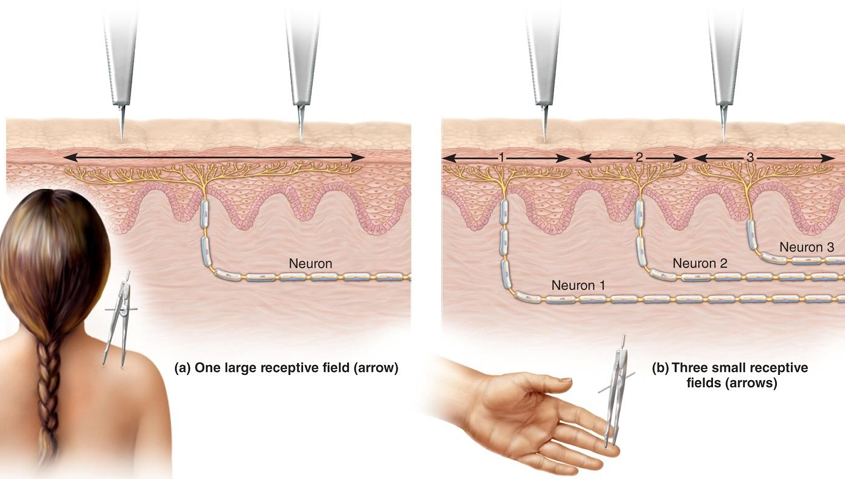
Your skin is packed with tiny sensors called touch receptors. These receptors are responsible for detecting pressure, texture, and other tactile sensations. When a touch receptor is stimulated, it generates a signal that is then transmitted to the nervous system via sensory neurons. However, these receptors aren't spread evenly across your body. Some areas have a much higher concentration, or density, of touch receptors compared to others.

Asemmisa {{asɛmmisaAhyɛnsode}}
4.
Asemmisa {{asɛmmisaAhyɛnsode}}
5.

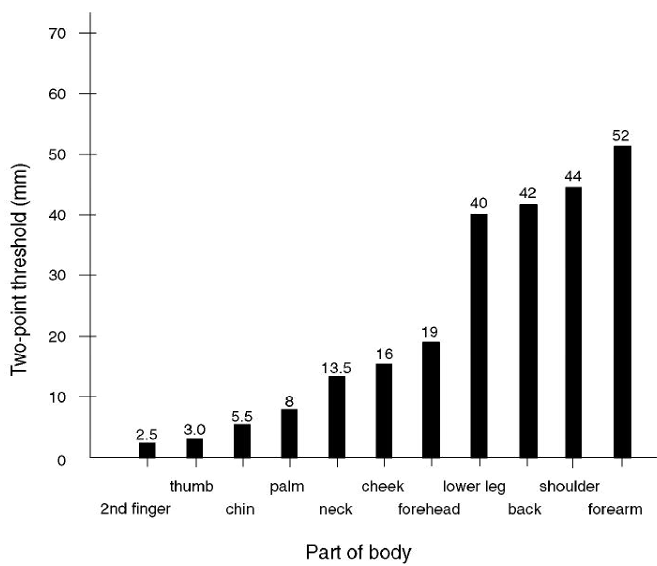
The graph below shows the results of a formal two-point discrimination test. This represents the expected results. The "two-point threshold" on the Y-axis is the minimum distance needed between two points for that part of the body to be able to feel those two points separately. In other words, the lower the "threshold", the HIGHER THE DENSITY OF TOUCH RECEPTORS in that area!

Did you group's experimental results match these expected results? Did your class period's experimental results match these expected results?

Briefly summarize your group's results and the class period's results. Explain whether they match the expected results. Finally, describe specific sources of "error" in the experiment - why might some groups NOT get the expected results?

Your response should be 3-4 full sentences.

Asemmisa {{asɛmmisaAhyɛnsode}}
6.

How did your group's results compare to the class period's results? Was there any difference between the "visual" and "auditory" reflex tests?

Briefly summarize your group's results and the class period's results, including any difference (or lack of difference) between the "visual" and "auditory" results. Explain why you think there was or was not a difference between your group and the class, as well as between "visual" and "auditory". Finally, describe specific sources of "error" in the experiment - why might some results not be "accurate" in this particular experiment?

Your response should be 3-4 full sentences.

Asemmisa {{asɛmmisaAhyɛnsode}}
7.

Please submit a SHARE LINK (with edit access) to your group's lab notebook here! :)