Thawing Permafrost and the Release of Ancient Carbon
Diagram 1.
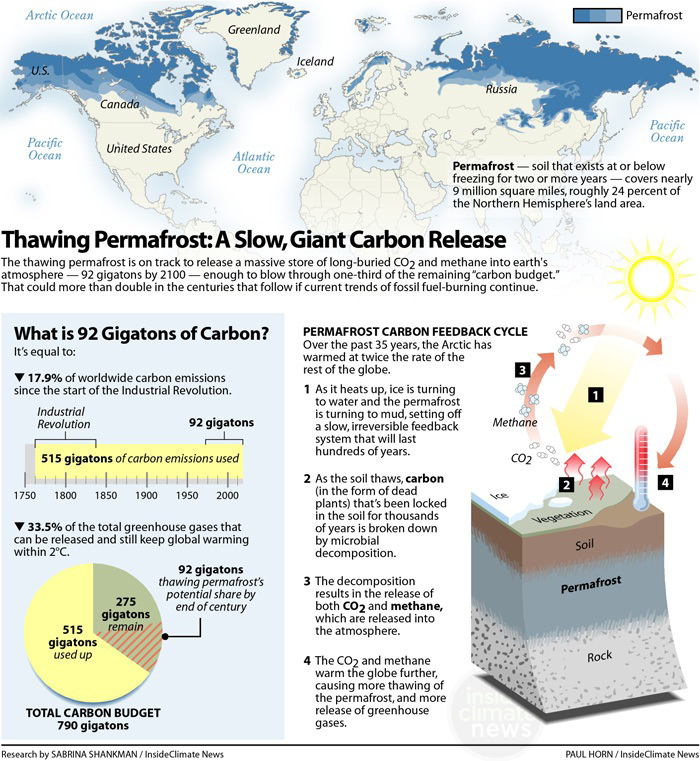
Source: https://insideclimatenews.org/news/23042015/thawing-permafrost-arctic-slow-giant-carbon-release/
Permafrost refers to permanently frozen ground found across the Arctic, sub-Arctic, and high-mountain regions. It stores enormous amounts of carbon - more than twice the amount currently in Earth’s atmosphere - locked away as frozen plant and animal material. As global temperatures rise, this frozen carbon reservoir begins to thaw, allowing microbes to break down organic material and release carbon dioxide $(\text{CO}_2)$ and methane $(\text{CH}_4)$. This process has major implications for the cycling of carbon among the atmosphere, biosphere, hydrosphere, and geosphere.
When permafrost thaws, organic matter that has been frozen for thousands of years becomes available to decomposers. Microbial respiration releases $\text{CO}_2$ in oxygen-rich soils and $\text{CH}_4$ in water-saturated areas such as thaw ponds and wetlands. Methane is especially concerning because it is a much more powerful greenhouse gas than $\text{CO}_2$. As emissions increase, more greenhouse gases accumulate in the atmosphere, raising air temperatures even further. This creates a positive feedback loop: warming causes thaw, thaw causes carbon release, and carbon release causes more warming.
Thawing permafrost also affects the hydrosphere. Meltwater carries dissolved organic carbon into streams, lakes, and eventually the Arctic Ocean. Within these waters, some carbon is consumed by microbes and released as greenhouse gases, while other carbon becomes buried in sediments, connecting thaw processes to long-term carbon burial in the geosphere. Meanwhile, changes in soil conditions and nutrient release can influence plant growth in the biosphere. In some areas, vegetation may increase, removing some $\text{CO}_2$ from the atmosphere, but this uptake is far smaller than the carbon being released from thawing soils.
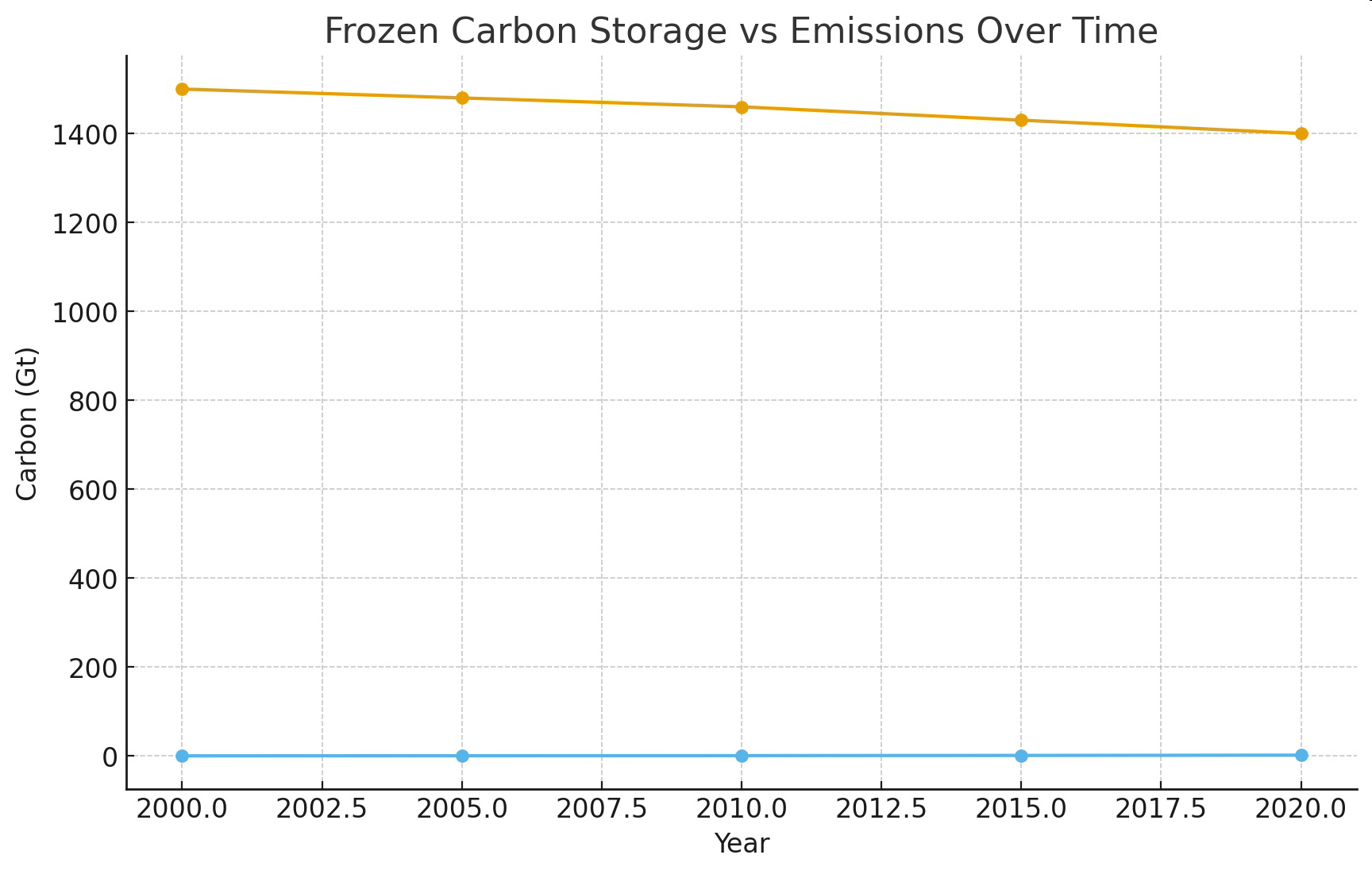
Mathematical patterns illustrate these relationships. As thaw depth increases, $\text{CO}_2$ and $\text{CH}_4$ release rises steeply. Over the past two decades, carbon stored in frozen soils has declined while annual emissions from permafrost regions have grown rapidly. These trends can be modeled through graphs that show both increasing carbon fluxes and decreasing frozen carbon stocks.
Thawing permafrost demonstrates how climate-driven changes in one Earth system cascade through others, altering the movement of carbon across the geosphere, hydrosphere, biosphere, and atmosphere. It also highlights the importance of mathematical representation in understanding carbon cycling feedback loops that influence Earth’s climate system.
Table 1.
Thaw Depth cm | CO$_2$ Release g/m$^2$/day | CH$_4$ Release g/m$^2$/day |
|---|
10 | 1.2 | 0.08 |
20 | 2.1 | 0.15 |
30 | 3.4 | 0.25 |
40 | 4.6 | 0.38 |
50 | 6 | 0.52 |
Graph of Information - Figure 1.
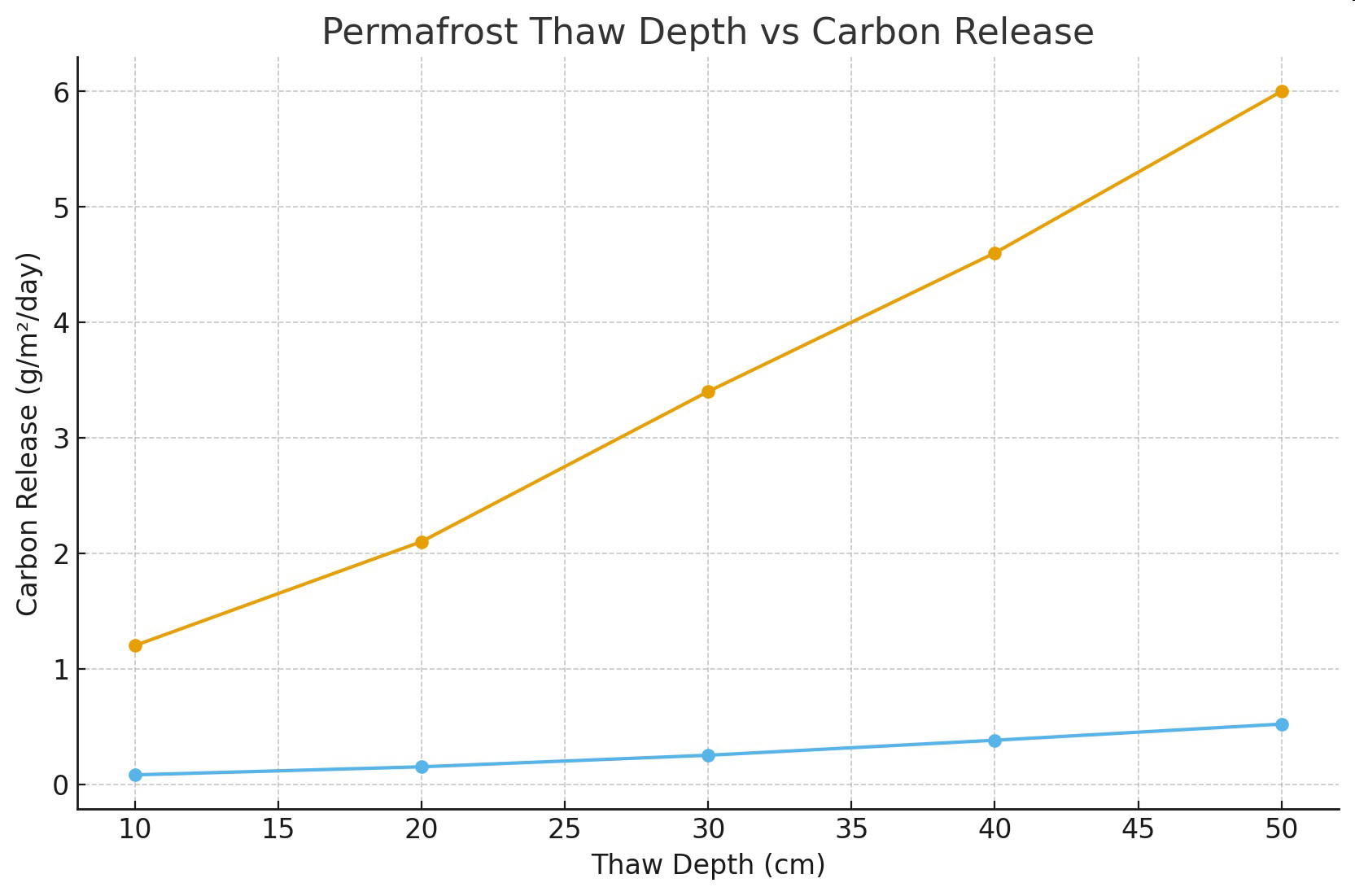
Table 2.
Year | Frozen Carbon Gt | Annual Emissions Gt |
|---|
2000 | 1500 | 0.4 |
2005 | 1480 | 0.6 |
2010 | 1460 | 0.9 |
2015 | 1430 | 1.3 |
2020 | 1400 | 1.9 |
Graph of Information - Figure 2.