Chapter 1 Reading Questions
star
star
star
star
star
Last updated 4 months ago
4 Nsɛmmisa
Why did the captain promise Jim a penny each month?
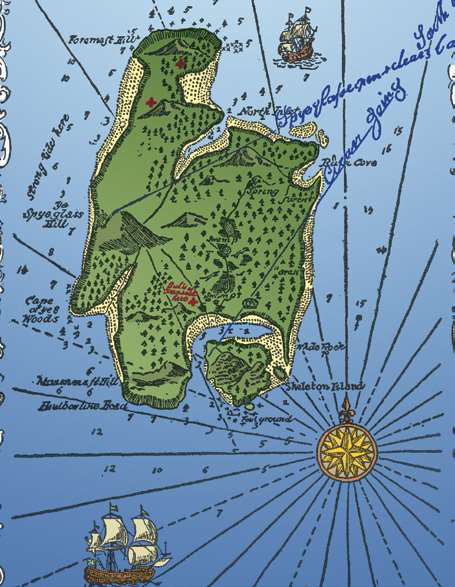
Squire Trelawney, Dr. Livesey, and the other gentlemen have asked me to record the story of Treasure Island, keeping nothing back but the bearings because there is still treasure there. Therefore, I take up my pen and go back to the time when my family ran the Admiral Benbow Inn, and the old seaman with the sabre cut on his cheek came to stay with us.
I remember the old seaman plodding to the inn door, dragging an enormous sea chest behind him. He was a tall, nut-brown man with gnarled hands and black, broken nails. He rapped on the wooden door and called for a drink. He drank it slowly, savoring the taste as he looked out at the rugged clifftop.
“This is a handy cove,” he said. “Much company?”
“Not much,” I said.
“Well, then,” he said, “this is the perfect place for me. I’ll stay here for a while. I’m a plain and simple man,” he continued. “Bacon and eggs for a start.”
“are all I need. You can call me Captain.” Then, as if by magic, he threw down four gold pieces. “Tell me when I’ve worked through that,” he said, looking fierce.
During the daytime, in sunshine or in driving rain, the old captain hung ’round the cove, keeping watch with a brass spyglass. In the evenings, he sat beside a roaring fire. We soon learned to let him be, lost as he was in his own private thoughts.
Every day he would ask if any seafaring men had gone by on the road. At first we thought he wanted company of his own kind, but we eventually realized he wanted to avoid them. It wasn’t long before I understood the reason for this odd behavior. He took me aside one day and promised me a penny on the first of every month if I would keep my eyes peeled for a seafaring man with one leg.
“Let me know the moment he appears!” he growled.
How the man with one leg haunted my dreams! On nights when the wind shook the house and the surf roared in the cove, I would see him in a thousand forms. Sometimes his leg would be cut off at the knee. Sometimes it would be cut off at the thigh. In my nightmares, the man with one leg chased me, calling out my name and hopping along on his good leg. He was always just a matter of inches behind me. I paid pretty dear for my monthly penny in the shape of those terrible dreams.
Often, in the evenings, the old captain would sing a wild sea song and force the inn guests to sing the chorus. On these occasions, it seemed as if the house was quaking as the words echoed within its walls. The old seaman’s stories about bloodthirsty pirates, ferocious storms at sea, and wild deeds on the Spanish Main terrified our guests. He must have lived among some of the most wicked men ever to sail the seas.
He stayed for several months and never offered us any further payment. Whenever my father mentioned his bill, the captain would raise his voice and stare ominously at him until he retreated. I am sure the terror in which my father lived greatly hastened his death.
One morning, while the captain was out walking and taking in the salty sea air, another seafaring man arrived. I was setting the breakfast table when the door opened and the man stepped in. He was a pale, rascally looking creature, and I noticed he was missing two fingers.
“Is this here table for my mate Bill?” he asked, pointing to a table that had indeed been set for our secretive guest. It was not a straightforward question, and he uttered those words with more than a hint of sarcasm.
I told him the table was for a man who called himself the captain.
“Has he got a nasty scar on one cheek?” he inquired.
“Yes,” I replied.
“Well, that would be my mate Bill. Is he here?” he continued.
“He’s out taking a stroll,” I explained.
The stranger announced that he would wait for his mate to return. Then he stood inside the door, peering out like a hungry cat waiting for a mouse. After a while, the captain strode in.
“Bill!” shouted the stranger.
The captain spun around. He had the look of a man who had seen a ghost.
“Black Dog!” he gasped.
“And who else?” returned the other. “Black Dog’s come to see his old shipmate Billy Bones.”
“Now look here,” hissed the captain. “You’ve managed to run me down. What’s your business?”
“I’ll have a drink,” said Black Dog. “Then we’ll sit down and talk square, like old mates.”
They sat down, and for a long time I could hear nothing but low mumbling. Gradually their voices grew louder until the interaction became a cacophony of unpleasant exchanges. This was followed by an explosion of crashing sounds—the chair and table went over, a clash of steel followed, and then a cry of pain. The next instant I saw Black Dog in full flight, and the captain in hot pursuit, both men with sabres drawn. Blood streamed from Black Dog’s left shoulder. At the door, the captain aimed one last tremendous blow, which would certainly have struck Black Dog had it not been intercepted by the inn’s signboard.
Black Dog, in spite of his wound, disappeared over the hill in half a minute. The captain stood staring like a bewildered man. At last he turned, staggered, gasped for breath, and grabbed the door with one hand.
“Jim!” he croaked. “Water!”
I ran to fetch him water, but as I fumbled with the jug, I heard a loud crash. Running back, I saw the captain lying on the floor. Immediately I heard my mother’s footsteps on the stairs. Moments later she was standing beside me. Together, we gently raised the captain’s head. It was clear that he needed a doctor, so we sent for Dr. Livesey. Then, as carefully as we could, we moved the captain into the parlor.
Shortly after Dr. Livesey arrived, the captain opened his eyes and looked about.
“Where’s Black Dog?” he mumbled.
“There’s no Black Dog here,” the doctor said. “You’ve had a stroke. Now lie back and rest.”
Dr. Livesey drew some blood, and the old sailor fell asleep.
“He needs to rest for at least a week,” said the doctor emphatically. “Another stroke will surely kill him.”
Later, when the captain woke up, his first words were, “Black Dog!”
“Jim,” he moaned, “you know I’ve been good to you. I’m pretty low and deserted by all. You’ll help me, won’t you?”
“But the doctor—” I began.
“Doctors! What do they know?” he growled. “What does that doctor know about seafaring men like me?”
Somewhat reluctantly, I agreed to help him. When I offered him water, he greedily gulped it down.
“Aye,” said he, “that’s better. Now, then, did that doctor say how long I’m supposed to lie here wasting time?”
“A week, at least,” I said.
“Thunder!” he cried. “Out of the question! They’d have the black spot on me by then.”
He attempted to sit up but fell back, weak and helpless on the bed. Then, after further contemplation, he spoke to me again.
“Jim,” he said, “you saw Black Dog? He’s a bad ’un, but there’s worse than him after me. I hope I may get away from them yet. If I can’t, and if they put the black spot on me, it’s my old sea chest they’re after. You go and see that doctor and tell him to send all hands—magistrates and such—to the Admiral Benbow. Tell him Captain Flint’s men are here—or all that’s left of the old crew. I was Flint’s first mate, and I’m the only one who knows the place where he hid his loot. But don’t tell the doctor unless they get me with the black spot, or you see Black Dog again—”
At that moment, he paused before continuing, “Or a seafaring man with one leg. Keep an eye out for him above all!” he concluded.
“But what is the black spot, Captain?” I asked.
“That’s a summons, mate. Mutiny! Keep your wits about you, Jim, and I’ll share with you equals, upon my honor,” he continued.
His voice grew weaker as he said this, and soon he fell into a heavy sleep. I should have told the story to the doctor, but my poor father died quite suddenly that evening, which naturally put all other matters aside.
The day after my father’s funeral, I was standing at the door full of sad thoughts when I saw a blind man slowly walking up the road. He wore a green mask over his eyes, and he tapped the ground with a stick. He was hunched, as if from age, and wore a hooded sea cloak.
As he drew near, he called out, “Will anyone inform a poor blind man who has lost his sight in the defense of England—God bless King George—where he may now be?”
“You are at the Admiral Benbow Inn,” I explained.
“I hear a young voice,” said he. “Will you lend me your hand and lead me in?”
I held out my hand, and the blind man gripped it like a vise. I struggled to escape, but he pulled me close.
“Now, boy,” the blind man said through gritted teeth, “take me to the captain.”
“But—” I protested.
“Take me in NOW!” he commanded. He gave my arm a twist that made me cry out in agony.
I’ve never heard a voice so utterly cruel and cold as that man’s. I obeyed him without further hesitation. We walked together toward the room where the captain was resting.
“When I’m in view, cry out, ‘Here’s a friend for you, Bill!’” he instructed me. As I opened the door, I repeated his words in a trembling voice.
The captain attempted to rise, but he was too weak. Then I saw the blind man slip something into the captain’s palm.
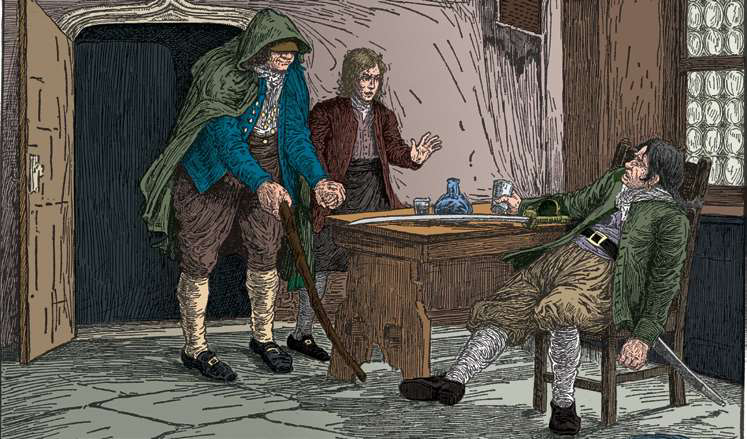
“Now that’s done,” said the blind man. With incredible nimbleness, he scurried out of the inn and back along the road. I could hear his stick tapping as he hurried away.
The captain gazed at the piece of paper the blind man had given him.
“Ten o’clock!” he cried. “That’s six hours from now. We’ll do them yet!” With that, he lurched forward and managed to get to his feet. Then, quite suddenly, he reeled about and put one hand to his throat. For a moment or two, I watched him as he swayed from side to side before crashing to the floor. I hurried to assist him, but it was too late.
My mother descended the stairs and saw the old seaman lying on the floor. I explained to her as best I could what had just happened. After much discussion, we decided we should open the captain’s sea chest and take the money he owed us. First, we had to retrieve the key from the captain.
The captain lay on his back with his eyes open and one arm outstretched. By his hand was the slip of paper, marked with the anticipated black spot. Scrawled on it was the message, “You have till ten tonight.”
I searched the dead man’s pockets, but could not discover the key to the chest.
“Perhaps it’s ’round his neck,” suggested my mother anxiously. I opened up his shirt, and there it was, hanging from a piece of string.
I cut the string with the old captain’s knife, and then my mother and I raced upstairs intent upon opening the captain’s sea chest.
After the fight, what injury did Black Dog have?
According to Dr. Livesey, what ailment struck the captain?
What item did the blind man slip into the captain's palm?