Chapter 4 Questions
star
star
star
star
star
Last updated 4 months ago
5 Nsɛmmisa
What did Captain Smollett think of the apple barrel?
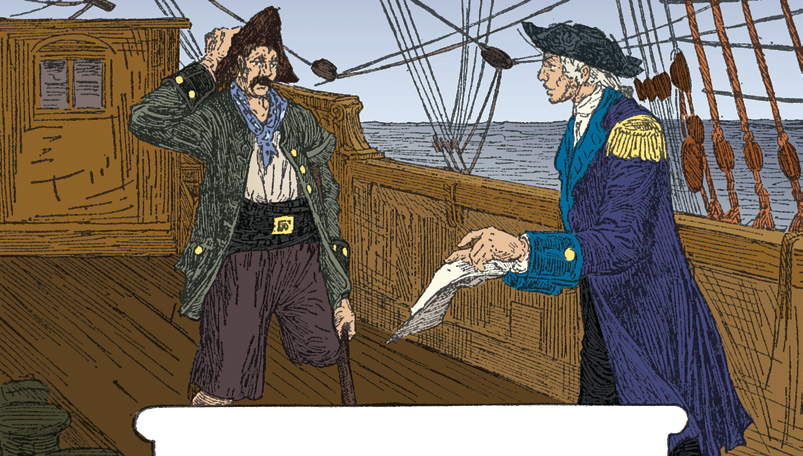
A few leagues out from Bristol we ran into some squalls and heavy weather, but this only confirmed the seaworthiness of the Hispaniola.
As we continued our voyage, every man on board the ship appeared to be cheerful. The old sea cook, John Silver, cooked up delicious grub, and the men were given generous portions. Squire Trelawney had even purchased a large barrel of apples, and it was left open so any of us could help ourselves whenever we felt the urge.
Captain Smollett disapproved of the apple barrel. “No good ever came of that sort of thing,” he said to Dr. Livesey.
Some good did come of the apple barrel though, and I will tell you how it came about.
It was the last day of our outward voyage. After sundown, when my work was done and I was on my way back to my berth, it occurred to me that I would like an apple. I went to the barrel and found there were only a few left, so I had to climb into the barrel to get one.
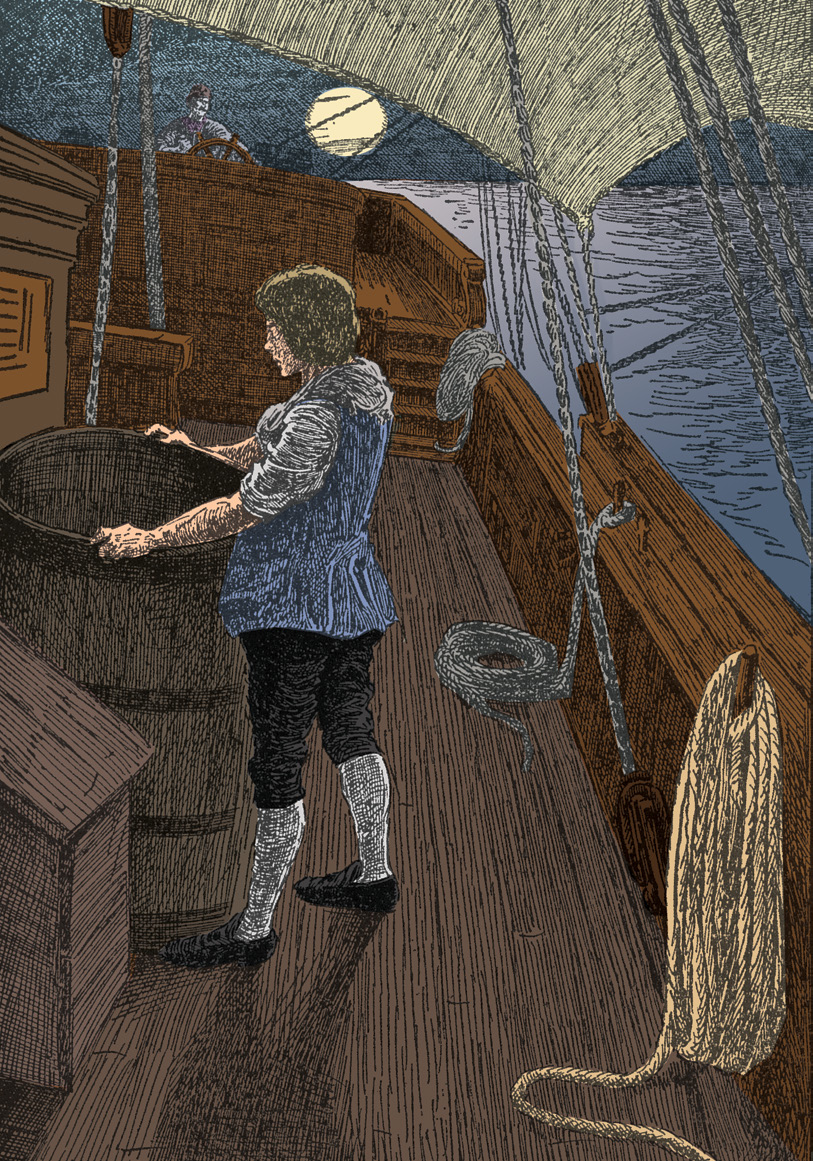
After sundown, when my work was done and I was on my way back to my berth, it occurred to me that I would like an apple.
While I was sitting in the barrel, comparing the quality of two apples, several members of the crew arrived. They were talking, and before I had heard a dozen words, my mood changed to one of fear and anxiety. You see, their conversation revealed that the lives of all the honest men aboard the Hispaniola depended upon me.
“No, not I,” said Silver. “Flint was cap’n and I was part of the crew. I lost my leg on that voyage, and old Pew lost his eyes. But I got my hands on some money, and it’s all safe in the bank. You see, boys, it’s not earning that does it—it’s saving.”
Another seaman mumbled something I could not hear.
“Look here, mate,” Silver said in reply, “you’re young, but you’re as smart as paint, and I’ll talk to you like a man.”
You can imagine how I felt when I heard those words “smart as paint,” as that was what Silver had said about me that day in Bristol! In fact, those were his exact words! I wanted to pounce on him, but he was unaware that I was listening, and he continued to speak.
“Gentlemen of fortune live rough, and they risk death every day,” Silver explained. “But when a cruise is done, they’ve got money in their pockets. Most spend it carelessly, but that’s not the course for me. I put it all away. I’m fifty years old now. Once I get back from this cruise, I’ll set myself up as a gentleman. My missus has gathered up all my money. She’s sold the Spyglass by now, and I’ll meet up with her when I return.”
“Well,” said one of the men named Dick, “I didn’t like this job till I had this talk with you, but now things are startin’ to look up! Here’s my hand on it, John!”
“A brave lad you are!” Silver answered. “And smart, too!”
By this time I understood what was happening. By “gentlemen of fortune,” Silver meant pirates, and he had just convinced another one of the honest men to join the mutiny he was planning.
Silver gave a little whistle and a third man joined them.
“Dick’s square,” said Silver to the newcomer.
“I knew he was no fool!” said the other. “But here’s what I want to know, Barbecue: When will we strike? I’ve had more than enough of Captain Smollett.”
“Listen, Israel,” said Silver. “Keep your eyes peeled till I give the order.”
I concluded that the new arrival must be Israel Hands.
“I don’t say no,” Hands growled, “but I say when?”
“At the last possible moment, that’s when,” replied Silver. “We’ve got a first-rate captain sailing the ship for us, and the squire and the doctor have Flint’s map. We’ll let them find the treasure and haul it onboard. Then we’ll strike.”
“And what will we do with them?” asked Dick.
“Well,” said Silver, “we could leave them on the island, marooned—or we could cut ’em down. That’s what Flint would have done—and Billy Bones, too.”
“Billy was the man for that,” added Hands. “‘Dead men don’t bite,’ he used to say. If ever a rough man came to port, it was Billy Bones!”
“Rough and ready,” said Silver, “and on this point, I agree with him. When I’m a rich man, back in England and riding in my coach, I don’t want these men coming home. We’ll wait, but when the time comes, let her rip! I claim Trelawney. Dick—” he added, breaking off suddenly, “jump up like a sweet lad, and get me an apple to wet my pipe.”
An apple! From the barrel! You can imagine how terrified I was.
I heard Dick getting up. I figured I was as good as dead, but then Hands said, “Nah, let’s have something to drink instead.”
Dick went to fetch the drinks, and Hands and Silver continued talking.
“That’s the last of them,” Hands said. “None of the others will join us.”
This lifted my spirits, for it meant there were at least a few faithful men onboard.
When Dick returned, he and the others drank a series of toasts.
“Here’s to luck!” said Dick.
“Here’s to old Flint!” said Hands.
Just then, the lookout up in the crow’s nest shouted, “Land ahoy!”
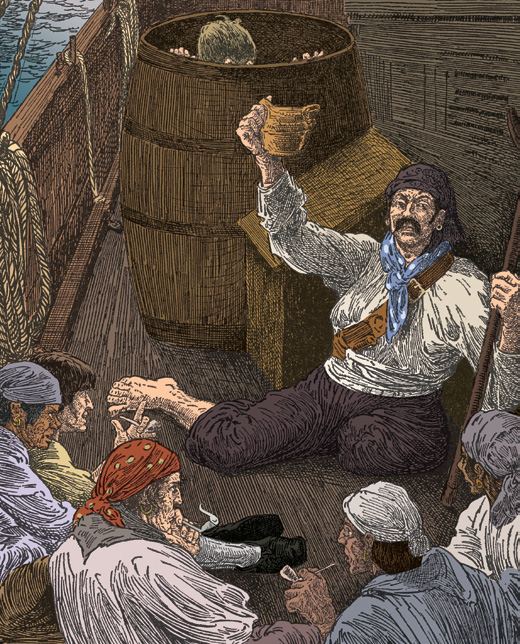
shuffling feet as the mutineers sprinted away. I waited a few seconds, then slipped out of the apple barrel and followed them.
As we drew near the island, Captain Smollett called out, “Men, have any of you ever seen the island ahead?”
“I have, sir,” said Silver. “Once, when I was a ship’s cook, we stopped there for fresh water. Skeleton Island, they calls it. It were a main hideout for pirates once. There are three hills on it, and the big one—the one in the middle there, with its top in the clouds—that’s called the Spyglass, because it’s the perfect place to post a lookout.”
“I have a map here,” said the captain. “Have a look and see if this is the place.”
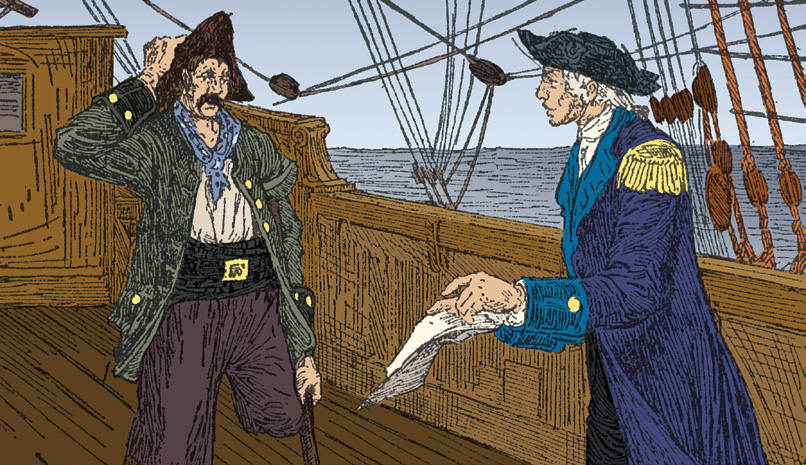
John Silver’s eyes burned with intensity as he took the map, but I could tell it was not the map I had found in Billy Bones’s chest. It was a copy that did not show the location of Flint’s treasure. Silver carefully concealed his disappointment.
“Yes, sir,” he said. “This is the spot—and I believe the best anchorage is right over here in this little cove.”
I was surprised at the coolness with which Silver declared his knowledge of the island. I had, by this time, such a fear of his cruelty and duplicity that I could scarcely conceal a shudder when he called out, “Ahoy there, Jim!” and laid his hand on my shoulder.
“This island is a sweet spot for a lad,” Silver said. “When you want to do a bit of exploring, just ask old John, and I’ll fix up a snack for you to take along.”
After Silver hobbled off, I met with the captain, the doctor, and the squire. I proceeded to tell them everything I had heard. Everyone sat quietly for a few moments until, at last, the squire broke the silence.
“Captain,” he said, “I believe I owe you an apology. You were right, and I was wrong. I await your orders.”
“Well,” said the captain, “I accept your apology, but now I must present to you my opinion of our current predicament. I see three or four important points for our consideration. First, we can’t turn back. If I gave orders to go back, Silver and the others would mutiny at once. Second, we have some time—at least until the treasure’s found. Third, we will come to blows sooner or later. What I propose is that we choose a time to fight when they least expect it. I take it we can count on your servants—Hunter, Joyce, and Redruth—Mr. Trelawney?”
“As upon myself,” declared the squire.
“That’s three honest men,” said the captain. “Ourselves make seven, counting Hawkins here. Now, what about the others?”
“I fancy we can also count on the men Trelawney hired,” said the doctor. “I mean the men he found by himself before Silver intervened.”
“Nay,” replied the squire. “Hands was mine.”
“Well, gentlemen,” said the captain, “we must determine who can be trusted.”
I felt helpless. There were only seven out of twenty-six who were known to be good—and one of those was me, a young boy.
Silver helped the captain guide the Hispaniola to the best anchorage. He knew the passage like the palm of his hand and never hesitated once. Still, there were problems afoot. Discipline had begun to break down. The men were now unfriendly and unwilling to take orders. They seemed to be on the verge of mutiny. Only Silver showed a willingness to obey. When an order was given, he was on his crutch in an instant with a cheery, “Aye, aye, sir!” and, when there was nothing else to do, he sang old sea songs.
The captain called a meeting with our group in his cabin.
“Gentlemen,” he said, “we are in a real pickle here. I believe that if I continue to command this ship, the men will mutiny. If I don’t, Silver will know that something is up. I believe there’s only one thing to do.”
“What’s that?” inquired the squire.
“Leave things to Silver,” the captain replied. “He’s as anxious as we are to cover things up. He doesn’t want the men to mutiny—at least not yet—and I say we give him a chance to talk them out of it. Let’s allow the men to go ashore if they like. Then Silver can talk with them and get them under his control. If they go, you mark my words, Silver will get them back in line. He’ll bring ’em on board again, mild as lambs.”
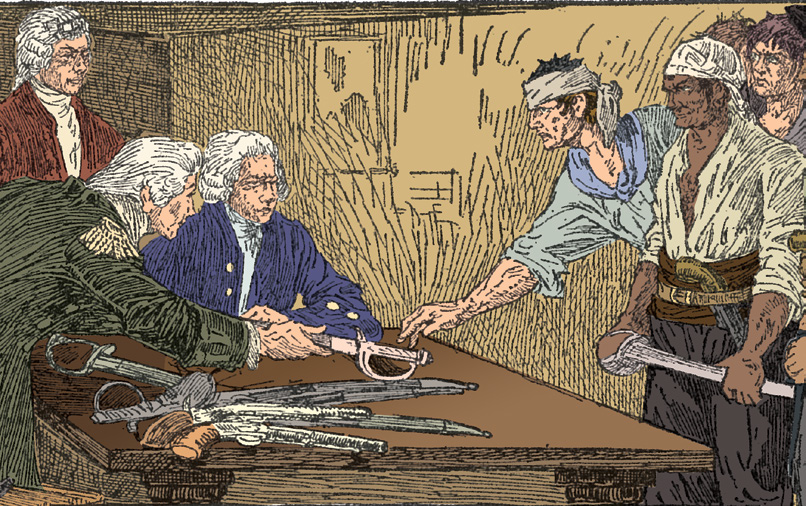
We all agreed this was the best plan. Loaded pistols were served out to all the sure men. The squire’s men—Hunter, Joyce, and Redruth—were taken into our confidence, and received the news with less surprise and better spirits than we anticipated. After the meeting, the captain went on deck and addressed the crew.
“Lads,” said he, “it’s hot, and we’re all tired. As many of you as would like may go ashore for the afternoon. Take the landing boats. I’ll fire a gun to call you back just before sundown.”
The men must have thought they would trip over treasure as soon as they landed, for their spirits seemed to lift in a moment, and they all gave a cheer. The captain whipped out of sight, leaving Silver to arrange the landing party. In a few minutes, the party was assembled. Six of the seamen were to stay on board. The remaining thirteen, including Silver, were to go ashore.
I thought about the numbers: If Silver was leaving six of his men on the Hispaniola, it was plain that our party could not take over the ship. At the same time, if he was leaving only six men, those men would not pose too much of a danger to the loyal hands. The captain and the others would be safe—and they would not need my help. I thought it might be more useful for me to go ashore. So, without debating the question any more, I slipped over the side and curled up in the front of the nearest boat.
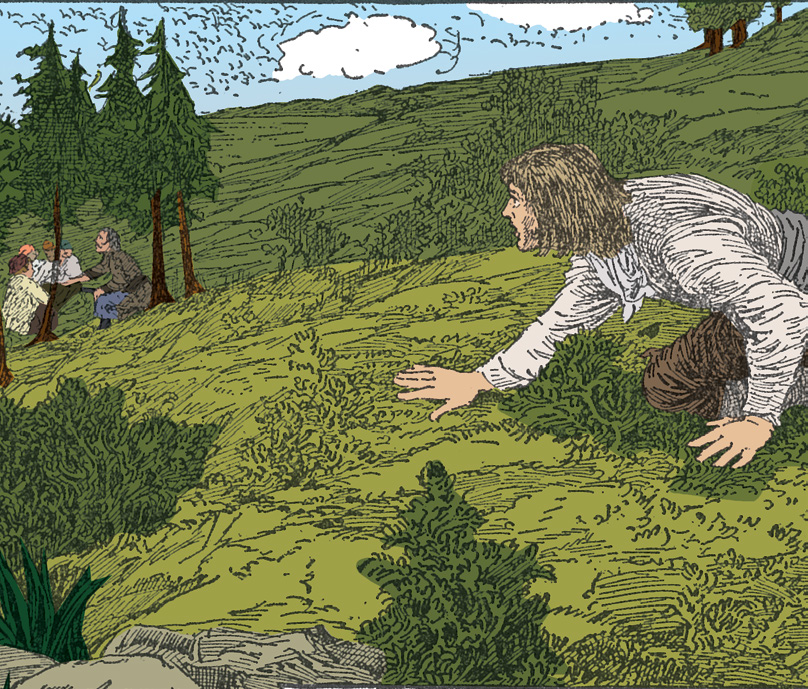
No one in the boat took any notice of me. When we reached the shore, and the men had wandered off, I came out of my hiding place and began to explore the island.
What did John Silver want to do with Captain Smollett and the others?
What did Jim Hawkins decide to do when they reached the island?
Who did Silver convince to join the mutiny?
How did the men feel after Captain Smollett offered shore leave?