Chapter 2 Questions
star
star
star
star
star
Last updated 4 months ago
5 Nsɛmmisa
What did the blind man want to find?
A strong, pungent smell of tobacco and tar rose from the interior of the old sea chest as we opened it. On the top was an elegant suit of clothes, never worn. Under that was a tin, a quadrant, tobacco, a bar of silver, West Indian shells, a Spanish watch, several compasses, and two pistols. At the bottom of the chest lay a bundle wrapped in oilcloth and a canvas bag that gave forth the jingle of coins.
“I pride myself on being an honest woman,” my mother said. “I’ll take what I’m owed and not a farthing more or less.”
She began to count the money into a bag. As she counted, we heard a familiar sound. It was the tap-tapping of the blind man’s stick upon the frozen road. It drew nearer while we held our breath. Then we heard the blind man’s voice, along with several others’.
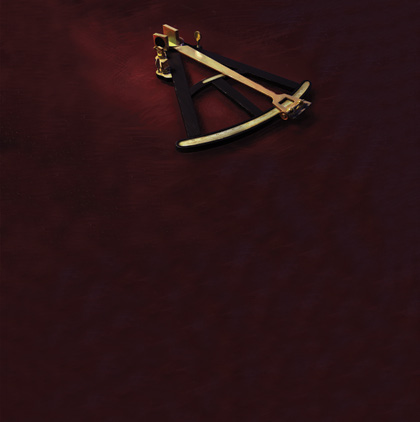
With nothing but sea and sky in sight, sailors in the 1700s used a navigational tool called a quadrant to find their way on the open waters. This quarter-circle shaped instrument measured the angle between the North Star and the horizon, which sailors used to determine their distance north or south of the equator.
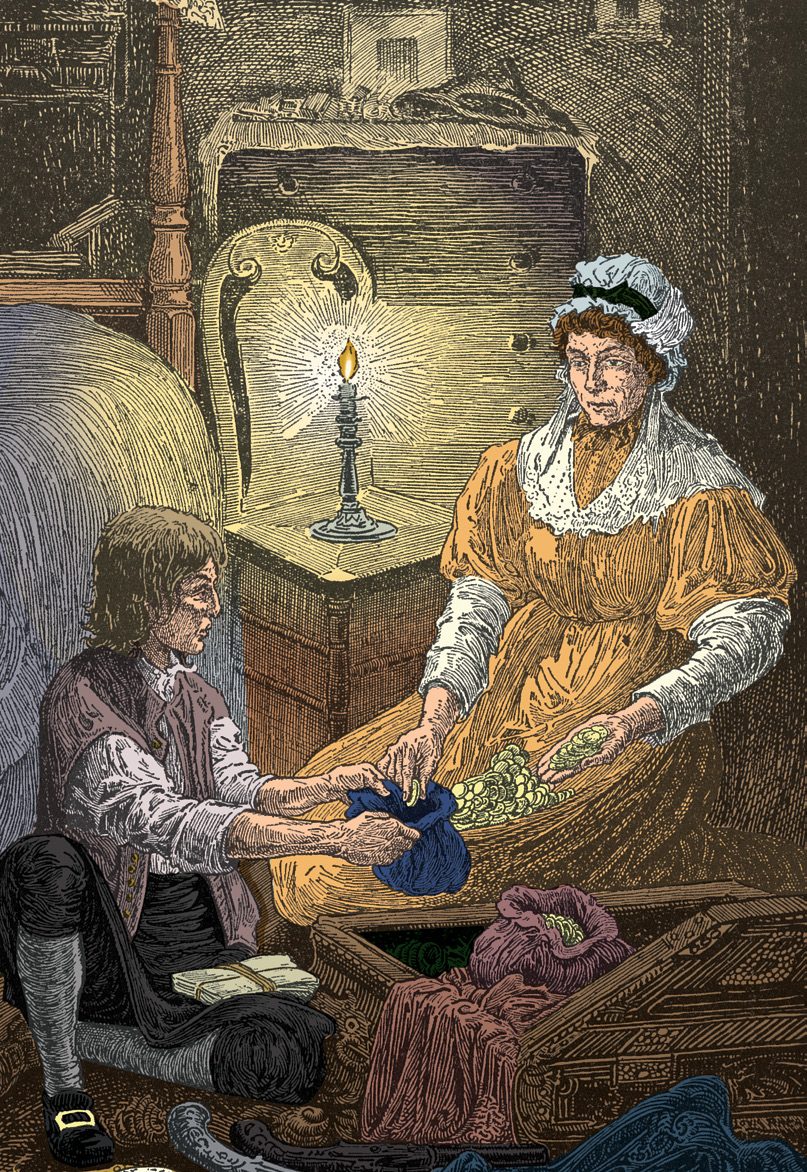
She began to count the money into a bag. As she counted, we heard a familiar sound.
“Mother!” I whispered nervously, “please hurry up!”
“I’ll hold onto what I have so far!” she exclaimed.
“I’ll take this to square the count,” I informed her as I picked up the bundle wrapped in oilcloth. Then we groped our way downstairs, threw open the back door, and ran out into the darkness of night—two desperate souls—unsure of what to do next.
A silvery moon peeped out from behind ominous storm clouds. The moonlight allowed us to glimpse the ditch that lay behind the inn. Without hesitating, we made our way toward it. There we waited, breathing in the cool night air, out of sight but within earshot of the inn.
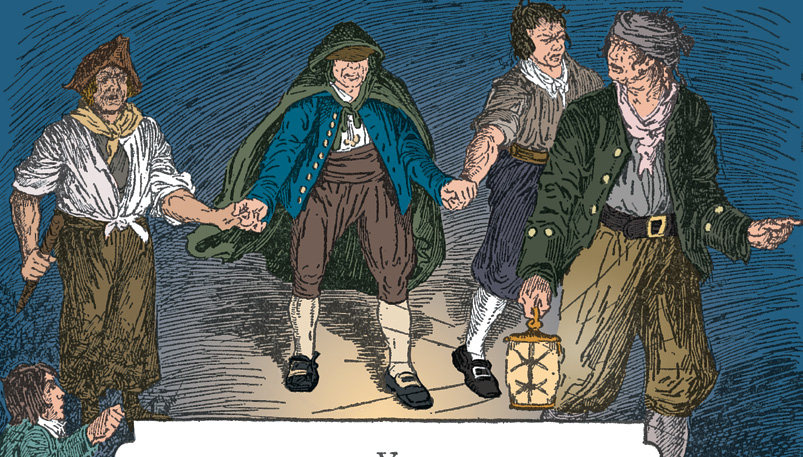
Before long, a number of shadowy figures appeared.
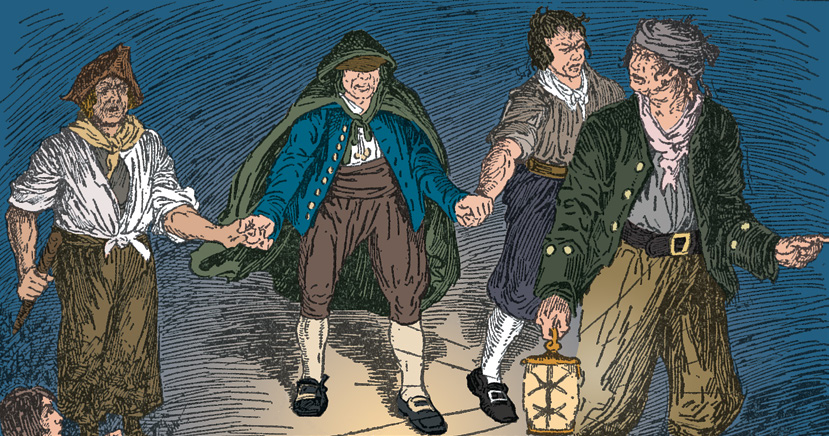
“Inside!” a chilling voice commanded. It was the blind man. “Find him!”
The others scurried forward in the darkness.
A few seconds later we heard a gruff voice call out, “Bill’s dead!”
“Search him!” shrieked the blind man. “Find the key—or you’ll answer to me!”
There was a lengthy pause, and then another cry. “Someone got here before us! The key’s gone!”
“Then find the sea chest and smash it to pieces!” screeched the blind man. The sound of his voice sent a cold shiver running down my spine.
I heard a commotion and the sound of footsteps coming from the upstairs area of the inn. Moments later the window to the captain’s room was flung open. Such force caused the glass to shatter and break. Then a man with a face resembling that of an angry gargoyle leaned out of the window into the moonlight.
“Pew!” he shouted. “It’s like I told ya already. Someone’s been here before us! They rifled through Bill’s chest!”
“Is it there?” Pew roared.
“There’s some money,” said the gargoyle-faced man.
“Forget the money!” Pew spat. “Flint’s map, I mean!”
“It’s nowhere to be found, I tell ya.”
“Blast it!” cried the blind man. “It’s that boy! I should have dealt with him earlier. He was here just a few minutes ago—I know it. Scatter, lads, and hunt the rascal down!”
A great to-do ensued in our old inn. Furniture was thrown about and beds were stripped. Doors were forcefully kicked in until finally the men came out and declared that I was nowhere to be found.
Just then we heard a whistle in the darkness. I guessed it was some sort of signal. The men had left a guard, and he was warning them of impending danger.
“There’s Dirk,” one of them pronounced. “We’ll have to scarper, and quick, mates!”
Pew, however, attempted to convince the others to hold their ground and not flee like scalded rats.
“The boy can’t have gone far,” he urged desperately. “That rascal was here no more than a few minutes ago. Scatter and look for him, you lily-livered cowards! Oh, if I had my eyes, what I wouldn’t do right now!”
Two of the men obeyed Pew and began to search around the exterior of the inn, but the others stood in the road, unsure of their next move. Pew sensed the men’s confusion.
“Get to it!” he yelled. “If we find what we came for, we’ll all be as rich as kings. Don’t stand there skulking! If you had the pluck of a weevil in a biscuit, you would catch him.”
“Hang it, Pew!” grumbled one of the men. “Don’t you think we should take the money and run?”
“He could be anywhere hereabouts,” moaned another. “Let’s call it a day and run before we get caught!”
Pew’s anger escalated and he began swinging his walking stick. He struck at the others right and left in his blindness. They, in turn, cursed the blind man, threatened him in horrid terms, and tried in vain to catch his stick and take it from him.
This quarrel saved us. For while it was raging, another sound came from the top of the nearby hill—galloping horses. A pistol shot came from the hedge. That must have been the final signal warning the men of serious danger, for they scattered like rabbits in every direction. In half a minute, only Pew remained.
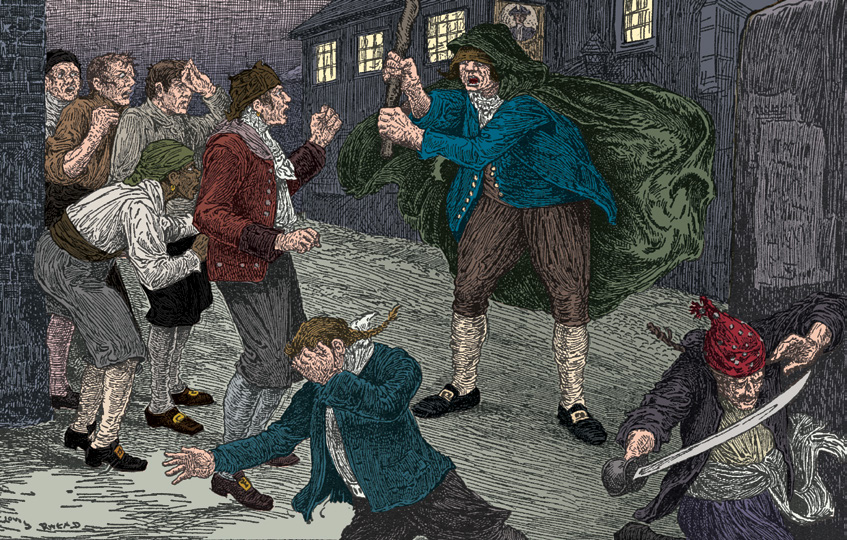
He tapped up and down the road in a frenzy, calling out to his comrades.
“Johnny!” he shouted. “Black Dog! Dirk! Don’t leave old Pew here without eyes to guide him!”
At that moment, five riders swept down the hill at full gallop. Pew sensed he was in their path and cried out, but it was too late. One of the horses knocked him to the ground, and another trampled over him. Pew made one last gasp and then lay silent on the ground. I saw that the horsemen were actually officers. One of them dismounted and checked on Pew, but there was nothing to be done.
I jumped up out of the ditch, and after conversing with the officers and calming my mother, I made my way to Dr. Livesey’s home.
I found Dr. Livesey dining with Squire Trelawney. I told them everything that had happened and showed them the bundle I had retrieved from the sea chest. At first they were stunned and rather silent, but eventually they were able to think clearly, and we began to converse.
“Have you heard of this Captain Flint?” Dr. Livesey asked Squire Trelawney.
“Heard of him!” the squire cried. “Of course I have! Why, John Flint was the bloodthirstiest pirate that ever flew the Jolly Roger. In fact, Blackbeard was a child compared to Flint!”
“Well,” said the doctor, “suppose this packet tells us where the old buccaneer hid his treasure. What would you do then, may I ask?”
“I would fit out a sailing ship in Bristol,” the squire declared confidently. “I’d take you and Jim Hawkins along, and I would find that treasure, even if I had to search for an entire year!”
With that said, the doctor cut the bundle open. It contained two things: a book and a sealed paper. Printed on the first page of the book were the words: Billy Bones, his account. The next twenty pages were filled with dates, sums of money, and little crosses. One line read, “June 12th, 1745, seventy pounds, off Caracas.” Next to this entry were six tiny crosses.
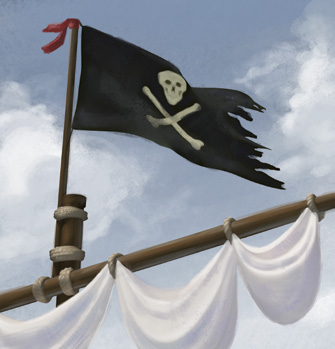
When merchant ship sailors saw the Jolly Roger’s skull and crossbones flying over a pirate ship, they knew they faced a strong set of armed buccaneers. The symbol struck such fear that oftentimes merchant ships immediately surrendered their goods in exchange for their lives. Not all ships flew exactly the same variation, and powerful pirate captains became infamous, identified by their customized flags.
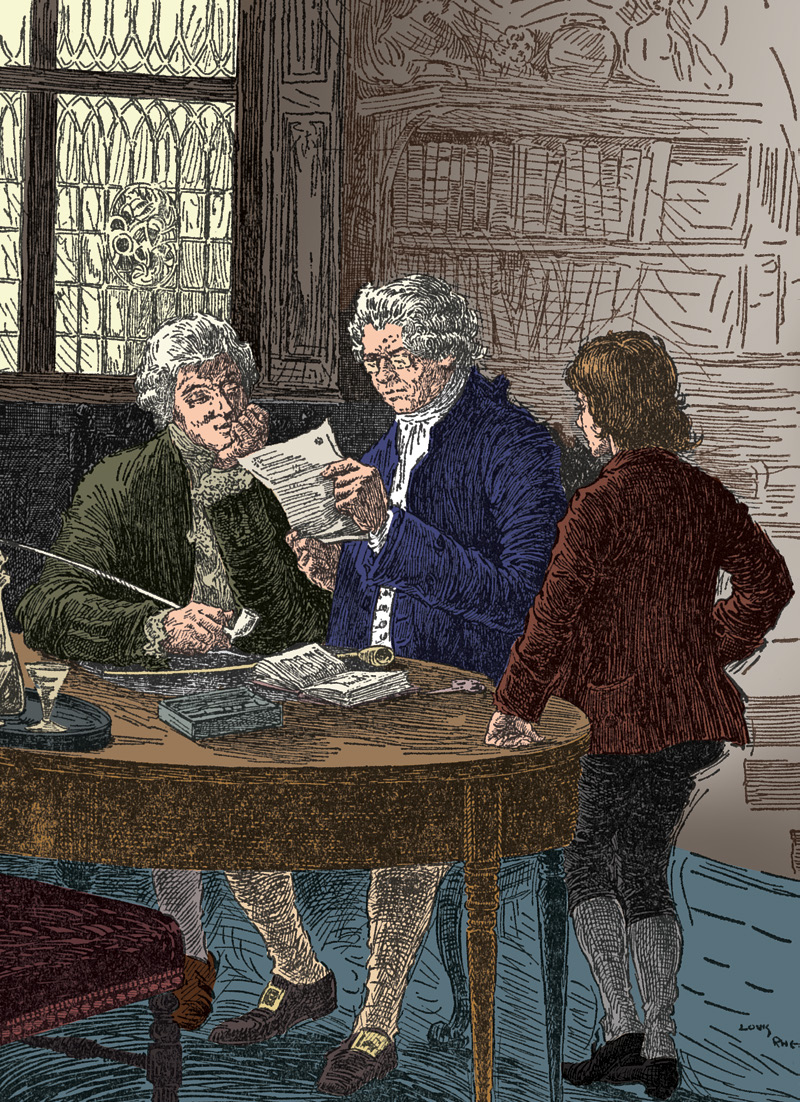
With that said, the doctor cut the bundle open. It contained two things: a book and a sealed paper.
“What does it mean?” I asked.
“This is the old captain’s account book,” said the squire. “This entry tells us that the pirates got seventy pounds of loot after they attacked a ship off the coast of Caracas on the Spanish Main.”
Next, we inspected the sealed paper. The doctor opened it carefully, and a map fell to the floor. It was a map of an island, labeled with latitude and longitude, water depths, names of hills, bays, and inlets, and all the details needed to bring a ship safely to anchorage upon its shores.
It seemed to me that the island was shaped like a portly dragon. From the map, we could see that the island was about nine miles long and five wide. It had two harbors, and there was a large hill in the center marked ‘Spyglass’.
Several things had been added to the map in red ink. There were three crosses—two on the north part of the island and one in the southwest. Next to one of these, written in a small, neat hand, very different from the captain’s, were the words: Bulk of treasure here.
On the back of the map, in the same hand, we read:
Tall tree, Spyglass shoulder, bearing a point to the N. of N.N.E. Skeleton Island E.S.E. and by E. Ten feet. The bar silver is in the north cache. Find it by the trend of the east hummock, ten fathoms south of the crag with the face on it. The arms are in the sand hill, N. point of north inlet cape, bearing E. and a quarter N. —J.F.
It did not make much sense to me, but the squire was delighted.
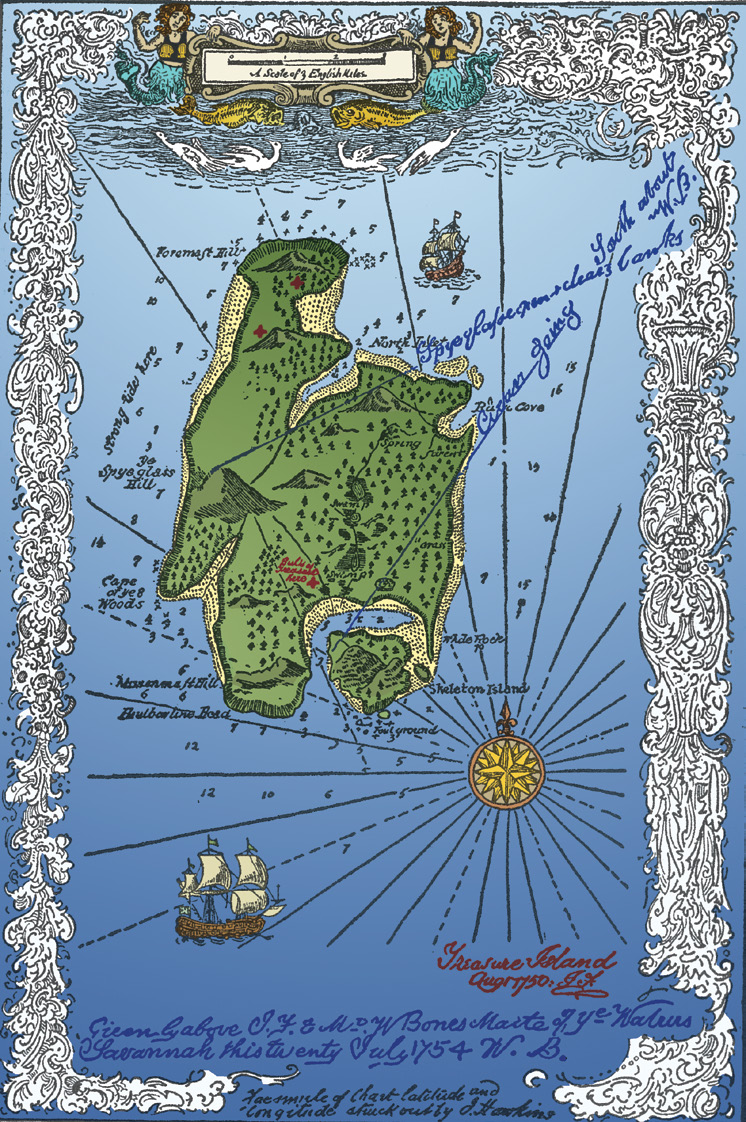
Several things had been added to the map in red ink.
“Tomorrow I’ll set off for Bristol,” he effused. “In ten days we’ll have the best ship and crew in England. Hawkins shall come with us as cabin boy. You, Livesey, will be the ship’s doctor, and I will be the admiral.
“We’ll have no difficulty in finding the spot, and we’ll have money to roll in ever after!”
“I’ll accompany you,” said the doctor. “And I hope Jim will, too. There’s only one man who concerns me.”
“Name the dog, sir!” cried the squire.
“You!” replied the doctor. “You cannot hold your tongue. Those fellows who ransacked the inn tonight are looking for this map—and for Flint’s treasure. We have to be extremely careful. You go to Bristol and take my two loyal servants, Joyce and Hunter, with you. Remember, do not breathe a word of what we’ve found.”
“Quite right!” said the squire. “You can rely on me to be as silent as the grave!”
So the squire, along with Joyce and Hunter, set off for Bristol. I stayed on at the hall with the squire’s gamekeeper, old Redruth. After a couple of weeks, Dr. Livesey received a letter from the squire.
Dear Livesey,
The ship lies at anchor, ready for sea. You never saw a sweeter schooner. Her name is the Hispaniola. I acquired her through my old friend Blandly.
At first, finding a crew troubled me. I wanted twenty men, and I had difficulty finding half a dozen, but then fortune brought me the man I required. I fell into talk with him on the dock. He keeps a tavern, and I found he knew all the seafaring men in Bristol. It seems he lost his health ashore, and was hoping to secure a position as a cook at sea. He had hobbled down there that morning, he said, to enjoy the salty sea air. I was touched by his story and engaged him on the spot to be the ship’s cook. Long John Silver he is called. He has lost a leg in his country’s service.
Between Long John Silver and myself we got together a fine company of seamen. Silver even got rid of two men I had already engaged. He explained that they were just the type of men we needed to avoid for an adventure of this importance.
I am in magnificent health and spirits, eating like a bull, sleeping like a tree. Yet I am eager to lift anchor. So do come quickly.
John Trelawney
P.S. My old friend Blandly has agreed to send another ship after us if we don’t turn up by the end of August. He found an admirable fellow for captain—a stiff man, but, in all other respects, a treasure. Long John Silver has unearthed a very competent mate.
What was inside the sea chest?
What did sailors use the quadrant for?
Who recognized Captain Flint's name?
What did the characters smell when they opened the sea chest?