Ɛhia
1
Ɛhia
1
Ɛhia
1
Ɛhia
1
Ɛhia
1
Ɛhia
1
Ɛhia
1
Ɛhia
1
Ɛhia
1
Ɛhia
1
Ɛhia
1
Ɛhia
1
Section 3: Special Right Triangles
Special right triangles have fixed side ratios.
If each leg is
Side ratio:
If the short leg (opposite
long leg (opposite
hypotenuse is
Side ratio:
Strategy: Identify the triangle type, choose
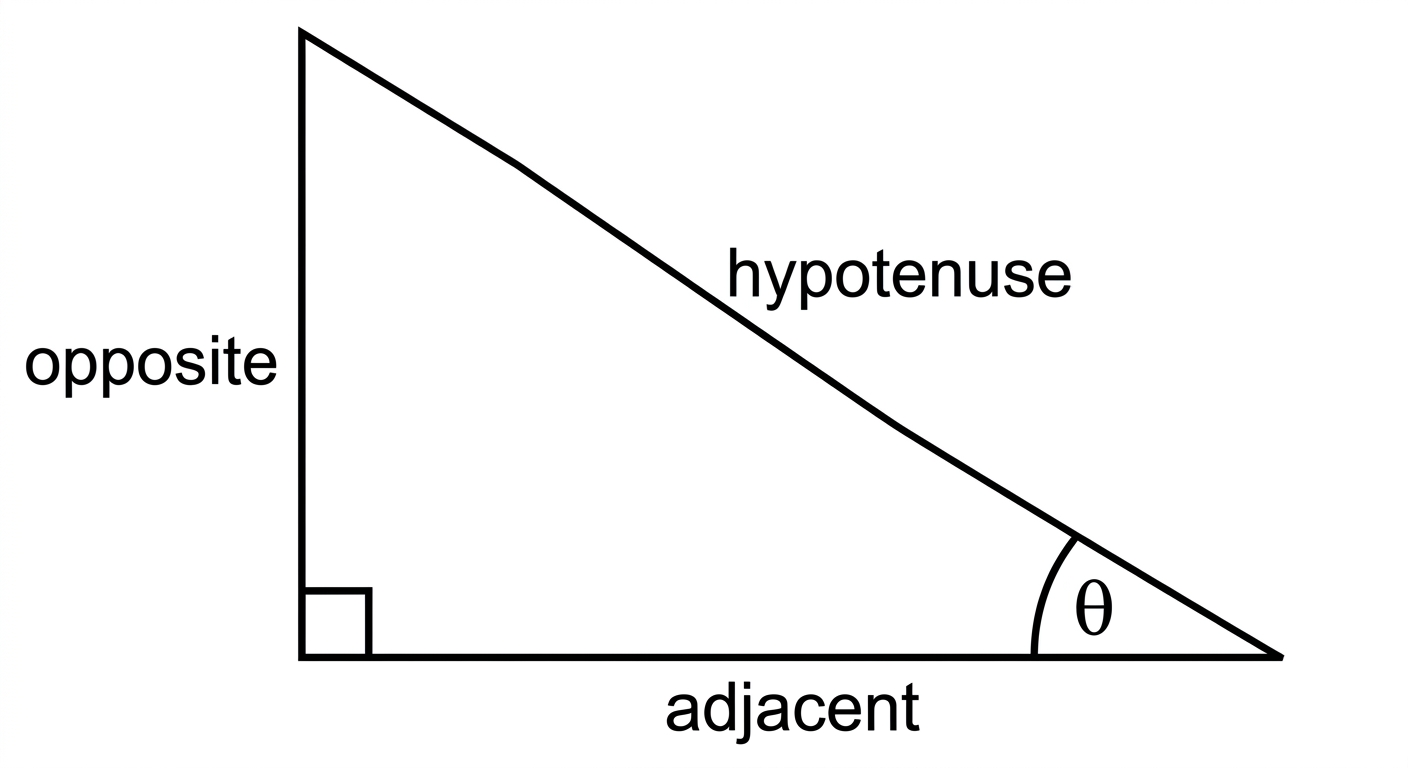
Use the triangle diagram above.
The hypotenuse is always opposite the right angle.
With respect to angle
opposite is across from
adjacent is next to
Then choose the correct trig ratio or solve for the missing value.
(See the triangle diagram above.)
The hypotenuse is always opposite the right angle.
The names opposite/adjacent depend on the angle you’re using.
In this diagram, the reference angle is θ.
Opposite is across from θ.
Adjacent touches θ but is not the hypotenuse.
sin(θ) = opposite / hypotenuse
cos(θ) = adjacent / hypotenuse
tan(θ) = opposite / adjacent
If opposite = 9 and hypotenuse = 15, then:
sin(θ) = opposite/hypotenuse = 9/15
Simplify by dividing by 3: sin(θ) = 3/5
Error analysis: A student wrote
Welcome to the awesome world of right triangles!
A right triangle has one
The Pythagorean Theorem
In any right triangle with legs
Worked example (find the hypotenuse): A right triangle has legs
Write the theorem:
Square and add:
Square root:
Tip: The hypotenuse is always the longest side and is opposite the right angle.
What does the hypotenuse refer to in a right triangle?
Using the Pythagorean Theorem, if one leg of a right triangle measures
If you are faced with a triangle having a
The Pythagorean Theorem can be used to find the distance between two points on a coordinate plane if represented as a right triangle.
Section 2 Notes: Trigonometric Ratios in Right Triangles
1) Vocabulary (depends on your chosen angle)
Hypotenuse: the longest side, always opposite the right angle.
Opposite (to
Adjacent (to
2) The three trig ratios (SOH–CAH–TOA)
3) How to choose the right ratio (quick checklist)
Circle the given angle
Label opposite/adjacent/hypotenuse.
Decide what you need (a side length or an angle).
Pick the ratio that uses the sides you have and the side you need.
4) Solving for a missing side
Write an equation using the correct ratio.
Substitute values.
Solve (use a calculator when needed).
Round to the nearest tenth unless directions say otherwise.
5) Solving for a missing angle (inverse trig)
If you know a ratio value, use inverse trig buttons on your calculator:
Round angles to the nearest degree unless directions say otherwise.
6) Common mistakes to avoid
Mixing up opposite vs. adjacent (they change when
Using the wrong ratio (check which sides are in the fraction).
Forgetting to round when asked.
In a right triangle, the side adjacent to
A person stands
Which expression correctly represents
A ladder is
In a right triangle,
Which expression correctly represents
In a right triangle, the side adjacent to
In a right triangle,
A person stands
A ladder is
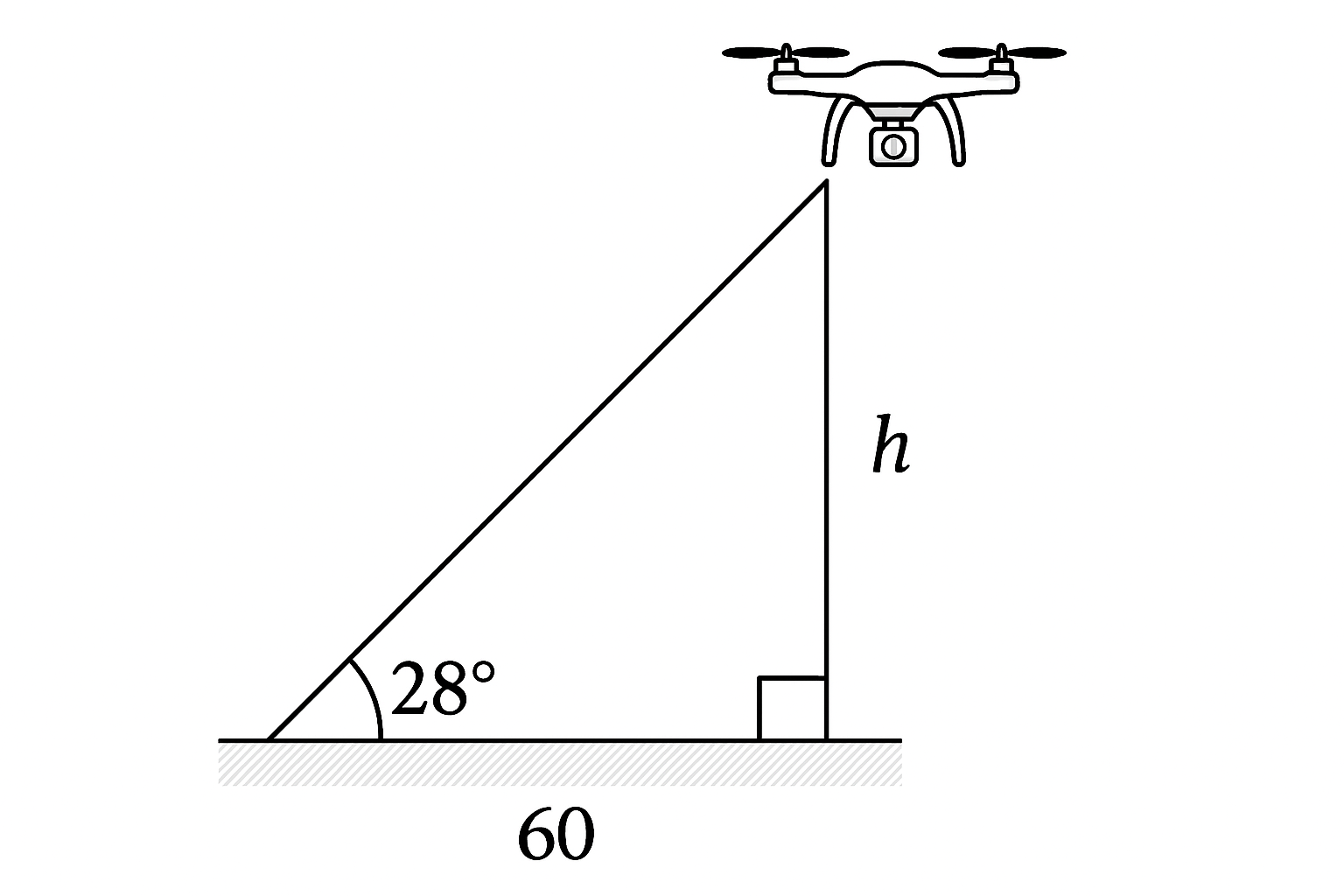
Which trig equation could you use to find the drone’s height
Find the height
Section 3 Notes: Special Right Triangles
Why they’re “special”
Two right-triangle angle sets create fixed side ratios. If you know one side, you can find the others by scaling.
45-45-90 triangle
Two equal angles means the legs are equal.
If each leg is
Ratio (leg : leg : hypotenuse) is
30-60-90 triangle
Short leg is opposite
Long leg is opposite
If short leg is
Ratio (short : long : hypotenuse) is
Worked example (30-60-90)
A 30-60-90 triangle has hypotenuse
In a 30-60-90, hypotenuse
So
Short leg
Long leg
How to use the ratios (every time)
Identify the triangle type from the angles.
Identify which side is short/long/hypotenuse.
Write what you know as a multiple of
Scale the other sides using the same factor.
Common mistake
Mixing up short vs. long leg in a 30-60-90 triangle.
In a
A
In a
Match each special right triangle to its side-length ratio or rule.
| Draggable item | arrow_right_alt | Corresponding Item |
|---|---|---|
30-60-90 triangle | arrow_right_alt | Leg : Leg : Hypotenuse = 1 : 1 : \sqrt{2} |
45-45-90 triangle | arrow_right_alt | Short : Long : Hypotenuse = 1 : \sqrt{3} : 2 |
In a
Which set of side lengths matches a
If adjacent =
If opposite =
Which expression equals