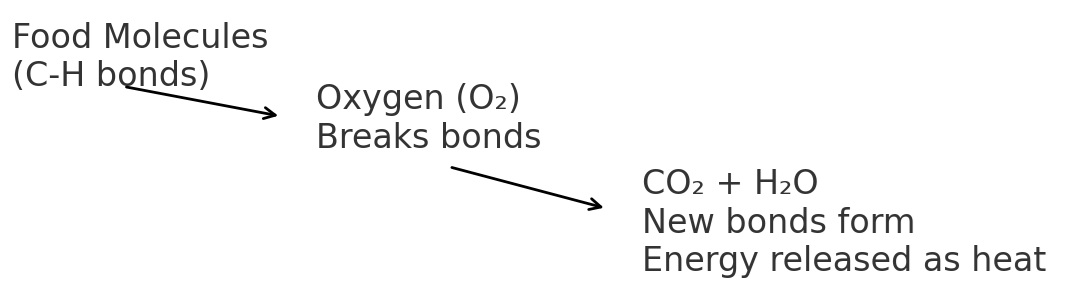
Why Compost Heats Up
Diagram 1.
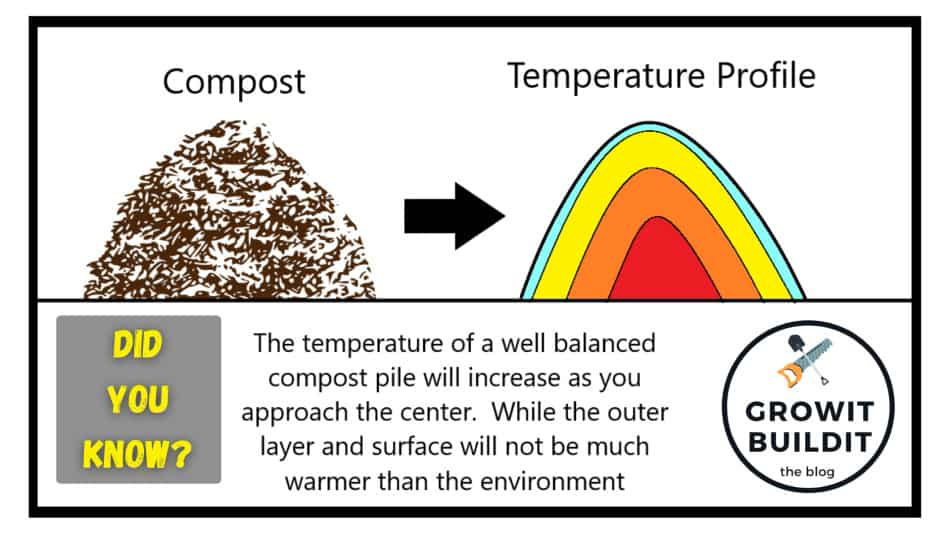 Source:
https://growitbuildit.com/time-for-hot-compost/
A compost pile may look like a simple heap of food scraps and yard waste, but inside it functions as a dynamic biological reactor. Billions of bacteria and fungi rapidly break down organic matter, and in doing so, they release large amounts of heat. This temperature rise is a direct result of aerobic cellular respiration, the chemical process by which microorganisms extract energy from food molecules.
In aerobic respiration, microbes break the chemical bonds in carbohydrates, fats, and proteins. These foods contain many carbon–hydrogen $\text{C–H}$ and carbon–carbon $\text{C–C}$ bonds that store chemical energy. When microbes consume these molecules, enzymes break these bonds, releasing electrons that carry energy. Oxygen plays a critical role in this process: it acts as the final electron acceptor in the electron transport chain, allowing new bonds to form in water $\text{H}_2\text{O}$. Meanwhile, carbon atoms from food molecules bond with oxygen to form carbon dioxide $\text{CO}_2$. These newly formed bonds are lower in energy, and the difference between the energy stored in the original food molecules and the products is released - mostly as heat.
This is why compost piles get warm. During the “active heating” phase of composting, microbial populations explode, and oxygen intake and food breakdown increase sharply. As more bonds are broken in food molecules and new bonds form in $\text{CO}_2$ and $\text{H}_2\text{O}$, more energy is released. This can drive temperatures well above $60^\circ\text{C}$ $140^\circ\text{F}$, which helps sterilize the compost by killing harmful pathogens.
When oxygen levels are high and organic material is plentiful, aerobic respiration dominates. As oxygen becomes limited or easily degradable materials are consumed, respiration slows. The temperature gradually drops during the “cooling” and “curing” stages, reflecting decreased microbial activity and fewer bond-breaking reactions.
Table 1.
Day | Compost Temperature ($^\circ \mathrm{C}$) | O$_2$ Consumption (mg O$_2$/kg/hr) |
|---|
1 | 22 | 12 |
3 | 38 | 28 |
5 | 52 | 47 |
7 | 63 | 65 |
10 | 58 | 54 |
14 | 50 | 42 |
Graph of Information - Figure 1.
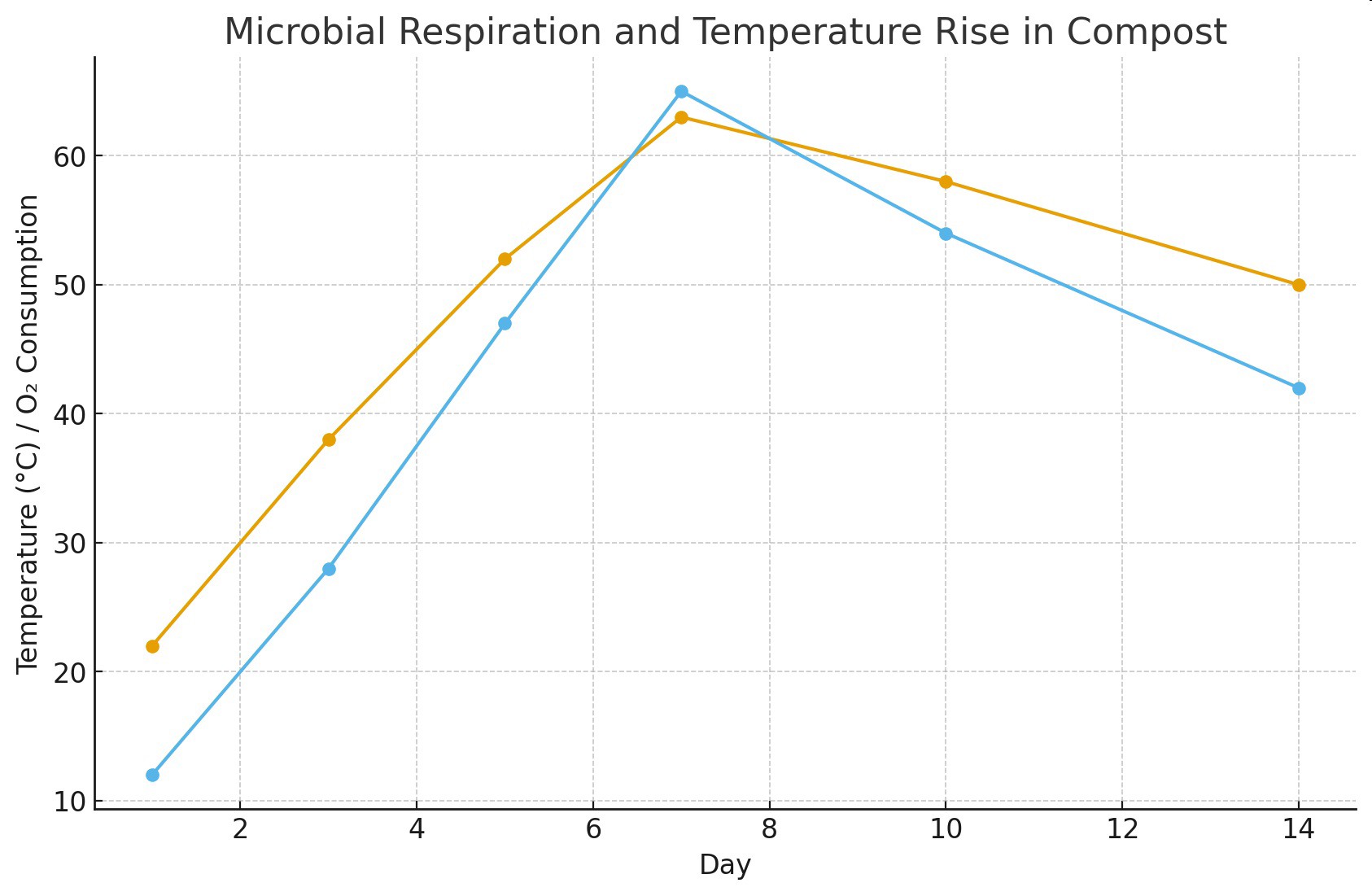
Table 2.
Decomposition Stage | CO$_2$ Production (g CO$_2$/day) | Heat Energy (kJ/day) |
|---|
Initial | 3.2 | 45 |
Active Heating | 12.5 | 165 |
Peak Thermophilic | 18.7 | 260 |
Cooling | 10.3 | 145 |
Curing | 4.8 | 60 |
Graph of Information - Figure 2.
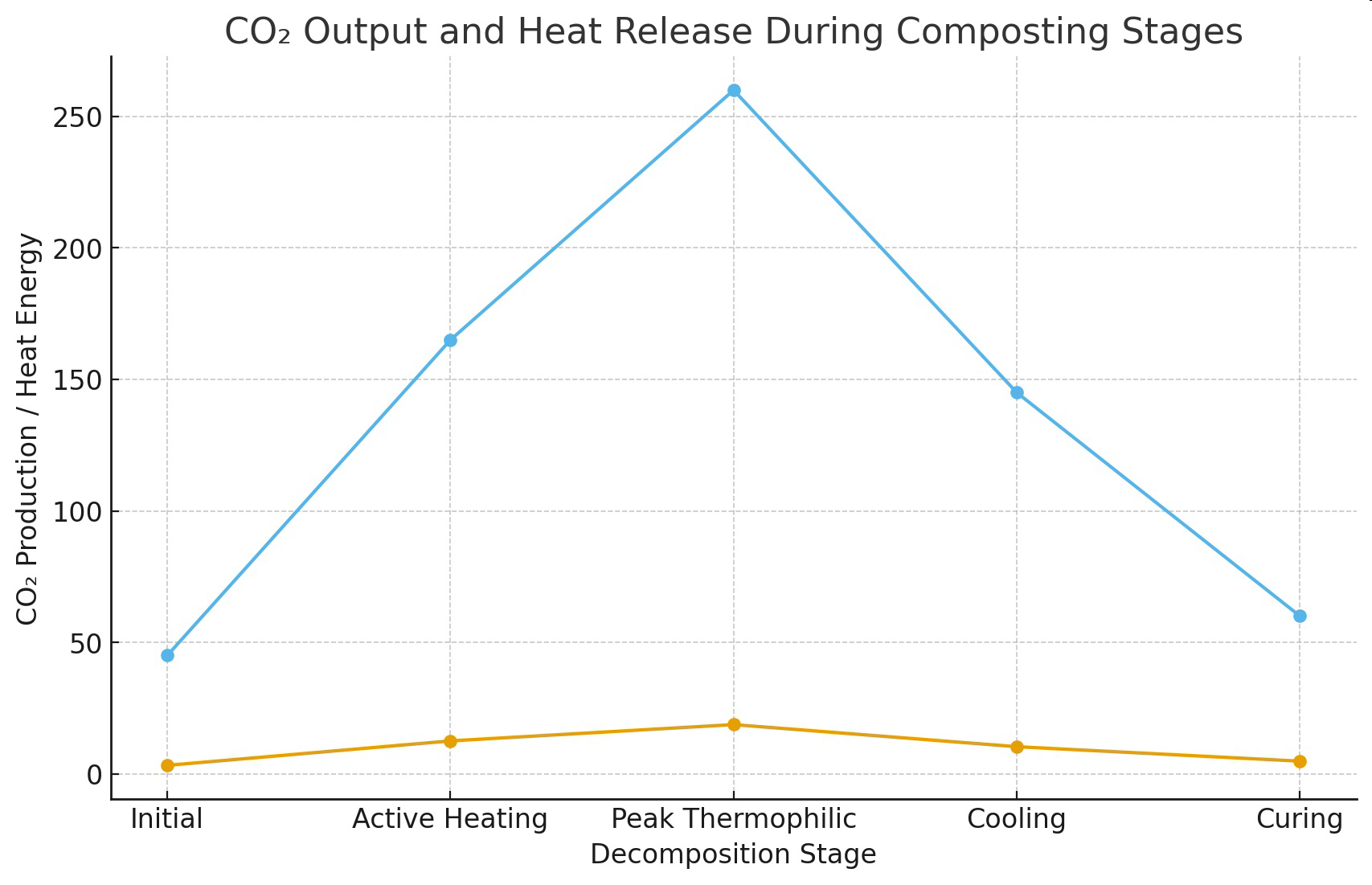
Diagram 2.