Competition for Limited Resources in Finch Populations
Diagram 1.
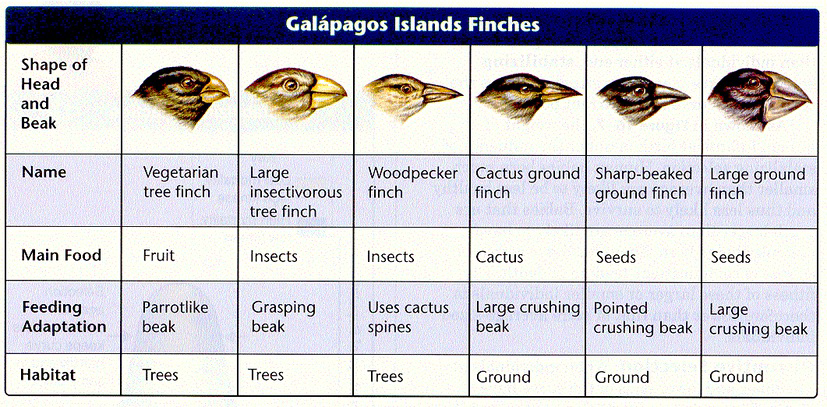
Finch populations on island ecosystems provide powerful evidence for how evolution is driven by interactions among genetic variation, reproduction, and competition for limited resources. On many islands, finches rely heavily on seeds as their primary food source. However, the availability and hardness of seeds vary dramatically across seasons and from year to year. These fluctuating conditions highlight how organisms with certain traits are more likely to survive, reproduce, and pass their traits to the next generation.
First, finch populations have the potential to increase rapidly. A single breeding pair can produce several offspring each season. However, resources—especially seeds—are limited. During drought years, only a small fraction of hatchlings survive. This contrast between potential population growth and actual survival sets the stage for natural selection.
Second, finches display heritable genetic variation in beak traits. Beak strength and depth are influenced by multiple genes, producing a continuous range of values within the population. Some birds naturally have stronger, deeper beaks that are better suited to cracking hard seeds, while others have weaker or shallower beaks better suited for soft seeds. These differences arise through genetic recombination during sexual reproduction and rare mutations that introduce new variation.
Third, competition becomes intense during periods when softer seeds are exhausted and only hard seeds remain. Birds with insufficient beak strength struggle to feed and are less likely to survive. Birds with stronger beaks obtain more food, maintain better body condition, and have a higher probability of reproducing successfully.
Fourth, over time, the proliferation of advantageous traits becomes visible in the population. When researchers measure the distribution of beak strengths before and after several harsh seasons, they often observe an increase in the average beak strength. Birds with traits suited to the environment survive at higher rates and pass on their alleles, causing a measurable evolutionary shift.
Researchers frequently collect large datasets documenting beak depth, beak strength, and survival rates across generations. By analyzing these patterns statistically, it becomes clear how genetic variation interacts with environmental pressure. Strong-beaked finches survive drought years more often, shifting trait frequencies in the population.
This phenomenon demonstrates the four key drivers of evolutionary change: reproductive potential, genetic variation, resource competition, and differential survival. Finch populations show how these factors work together to shape the distribution of traits and how evolution proceeds through the success of individuals who are better adapted to their environment.
Diagram 2.
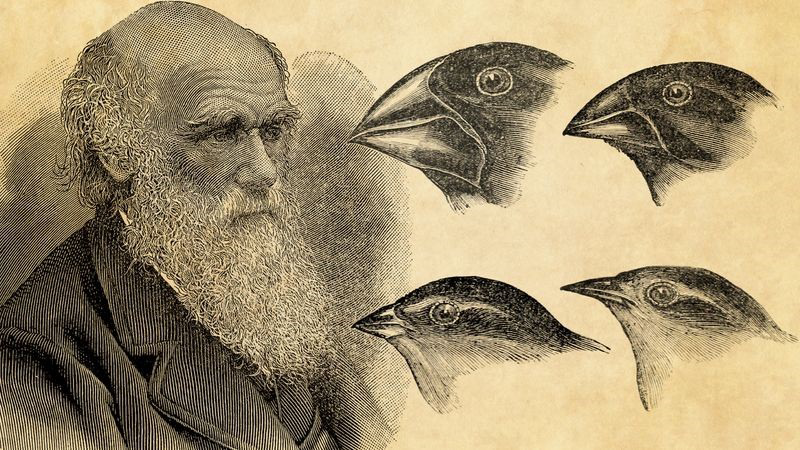
Source:
https://www.iasgyan.in/daily-current-affairs/charles-darwins-theory-of-evolution
Table 1.
Trait Variant | Seed-Cracking Efficiency (%) | Survival Under Scarcity (%) |
|---|
Large Beak | 85 | 78 |
Medium Beak | 60 | 52 |
Small Beak | 30 | 20 |
Graph of Information - Figure 1.
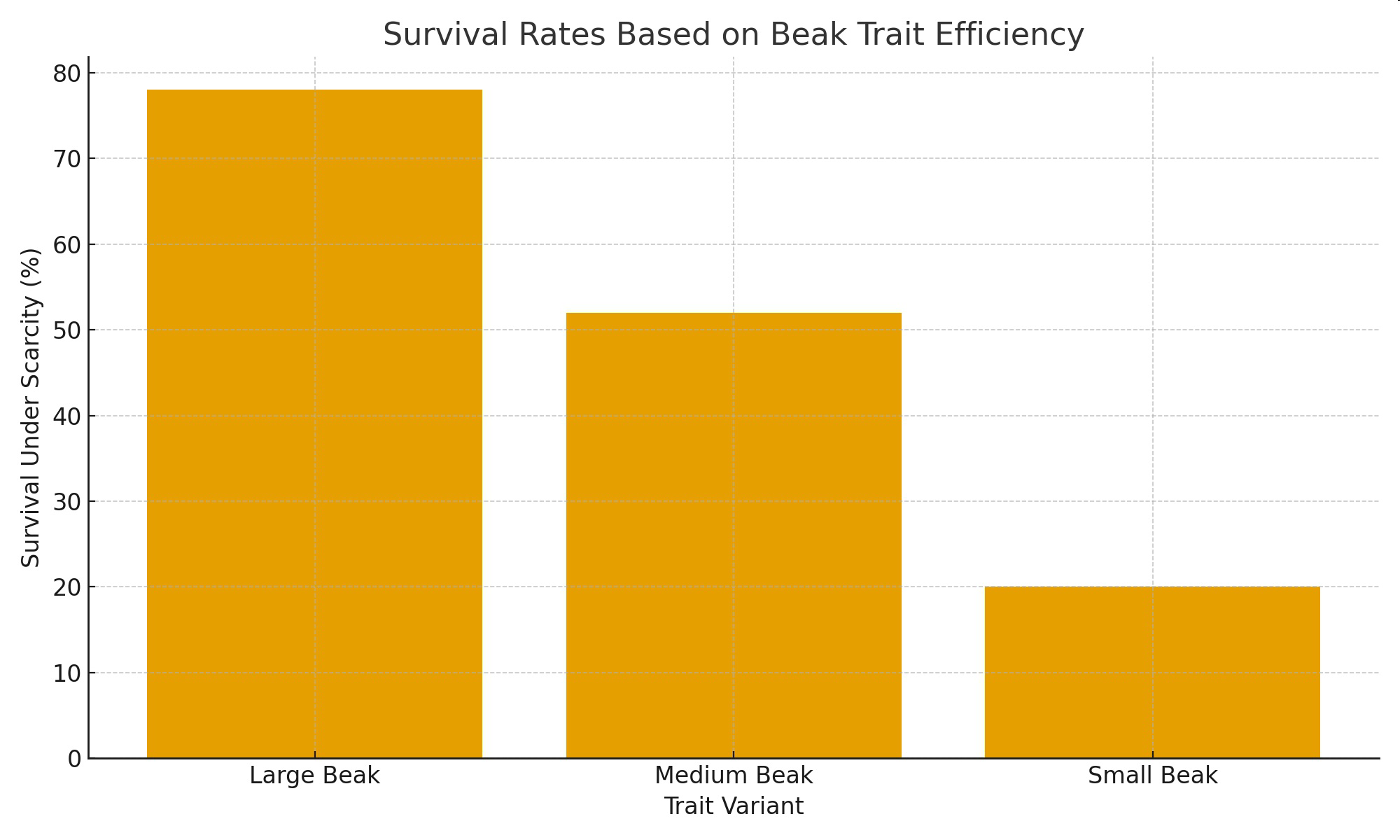
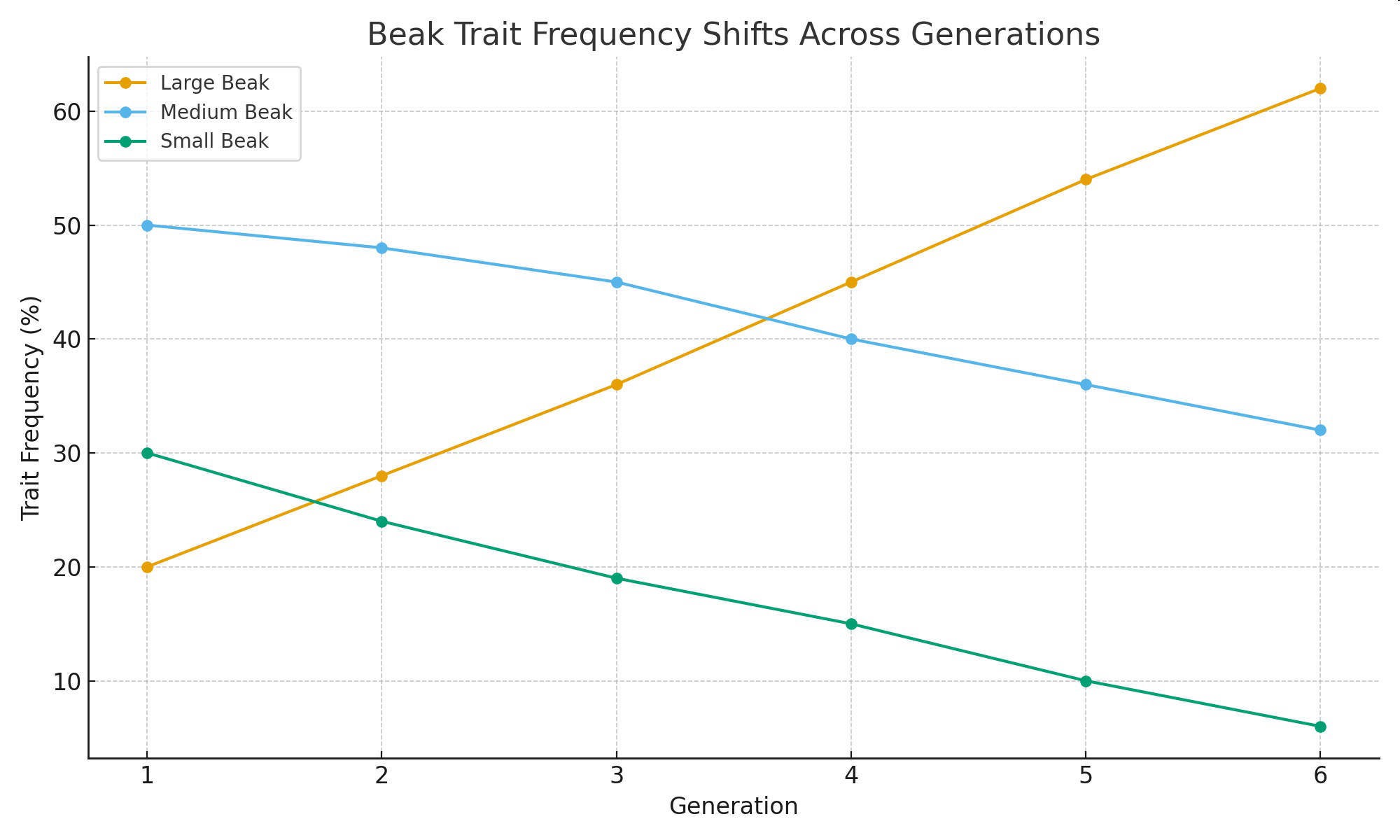
Table 2.
Generation | Large Beak Frequency (%) | Medium Beak Frequency (%) | Small Beak Frequency (%) |
|---|
1 | 20 | 50 | 30 |
2 | 28 | 48 | 24 |
3 | 36 | 45 | 19 |
4 | 45 | 40 | 15 |
5 | 54 | 36 | 10 |
6 | 62 | 32 | 6 |
Graph of Information - Figure 2.