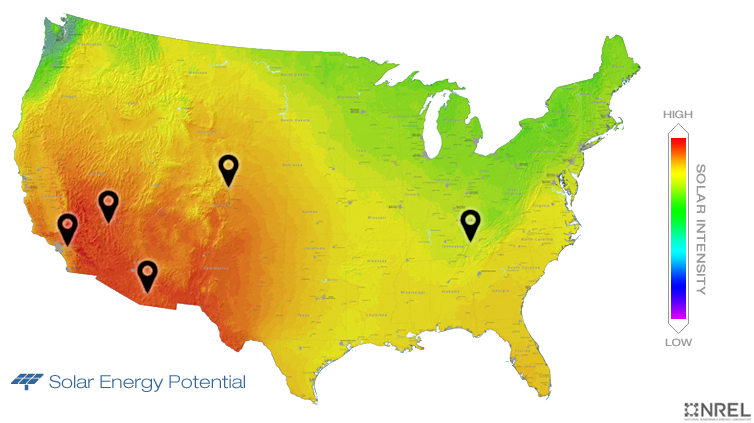
Predict: What city marked on the map of the USA has the most potential to generate solar power? Which city has the least?
Mmuae Afoforo a Wobɛpaw:
most potential
least potential
Learning Targets
Analyze data to understand which renewable resources work best in different locations
Design an energy system that meets a city's power needs while considering budget constraints, environmental impact, and efficiency.
Success Criteria
Identify and explain why areas have the most/least solar, wind, geothermal, and biomass potential.
Decide which renewable technologies to use based on priorities and data.
Learning Targets
Analyze data to understand which renewable resources work best in different locations
Design an energy system that meets a city's power needs while considering budget constraints, environmental impact, and efficiency.
Success Criteria
Identify and explain why areas have the most/least solar, wind, geothermal, and biomass potential.
Decide which renewable technologies to use based on priorities and data.
What is energy?
Energy exists in different forms. We can energy from one form to another. It can be generated by sources such as solar, wind, geothermal, and biomass, and sources such as oil, coal, and natural gas. The law of tells us that energy cannot be created or destoyed. It can only change forms.
convert
renewable
conservation of energy
nonrenewable
Match the each energy source to the correct description.
| Draggable item | arrow_right_alt | Corresponding Item |
|---|---|---|
Wind | arrow_right_alt | Captures the sun's radiant energy to make electricity |
Geothermal | arrow_right_alt | Captures moving air to spin turbines |
Biomass | arrow_right_alt | Uses heat from inside the Earth |
Solar | arrow_right_alt | Uses plant material to create energy |
What are solar, wind, geothermal, and biomass called "renewable"?
Predict: What city marked on the map of the USA has the most potential to generate solar power? Which city has the least?
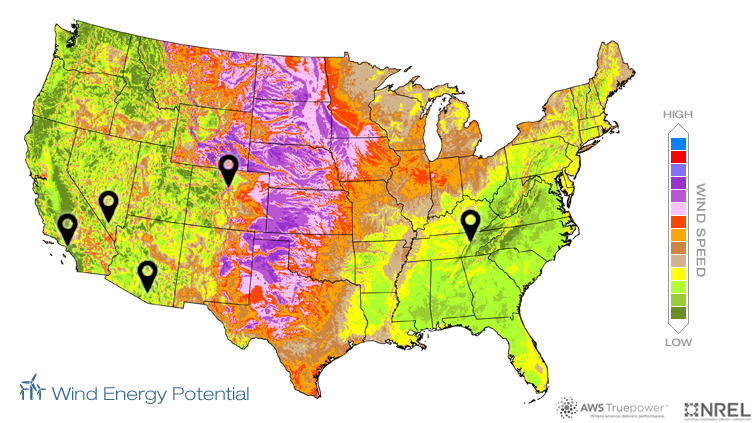
Predict: What city marked on the map of the USA has the most potential to generate wind power? Which city has the least?
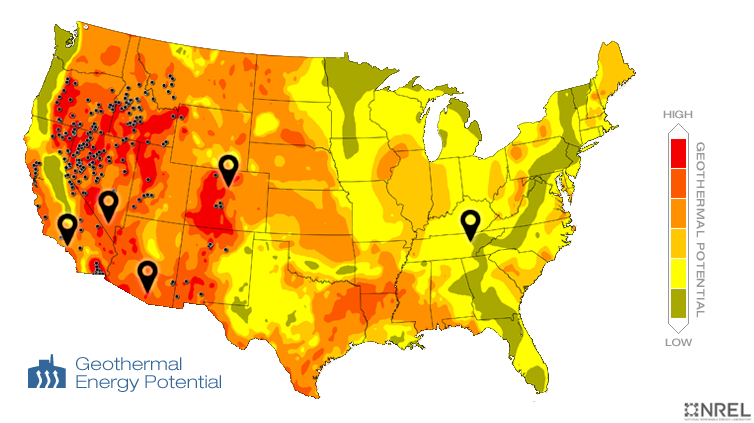
Predict: What city marked on the map of the USA has the most potential to generate geothermal energy? Which city has the least?
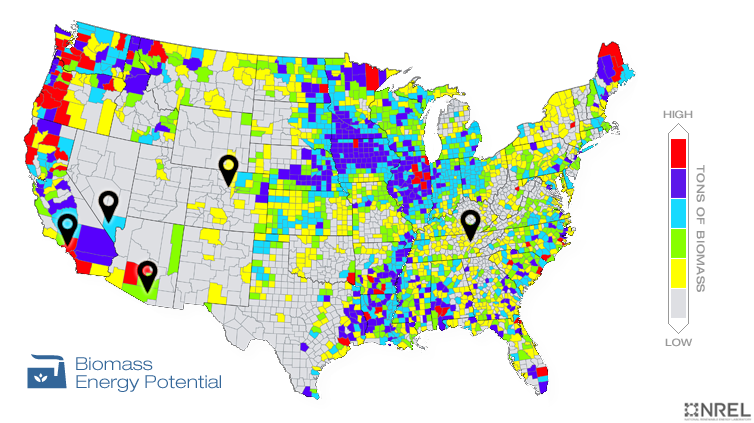
Predict: What city marked on the map of the USA has the most potential to generate biomass energy? Which city has the least?
You are an energy engineer hired to design renewable energy systems in several cities. You will be using the Nova Energy Lab to test your ideas.
Why would it be good to design an energy system that uses more than one energy source?
Open the Nova Energy Lab and click Begin.
Select Boulder, CO on the map.
Examine Boulder's Energy Profile and Your Challenge.
Then click Design Your System.
Compare solar and wind average cost. Which technology has the lowest cost in this city?
Compare solar and wind local potential by clicking on the gray "Local Potential" buttons. Which technology has the greatest potential in this city?
Adjust the sliders for solar and wind, while staying within the available budget and area.
What was your strategy?
Solar:
Wind:
Click Test Your System.
If your power supply gets low, there will be pop-ups with opportunities to make adjustments to your system.
When the test finishes, click Power Up.
When you tested your design, what happened? (Check all that apply.)
In the upper left hand corner, you'll see how much CO2 you saved and how much CO2 cost per ton.
Record those values here:
CO2 Saved (tons):
Cost per Ton (of CO2):
Click on the map icon in the upper right hand corner.

Select Las Vegas, NV on the map.
Examine Las Vegas' Energy Profile and Your Challenge.
Then click Design Your System.
Compare solar, wind, and geothermal average cost. Which technology has the lowest cost in this city?
Compare solar, wind, and geothermal local potential by clicking on the gray "Local Potential" buttons. Which technology has the greatest potential in this city?
Adjust the sliders for solar, wind, and geothermal, while staying within the available budget and area.
What was your strategy?
Solar:
Wind:
Geothermal:
Click Test Your System.
If your power supply gets low, there will be pop-ups with opportunities to make adjustments to your system.
When the test finishes, click Power Up.
When you tested your design, what happened? (Check all that apply.)
In the upper left hand corner, you'll see how much CO2 you saved and how much CO2 cost per ton.
Record those values here:
CO2 Saved (tons):
Cost per Ton (of CO2):
When fighting climate change, there are two important questions to ask:
How much CO2 did we save?
This measures total impact, or the amount of carbon we prevented from entering the atmosphere.
What did it cost us per ton of CO2 saved?
This measures efficiency, or the amount of money we spent for each ton of CO2 prevented.
Use the numbers you recorded in questions 13 and 17.
Which city had the greatest impact by saving the most CO2?
Which city was the most efficient by spending the least for each ton of CO2?
In the real world, cities don't just pick ONE technology. They use a MIX (like you probably did).
Why is using multiple renewable technologies smarter than using just one?
Which of the following information would NOT help you make a better decision about which technology to use?
Two companies designed energy systems with the following results:
Total CO₂ Saved | Total Cost | Cost Per Ton | |
|---|---|---|---|
Company A | 400 tons/year | $80,000 | $200/ton |
Company B | 600 tons/year | $180,000 | $300/ton |
Which of the following is true?
A power companyis choosing between 3 renewable technologies:
Cost Per Ton of CO2 | Total CO2 Saved Per Year | |
|---|---|---|
Solar | $150/ton | 5,000 tons |
Wind | $200/ton | 8,000 tons |
Geothermal | $100/ton | 2,000 tons |
Biomass | $120/ton | 6,000 tons |
If you were the power company leader, which strategy would you choose?
In your own words: Why did you choose this strategy? Consider what matters most: saving the most CO₂, spending money wisely, or something else?
Reflect on your understanding of the learning objectives:
Learning Targets
Analyze data to understand which renewable resources work best in different locations
Design an energy system that meets a city's power needs while considering budget constraints, environmental impact, and efficiency.
Success Criteria
Identify and explain why areas have the most/least solar, wind, geothermal, and biomass potential.
Decide which renewable technologies to use based on priorities and data.
Analyze data to understand which renewable resources work best in different locations | |
|---|---|
Design an energy system that meets a city's power needs while considering budget constraints, environmental impact, and efficiency. |
Reflect on your mastery of the success criteria:
Identify and explain why areas have the most/least solar, wind, geothermal, and biomass potential. | |
|---|---|
Decide which renewable technologies to use based on priorities and data. |
Which technology is most cost efficient (costs the LEAST per ton of CO2)?
Which technology saves the most total CO2?
The power company has limited money. They want to pick TWO technologies, but they're torn between two strategies:
Choose the two technologies that save the MOST total CO₂ (biggest climate impact)
Which two technologies would you pair together?
Strategy 2: "Go Smart"
Choose the two technologies that are MOST cost-efficient (best bang for your buck)
Which two technologies would you pair together?