Armor Plate Reduction in Stickleback Fish Populations
Stickleback fish provide one of the most compelling examples of how natural selection leads to adaptation in populations. Marine sticklebacks typically have heavy bony armor plates covering much of their sides, along with large spines that help deter predators. However, when marine sticklebacks colonize freshwater lakes and streams, the population often evolves a dramatically different body form: individuals tend to lose many of their bony plates and show reduced or modified spines. This shift occurs repeatedly across isolated freshwater systems, making sticklebacks a model system for studying natural selection and adaptation.
Diagram 1.
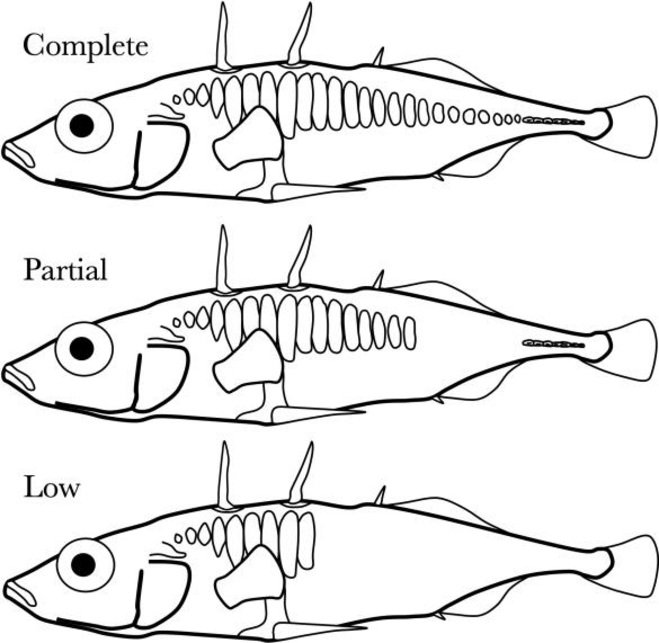
Source: https://www.researchgate.net/figure/Threespine-sticklebacks-with-Complete-C-Partial-P-and-Low-L-plate-morphs-Note_fig1
The key to understanding this evolutionary change lies in the environmental conditions. Freshwater habitats generally contain fewer large marine predators but impose other challenges, such as increased metabolic costs from growing heavy armor and the need for increased maneuverability in vegetation-dense waters. Fish with reduced plating use less calcium and energy during development, allowing them to grow faster and reproduce earlier. These advantages increase their fitness in freshwater environments.
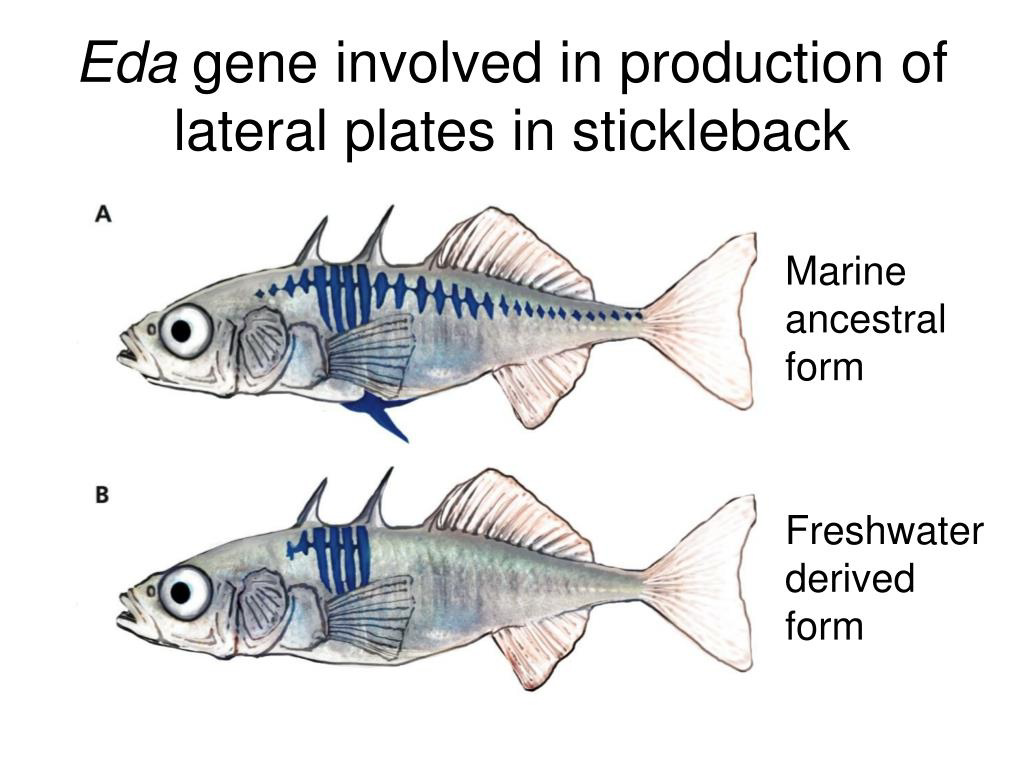
A major genetic contributor to this pattern is variation in the Eda gene, which influences armor plate number. Marine sticklebacks usually carry the “complete armor” allele, while freshwater fish often carry the “low-armor” allele. When marine sticklebacks enter freshwater lakes, individuals that carry the low-armor allele experience higher survival and reproductive success. Over generations, this advantageous allele increases in frequency, and the population becomes dominated by low-plated individuals.
Diagram 2.
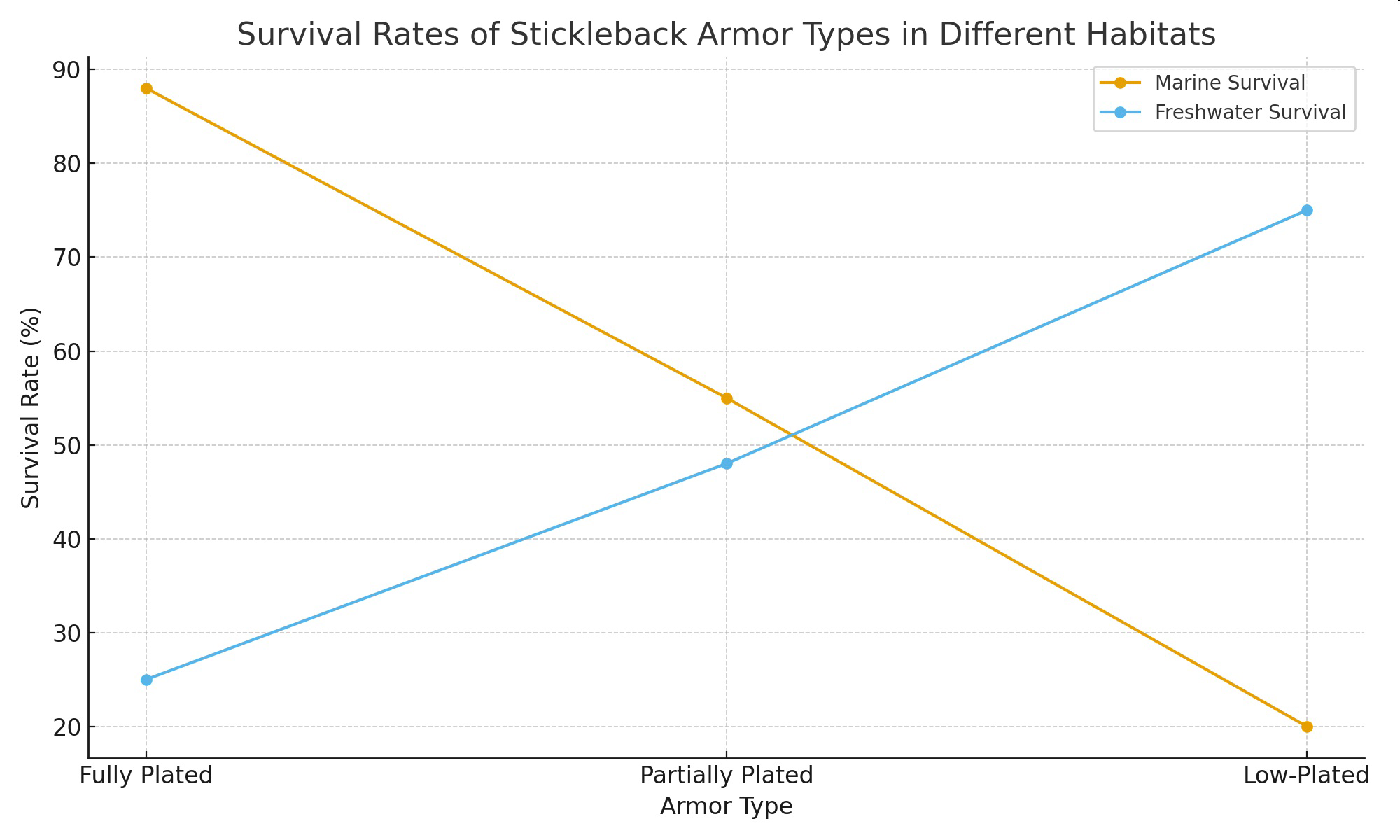
Scientists have tracked this change using both field surveys and genetic sampling. In newly colonized lakes, the low-armor allele might initially appear in just 5–10% of the population. But within just a few decades, frequencies can rise above 70–90% as selection repeatedly favors individuals with fewer plates. Data also show that fish with reduced armor have higher survival rates in freshwater, especially during juvenile stages when heavy armor slows movement.
Table 1.
Habitat | Fully Plated (%) | Partially Plated (%) | Low-Plated (%) |
|---|
Marine | 92 | 7 | 1 |
Estuary | 68 | 22 | 10 |
Freshwater (Lake 1) | 22 | 38 | 40 |
Freshwater (Lake 2) | 18 | 40 | 42 |
Graph of Information - Figure 1.
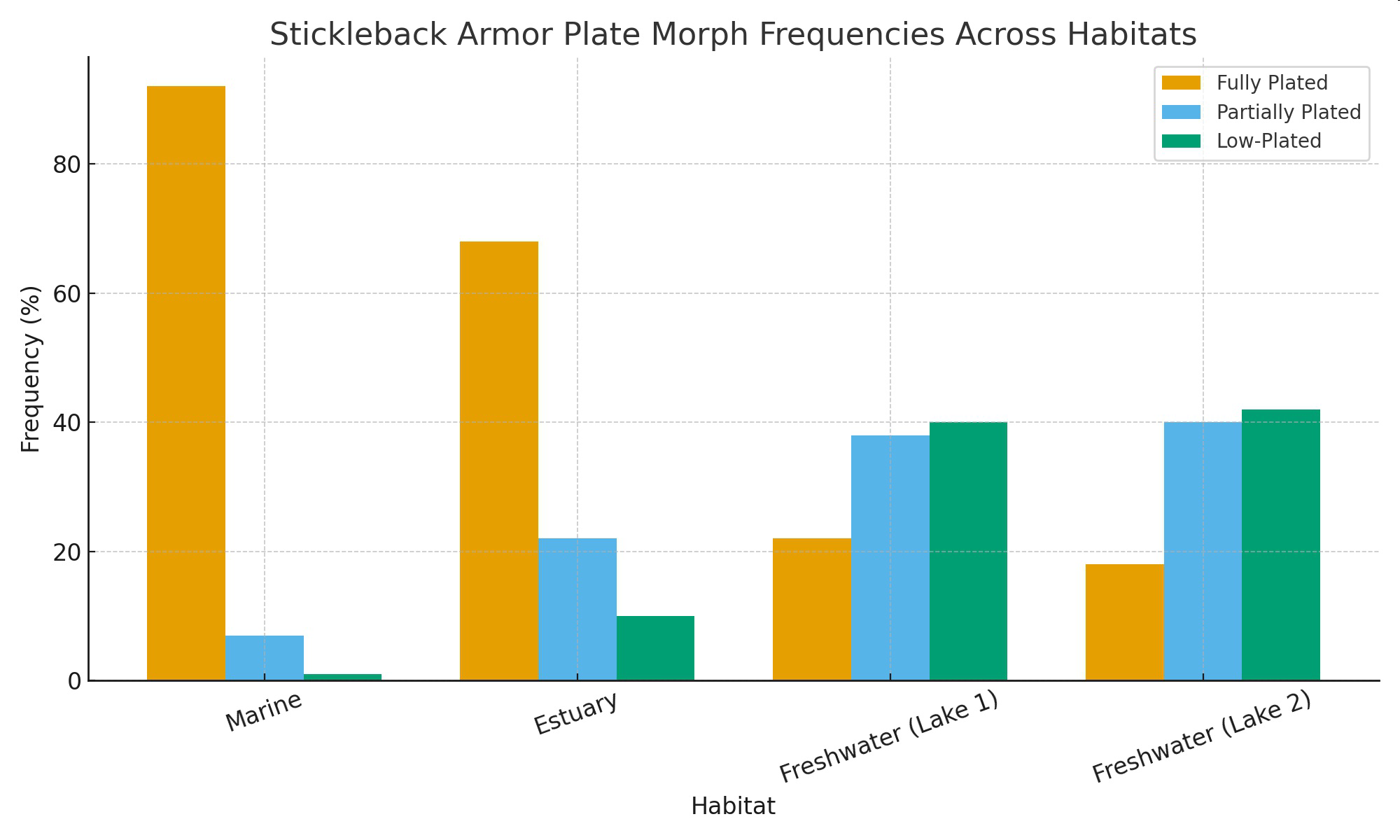
Table 2.
Armor Type | Survival in Marine (%) | Survival in Freshwater (%) |
|---|
Fully Plated | 88 | 25 |
Partially Plated | 55 | 48 |
Low-Plated | 20 | 75 |
Graph of Information - Figure 2.