Climate-Driven Expansion of Bark Beetles in North America
Bark beetles, especially the mountain pine beetle ($Dendroctonus ponderosae$), are native insects found throughout western North America. For thousands of years, these beetles existed in relatively stable numbers, controlled naturally by climate conditions, predators, and the defenses of healthy pine trees. However, over the last several decades, rising temperatures and milder winters associated with climate change have dramatically altered the beetle’s population dynamics. These environmental shifts have allowed beetle numbers to increase, enabled their expansion into new regions, and contributed to widespread tree mortality across millions of hectares of forest.
Diagram 1.
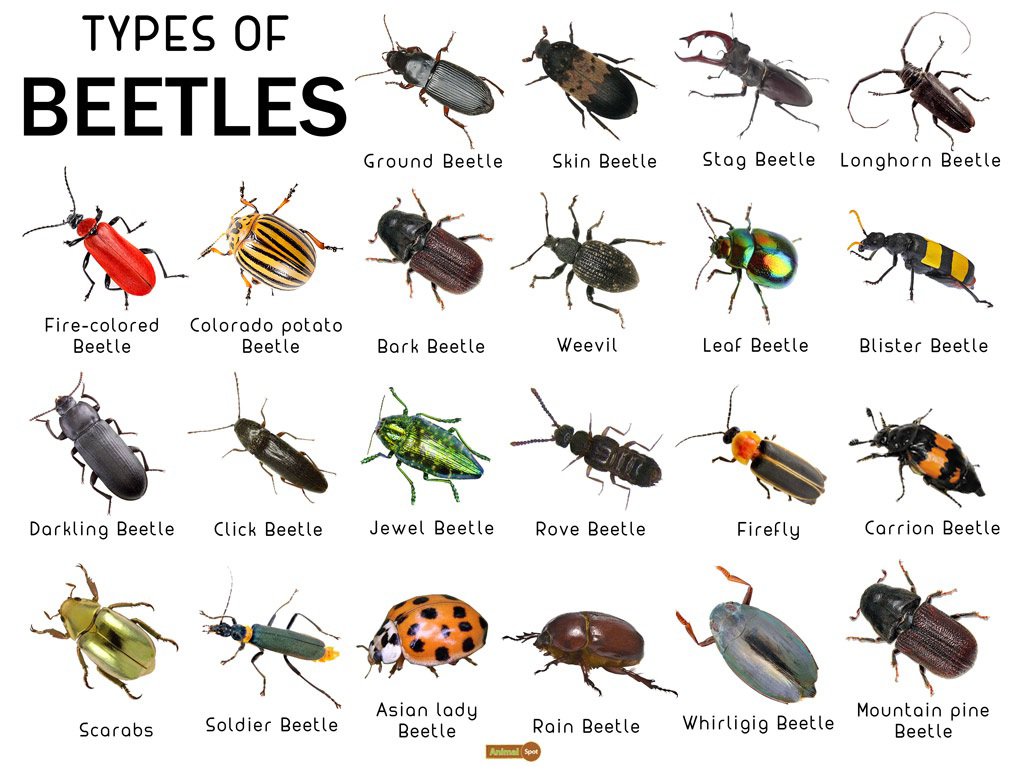
Source: https://www.animalspot.net/beetle
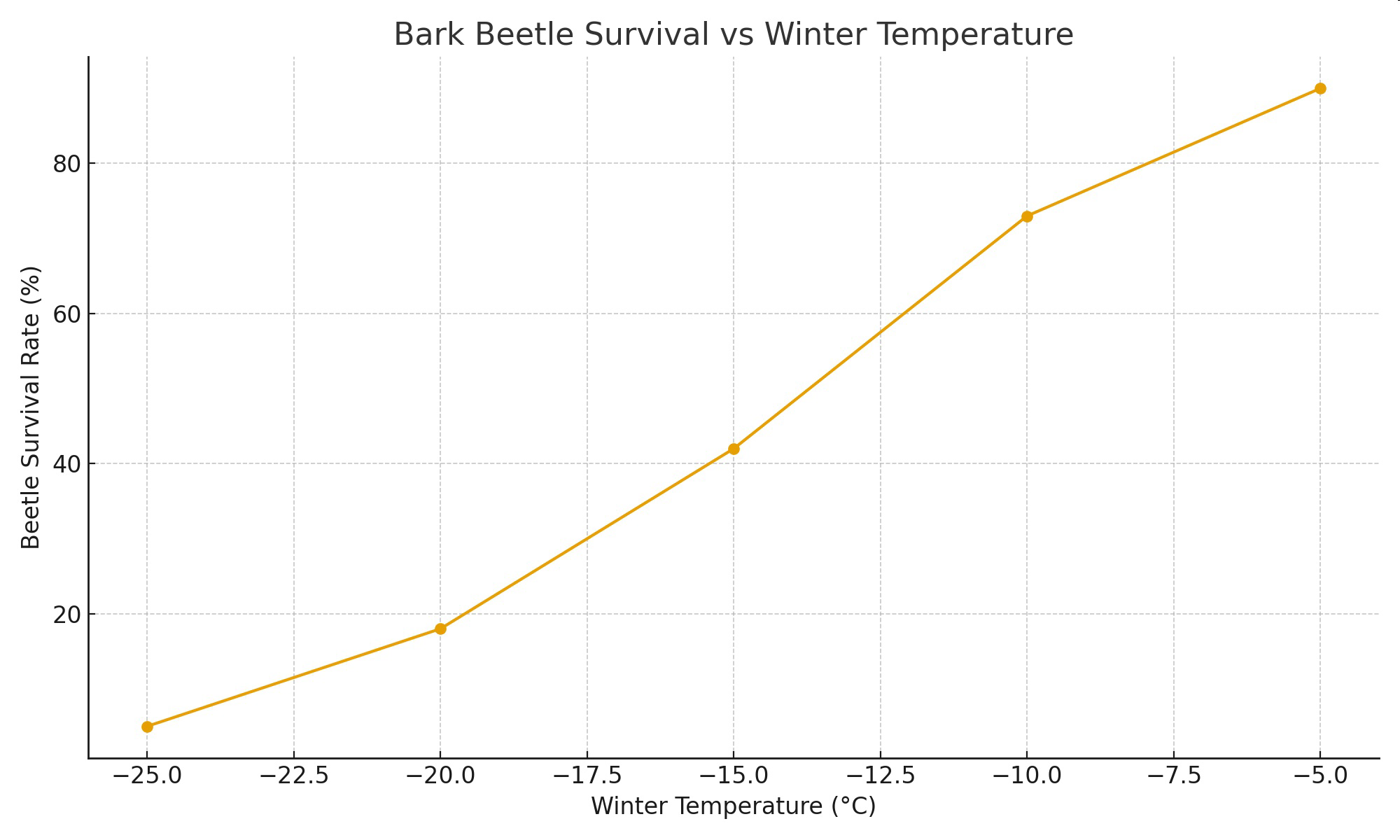
Historically, cold winter temperatures limited bark beetle survival. Prolonged hard freezes killed overwintering larvae, keeping beetle populations low. Warmer winters now result in much higher overwinter survival rates. In addition, hotter summers speed up beetle development, allowing some populations to complete more life cycles per year. These temperature-driven changes represent clear environmental pressures that influence species numbers over time.
As beetle populations surge, their geographic range has expanded dramatically. The insects have moved northward into British Columbia and the Yukon, and eastward across the Canadian Rockies—territory once too cold to support them. This expansion demonstrates how environmental change can lead directly to increases in the number of individuals of a species and facilitate the establishment of populations in new regions.
These beetle outbreaks have additional ecosystem consequences. As beetles kill large numbers of mature pines, the affected forests shift toward young, early-successional species. Some species highly dependent on old-growth pine forests have declined. In extreme cases, entire stands of lodgepole pine have collapsed, demonstrating how environmental change can contribute to localized extinction or major reductions in certain species.
Diagram 2.
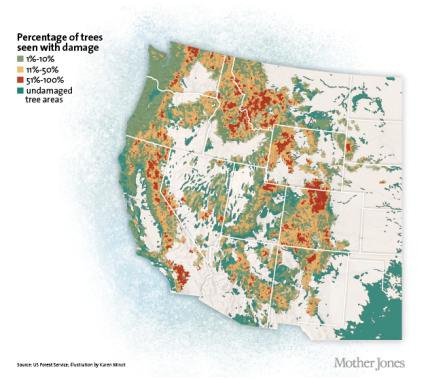 Source: https://www.climatesignals.org/resources/map-bark-beetle-damage-american-west-2000-2014
Multiple lines of evidence support these conclusions. Long-term monitoring shows that beetle populations increased dramatically following periods of unusually warm winters. Tree-ring data reveal abrupt declines in pine growth and sudden mortality events that align with beetle outbreaks. Satellite imagery documents the rapid spread of beetle-affected forests across western Canada and the United States. Ecological models also show that warming temperatures align with observed increases in beetle survival, reproduction, and dispersal.
Table 1.
Year | Mean Temperature Anomaly (${^\circ}C$) | Infested Forest Area (million ha) |
|---|
2000 | 0.2 | 1.2 |
2005 | 0.35 | 2.1 |
2010 | 0.45 | 3.8 |
2015 | 0.62 | 5.4 |
2020 | 0.78 | 7.1 |
2025 | 0.95 | 8.9 |
Graph of Information - Figure 1.
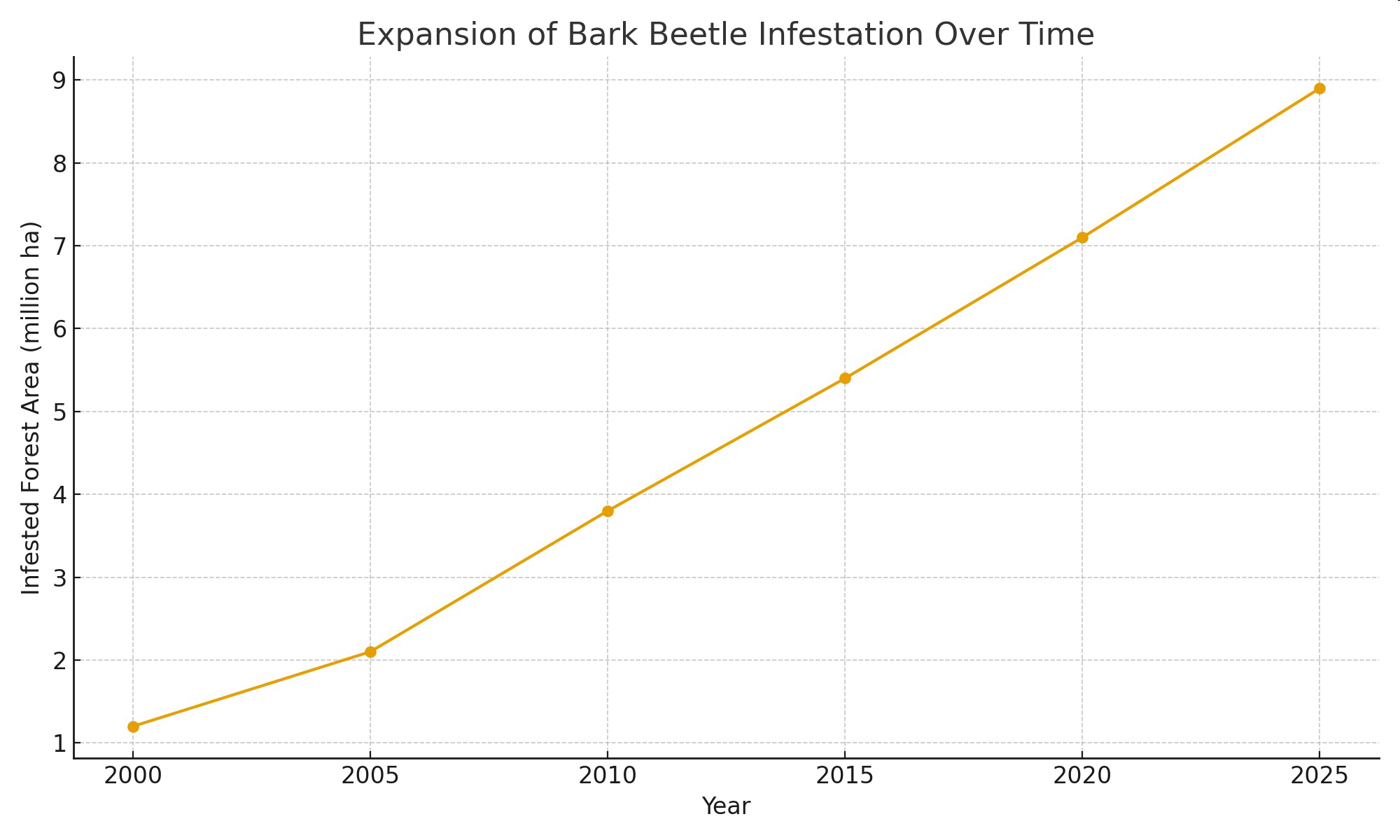
Table 2.
Winter Temperature ($^\circ\text{C}$) | Beetle Survival Rate (%) |
|---|
-25 | 5 |
-20 | 18 |
-15 | 42 |
-10 | 73 |
-5 | 90 |
Graph of Information - Figure 2.