New Evidence from Molecular Biology
The unifying principle of common descent that emerges from all the foregoing lines of evidence is being reinforced by the discoveries of modern biochemistry and molecular biology.
The code used to translate nucleotide sequences into amino acid sequences is essentially the same in all organisms. Moreover, proteins in all organisms are invariably composed of the same set of 20 amino acids. This unity of composition and function is a powerful argument in favor of the common descent of the most diverse organisms.
In 1959, scientists at Cambridge University in the United Kingdom determined the three-dimensional structures of two proteins that are found in almost every multicelled animal: hemoglobin and myoglobin. Hemoglobin is the protein that carries oxygen in the blood. Myoglobin receives oxygen from hemoglobin and stores it in the tissues until needed. These were the first three-dimensional protein structures to be solved, and they yielded some key insights. Myoglobin has a single chain of 153 amino acids wrapped around a group of iron and other atoms (called “heme”) to which oxygen binds. Hemoglobin, in contrast, is made of up four chains: two identical chains consisting of 141 amino acids, and two other identical chains consisting of 146 amino acids. However, each chain has a heme exactly like that of myoglobin, and each of the four chains in the hemoglobin molecule is folded exactly like myoglobin. It was immediately obvious in 1959 that the two molecules are very closely related.
During the next two decades, myoglobin and hemoglobin sequences were determined for dozens of mammals, birds, reptiles, amphibians, fish, worms, and mollusks. All of these sequences were so obviously related that they could be compared with confidence with the three-dimensional structures of two selected standards—whale myoglobin and horse hemoglobin. Even more significantly, the differences between sequences from different organisms could be used to construct a family tree of hemoglobin and myoglobin variation among organisms. This tree agreed completely with observations derived from paleontology and anatomy about the common descent of the corresponding organisms.
Myoglobin, which stores oxygen in muscles, consists of a chain of 153 amino acids wrapped around an oxygen-binding molecule.
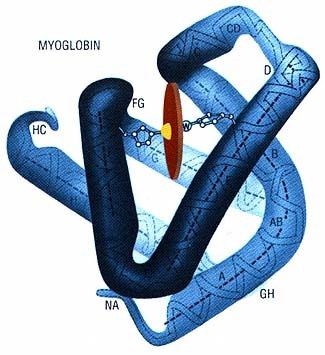
Figure 10. Myoglobin
Similar family histories have been obtained from the three-dimensional structures and amino acid sequences of other proteins, such as cytochrome c (a protein engaged in energy transfer) and the digestive proteins trypsin and chymotrypsin. The examination of molecular structure offers a new and extremely powerful tool for studying evolutionary relationships. The quantity of information is potentially huge—as large as the thousands of different proteins contained in living organisms, and limited only by the time and resources of molecular biologists.
As the ability to sequence the nucleotides making up DNA has improved, it also has become possible to use genes to reconstruct the evolutionary history of organisms. Because of mutations, the sequence of nucleotides in a gene gradually changes over time. The more closely related two organisms are, the less different their DNA will be. Because there are tens of thousands of genes in humans and other organisms, DNA contains a tremendous amount of information about the evolutionary history of each organism.
Genes evolve at different rates because, although mutation is a random event, some proteins are much more tolerant of changes in their amino acid sequence than are other proteins. For this reason, the genes that encode these more tolerant, less constrained proteins evolve faster. The average rate at which a particular kind of gene or protein evolves gives rise to the concept of a "molecular clock." Molecular clocks run rapidly for less constrained proteins and slowly for more constrained proteins, though they all time the same evolutionary events.
The concept of a molecular clock is useful for two purposes. It determines evolutionary relationships among organisms, and it indicates the time in the past when species started to diverge from one another. Once the clock for a particular gene or protein has been calibrated by reference to some event whose time is known, the actual chronological time when all other events occurred can be determined by examining the protein or gene tree.
Species that diverged longer ago have more differences in their corresponding proteins, reflecting changes in the amino acids over time.
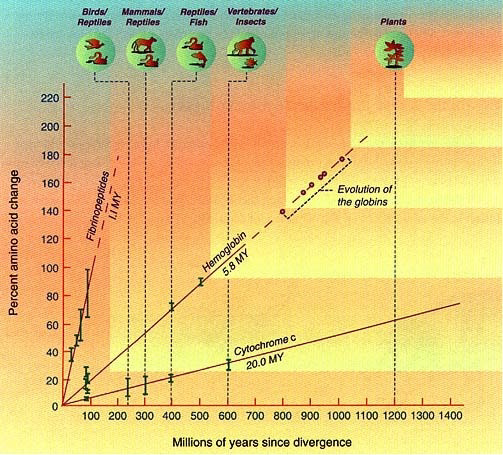
Figure 11. Molecular Clocks
The evidence for evolution from molecular biology is overwhelming and is growing quickly. In some cases, this molecular evidence makes it possible to go beyond the paleontological evidence. For example, it has long been postulated that whales descended from land mammals that had returned to the sea. From anatomical and paleontological evidence, the whales' closest living land relatives seemed to be the even-toed hoofed mammals (modern cattle, sheep, camels, goats, etc.).
Recent comparisons of some milk protein genes (beta-casein and kappa-casein) have confirmed this relationship and have suggested that the closest land-bound living relative of whales may be the hippopotamus. In this case, molecular biology has augmented the fossil record.

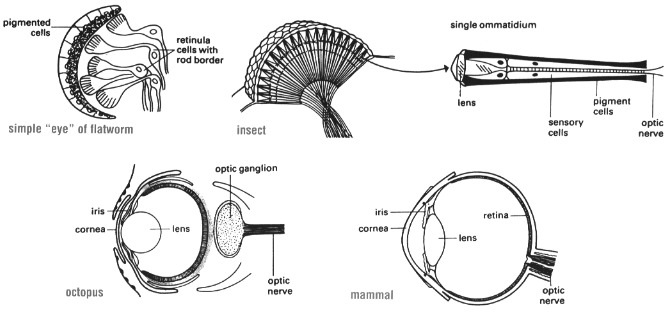 Figure 4. Eyes evolved over many millions of years from simple organs that can detect light.