Industrial Melanism and the Decline of Light-Colored Moths
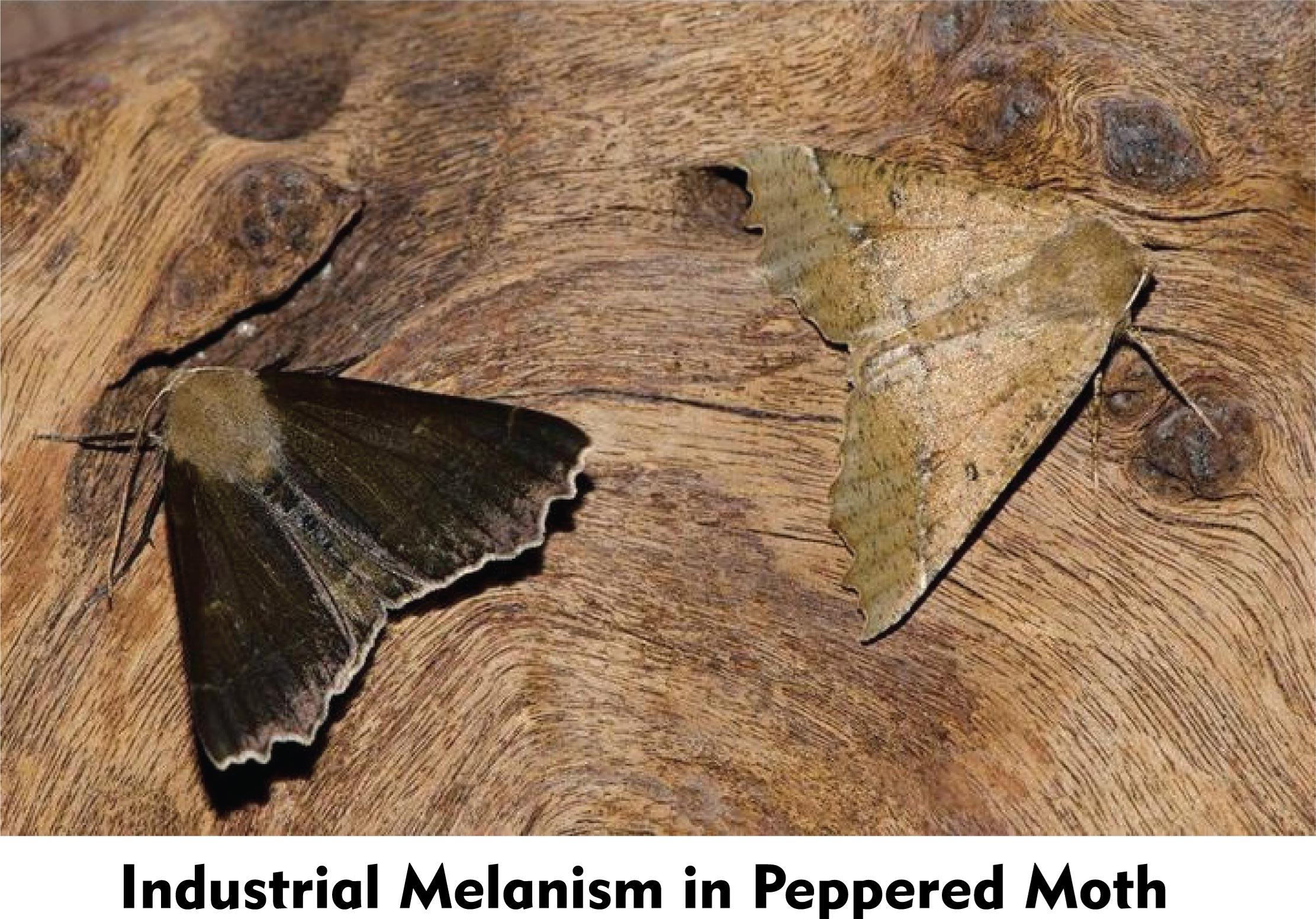
During the Industrial Revolution in the 1800s, many regions of England experienced heavy coal burning that released soot into the environment. Forests that were once covered in light-colored lichens became darkened by soot. This environmental shift dramatically altered the survival landscape for the peppered moth (Biston betularia), which exists in two major forms: a light-colored “typica” morph and a dark “carbonaria” morph. Before industrialization, the light moths were well camouflaged against lichen-covered bark, while the dark moths were more visible to predators. As a result, light moths made up the vast majority of the population.
Diagram 1.
Source: https://www.vedantu.com/question-answer/industrial-melanism-is-an-example-of-a-natural-class-12-biology-cbse
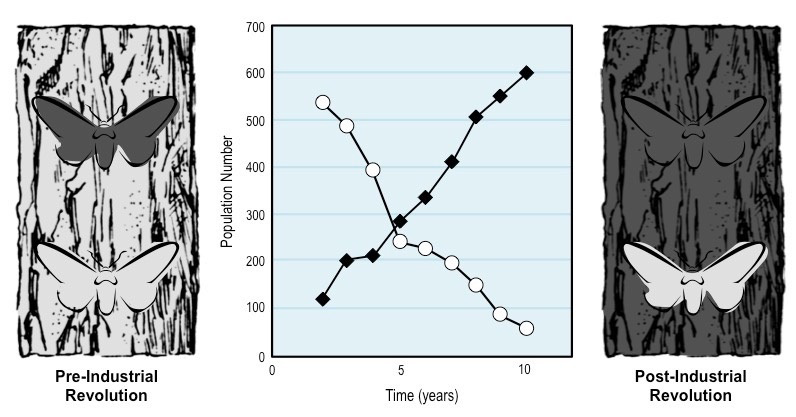
However, when soot darkened the trees, the camouflage advantage reversed. Light moths became far more visible to predators, especially birds, while dark moths blended into the soot-covered surfaces. This change in environmental conditions caused a rapid shift in population frequencies: dark moths increased dramatically, and light moths declined. This phenomenon - called industrial melanism - is one of the most famous examples supporting changes in the environment can increase the numbers of some species (or traits) while reducing others.
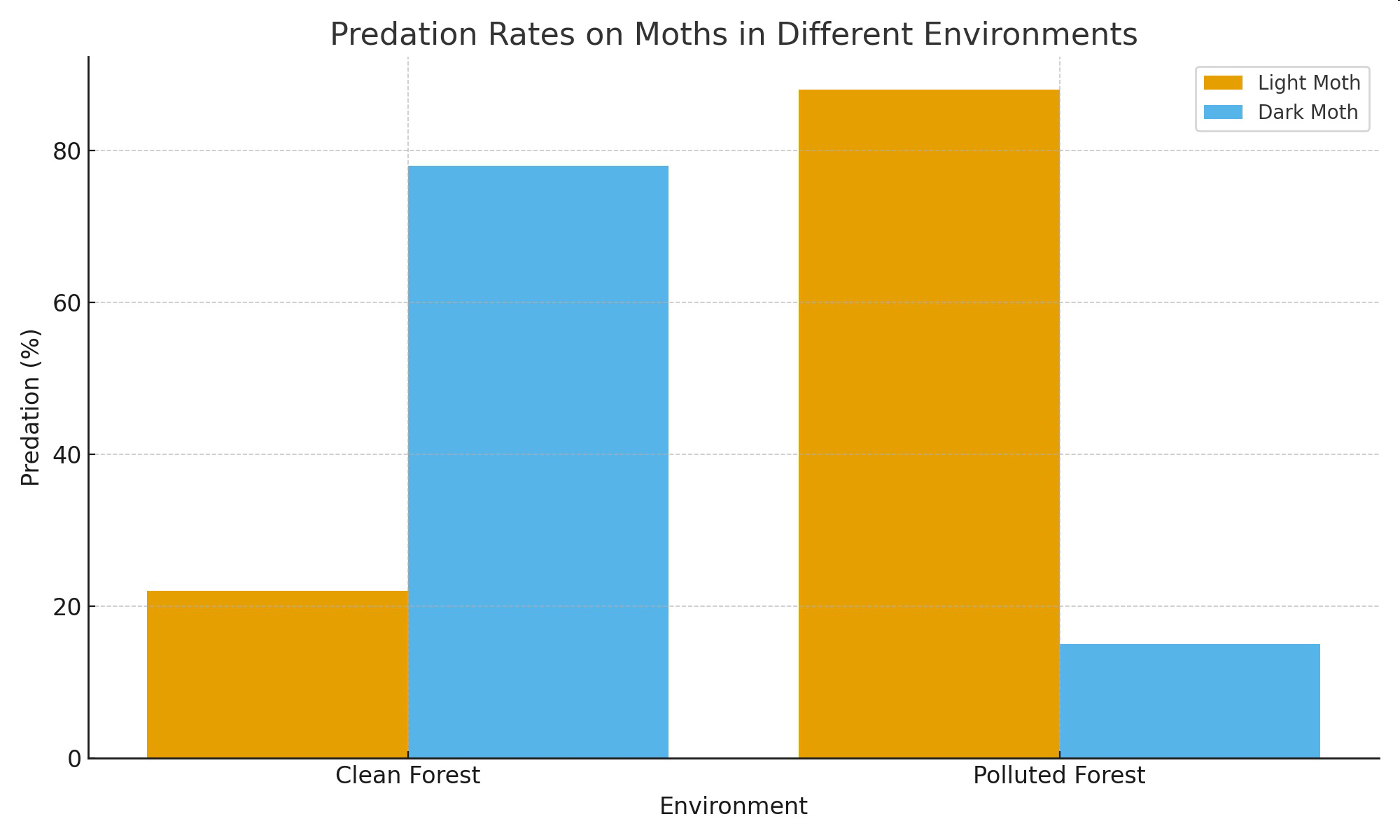
Scientists have documented this shift using both historical records and modern experiments. In the mid-1900s, Bernard Kettlewell conducted field experiments showing that birds preyed heavily on whichever moth form was most visible in a given habitat. When the environment was polluted and bark was dark, predation on light moths increased. When the environment was cleaner, the advantage flipped, and dark moth frequencies fell.
After clean-air laws reduced pollution beginning in the 1950s, lichens returned to many forested areas. As the environment became lighter again, the frequency of the dark morph decreased, and the light morph once more became the dominant form in many populations. This rapid reversal demonstrated how changes in environmental conditions - whether pollution or restoration - directly affect which traits are favored.
Diagram 2.
 Source:
https://old-ib.bioninja.com.au/standard-level/topic-5-evolution-and-biodi/51-evidence-for-evolution/evolution-example.html
Table 1.
Year | Light Moth (%) | Dark Moth (%) |
|---|
1950 | 78 | 22 |
1960 | 42 | 58 |
1970 | 18 | 82 |
1980 | 10 | 90 |
1990 | 22 | 78 |
2000 | 40 | 60 |
2010 | 63 | 37 |
Graph of Information - Figure 1.
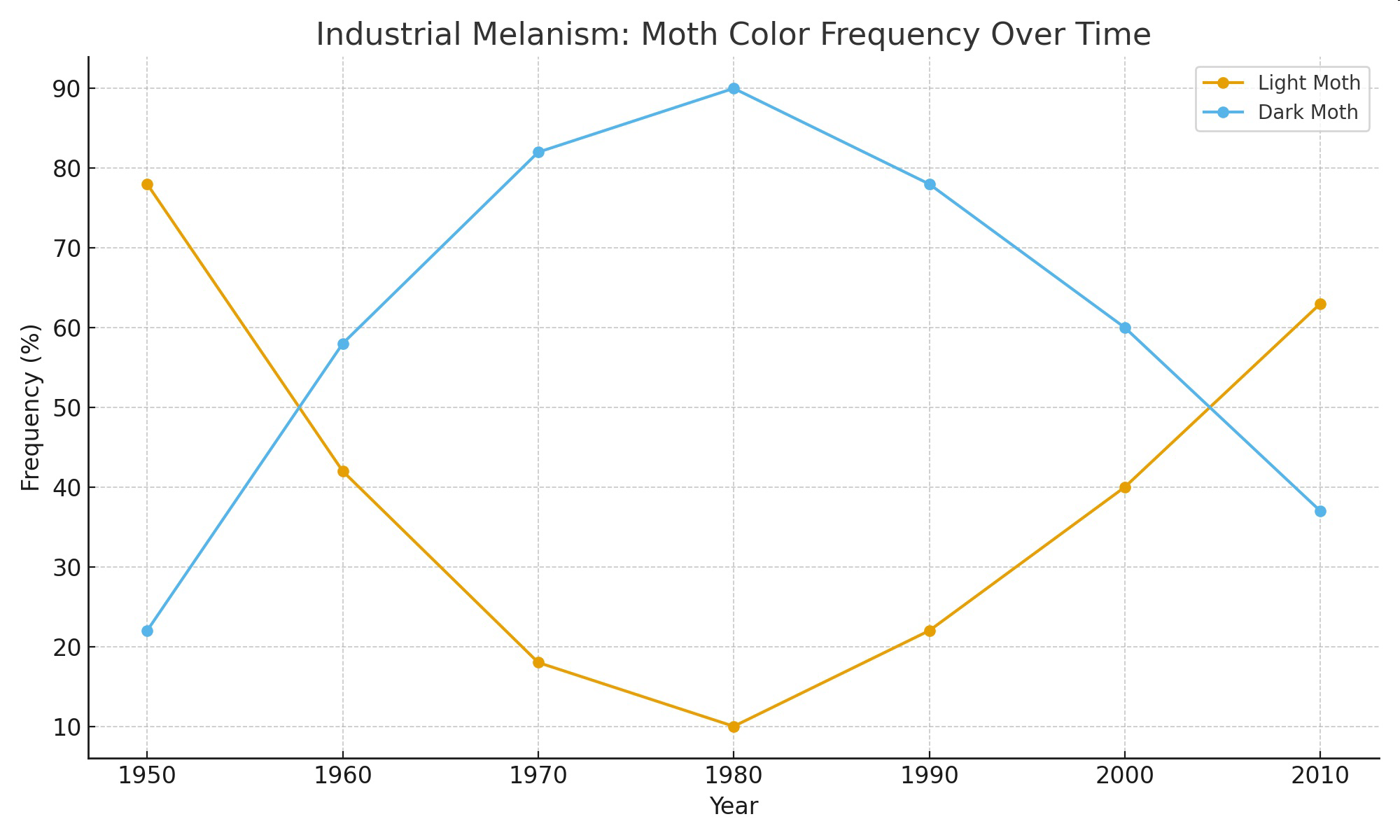
Table 2.
Environment | Light Moth Predation (%) | Dark Moth Predation (%) |
|---|
Clean Forest | 22 | 78 |
Polluted Forest | 88 | 15 |
Graph of Information - Figure 2.