Wk 34: EOL 8.3
star
star
star
star
star
Last updated 4 months ago
21 Nsɛmmisa
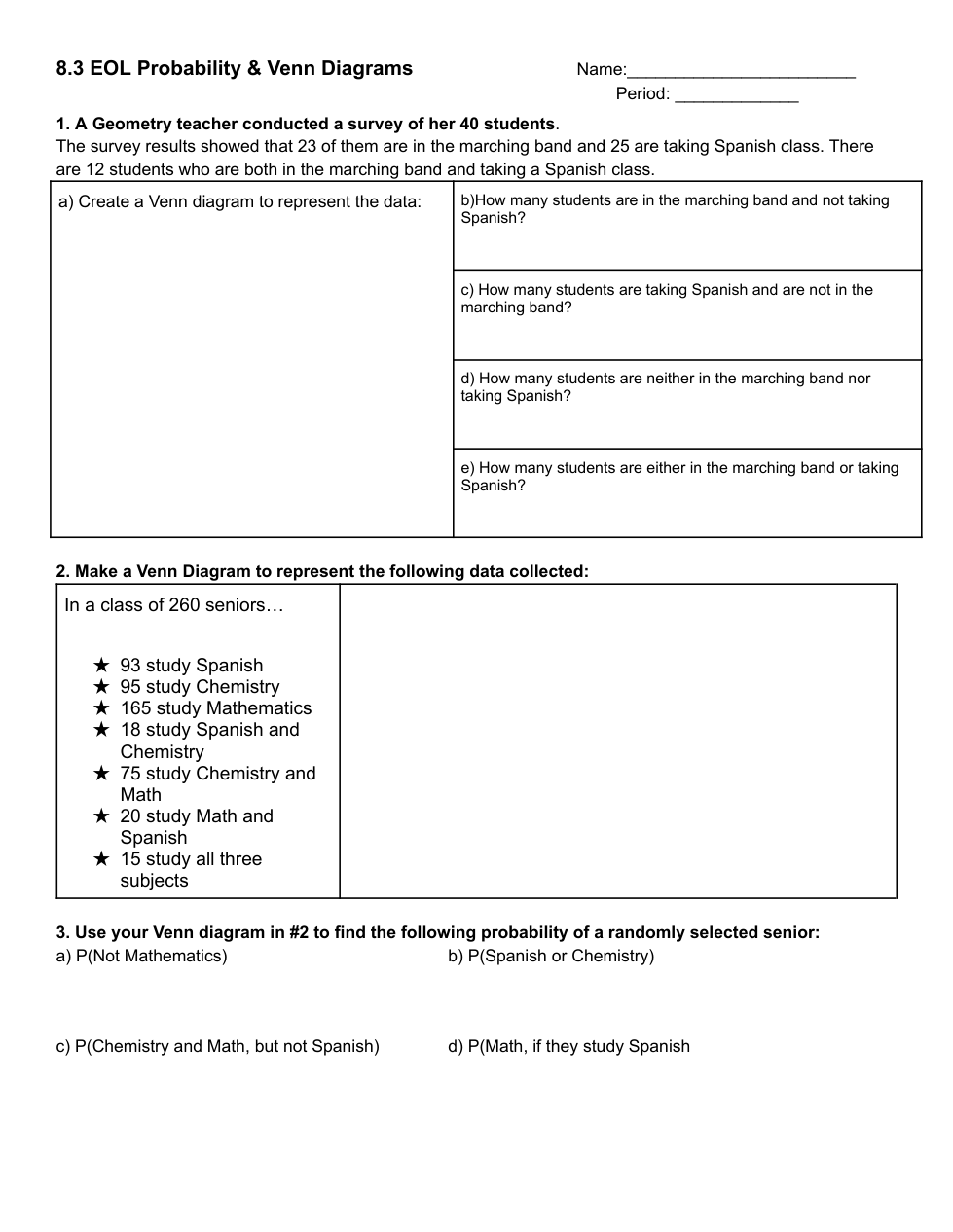
1. A Geometry teacher conducted a survey of her 40 students.
The survey results showed that 23 of them are in the marching band and 25 are taking Spanish class. There are 12 students who are both in the marching band and taking a Spanish class. Show all your work for full credit
a) Create a Venn diagram to represent the data:
1. A Geometry teacher conducted a survey of her 40 students.
The survey results showed that 23 of them are in the marching band and 25 are taking Spanish class. There are 12 students who are both in the marching band and taking a Spanish class. Show all your work for full credit
b)How many students are in the marching band and not taking
Spanish?
1. A Geometry teacher conducted a survey of her 40 students.
The survey results showed that 23 of them are in the marching band and 25 are taking Spanish class. There are 12 students who are both in the marching band and taking a Spanish class. Show all your work for full credit
c) How many students are taking Spanish and are not in the
marching band?
1. A Geometry teacher conducted a survey of her 40 students.
The survey results showed that 23 of them are in the marching band and 25 are taking Spanish class. There are 12 students who are both in the marching band and taking a Spanish class. Show all your work for full credit
d) How many students are neither in the marching band nor
taking Spanish?
1. A Geometry teacher conducted a survey of her 40 students.
The survey results showed that 23 of them are in the marching band and 25 are taking Spanish class. There are 12 students who are both in the marching band and taking a Spanish class. Show all your work for full credit
e) How many students are either in the marching band or taking
Spanish?
2. Make a Venn Diagram to represent the following data collected:
3. Use your Venn diagram in #2 to find the following probability of a randomly selected senior: Show all your work for full credit
a) P(Not Mathematics)
3. Use your Venn diagram in #2 to find the following probability of a randomly selected senior: Show all your work for full credit
b) P(Spanish or Chemistry)
3. Use your Venn diagram in #2 to find the following probability of a randomly selected senior: Show all your work for full credit
c) P(Chemistry and Math, but not Spanish)
3. Use your Venn diagram in #2 to find the following probability of a randomly selected senior: Show all your work for full credit
d) P(Math, if they study Spanish
4. Using a standard 52 deck of cards, find the following probabilities: Show all your work for full credit
a) P(face cards)
4. Using a standard 52 deck of cards, find the following probabilities: Show all your work for full credit
b) P(hearts and face cards)
4. Using a standard 52 deck of cards, find the following probabilities: Show all your work for full credit
c) P(reds or number cards)
4. Using a standard 52 deck of cards, find the following probabilities: Show all your work for full credit
f) P(not a red king)
4. Using a standard 52 deck of cards, find the following probabilities: Show all your work for full credit
g) P(not a spade or queen)
4. Using a standard 52 deck of cards, find the following probabilities: Show all your work for full credit
h) P(Diamond | Red)
5. A recent study of smoking cessation programs collected information about the nicotine replacement
therapies that people were using to try to quit smoking.
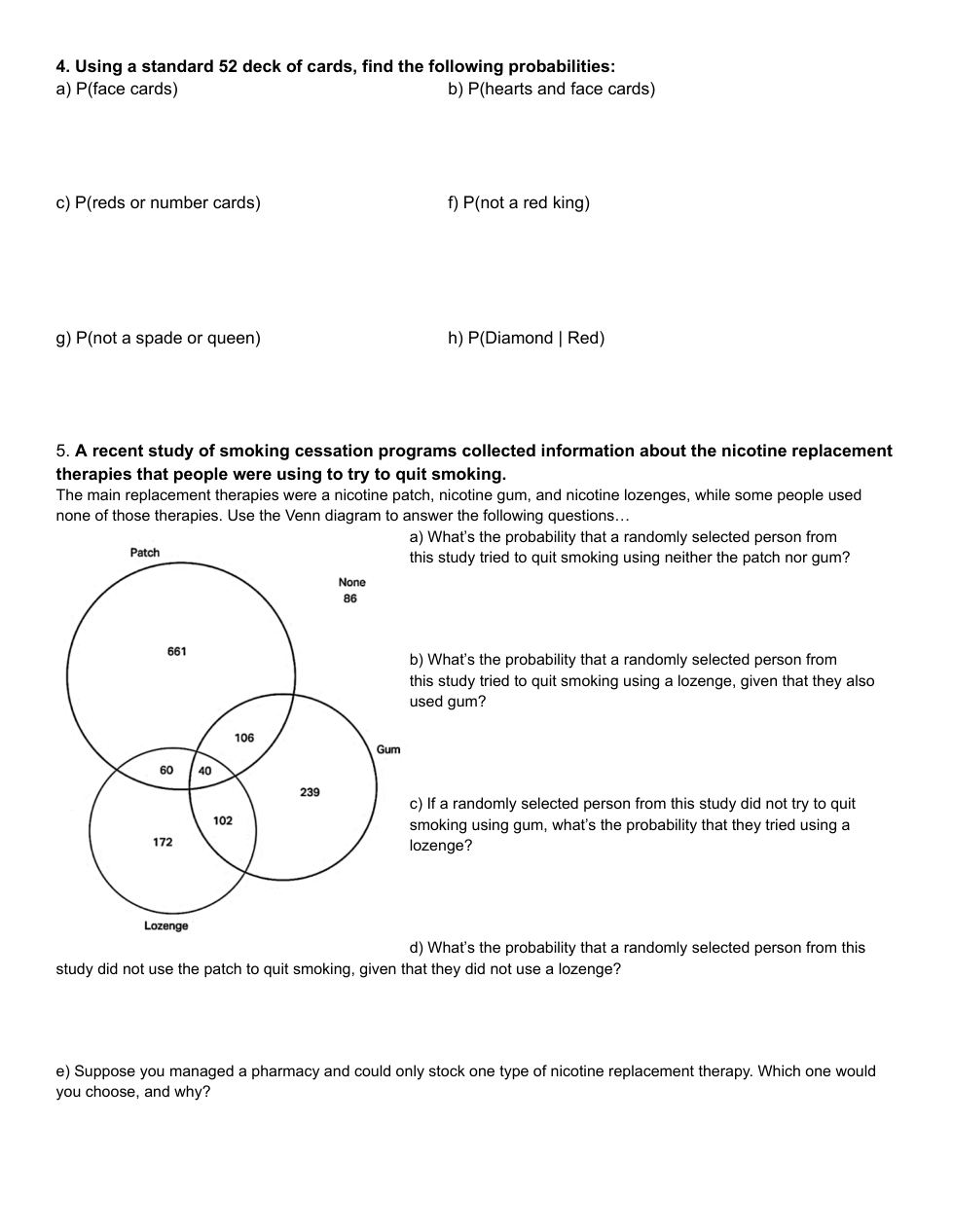
The main replacement therapies were a nicotine patch, nicotine gum, and nicotine lozenges, while some people used none of those therapies. Use the Venn diagram to answer the following questions… Show all your work for full credit
a) What’s the probability that a randomly selected person from this study tried to quit smoking using neither the patch nor gum?
5. A recent study of smoking cessation programs collected information about the nicotine replacement
therapies that people were using to try to quit smoking.
The main replacement therapies were a nicotine patch, nicotine gum, and nicotine lozenges, while some people used none of those therapies. Use the Venn diagram to answer the following questions… Show all your work for full credit
b) What’s the probability that a randomly selected person from this study tried to quit smoking using a lozenge, given that they also used gum?
5. A recent study of smoking cessation programs collected information about the nicotine replacement
therapies that people were using to try to quit smoking.
The main replacement therapies were a nicotine patch, nicotine gum, and nicotine lozenges, while some people used none of those therapies. Use the Venn diagram to answer the following questions… Show all your work for full credit
c) If a randomly selected person from this study did not try to quit smoking using gum, what’s the probability that they tried using a lozenge?
5. A recent study of smoking cessation programs collected information about the nicotine replacement
therapies that people were using to try to quit smoking.
The main replacement therapies were a nicotine patch, nicotine gum, and nicotine lozenges, while some people used none of those therapies. Use the Venn diagram to answer the following questions… Show all your work for full credit
d) What’s the probability that a randomly selected person from this study did not use the patch to quit smoking, given that they did not use a lozenge?
e) Suppose you managed a pharmacy and could only stock one type of nicotine replacement therapy. Which one would you choose, and why? *Explain and show your work thoroughly.