Peppered Moth Color Variation in Polluted vs Clean Environments
The peppered moth (Biston betularia) has become one of the most iconic real-world examples of how evolution operates through four fundamental factors: the potential for populations to increase, heritable variation, competition, and differential survival and reproduction. During the Industrial Revolution, air pollution from coal burning darkened tree trunks throughout parts of England.
Peppered moths exist in two main color forms: the light “typica” form and the dark “carbonaria” form. These phenotypes are determined by heritable genetic variation. Before industrial pollution increased, most moths were light-colored, which helped them blend into pale lichen-covered trees and avoid bird predators. Dark moths existed, but at low frequency because they were more easily spotted and eaten.
The first factor - the potential for a species to increase in number - applies strongly to peppered moths. Each generation produces far more offspring than can survive, setting the stage for natural selection. Among these offspring is heritable genetic variation, the second factor, including differences in coloration caused by genetic mutations.
The third factor, competition for limited resources, plays out in the form of limited safe resting sites and constant predation pressure. Birds consume large numbers of moths, so only individuals with traits that improve camouflage survive long enough to reproduce.
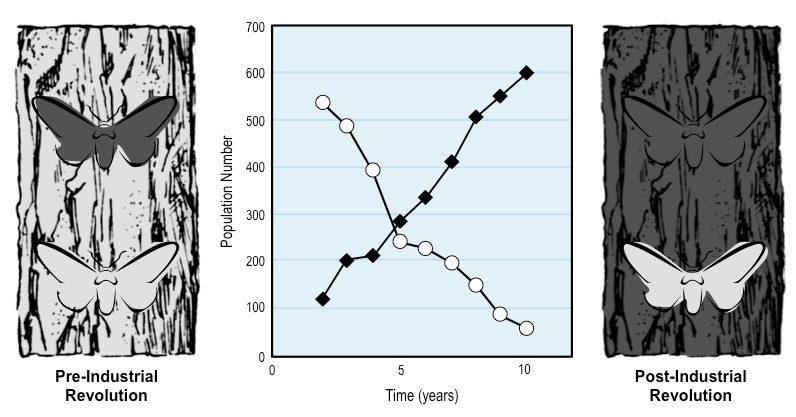
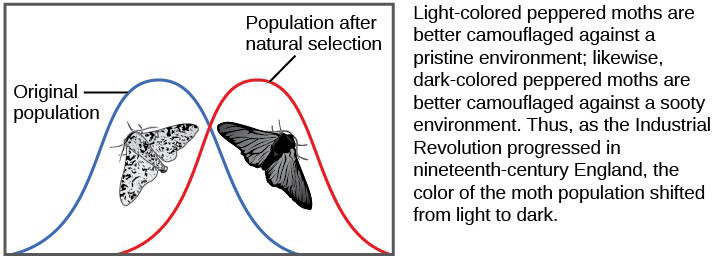
When industrial soot darkened tree bark, the selective pressure flipped. Now, the dark moths were better camouflaged. They had a higher probability of surviving, while light moths were eaten more frequently. This leads to the fourth factor: the proliferation of organisms better able to survive and reproduce. Over several decades, the frequency of the dark phenotype increased dramatically in polluted areas.
Diagram 1.
 Source:
https://old-ib.bioninja.com.au/standard-level/topic-5-evolution-and-biodi/51-evidence-for-evolution/evolution-example.html
As air pollution decreased in the late 20th century, tree bark lightened again. The selective advantage shifted back, and light moths increased in frequency. This back-and-forth change demonstrates that trait frequencies shift when environmental conditions shift and that natural selection acts on existing heritable variation.
The peppered moth story illustrates all four drivers of evolution. Populations produce many offspring, some genetically different; those differences affect survival under specific environmental conditions; and traits that improve survival become more common over generations. Multiple datasets - population surveys, predation experiments, and long-term environmental data - provide strong real-world evidence for this evolutionary process.
Diagram 2.
Source: https://open.lib.umn.edu/humanbiology2e/chapter/1-3-the-genetic-basis-of-evolution/
Table 1.
Environment | Light Moth (%) | Dark Moth (%) |
|---|
Clean Forest | 85 | 15 |
Polluted Forest | 20 | 80 |
Graph of Information - Figure 1.
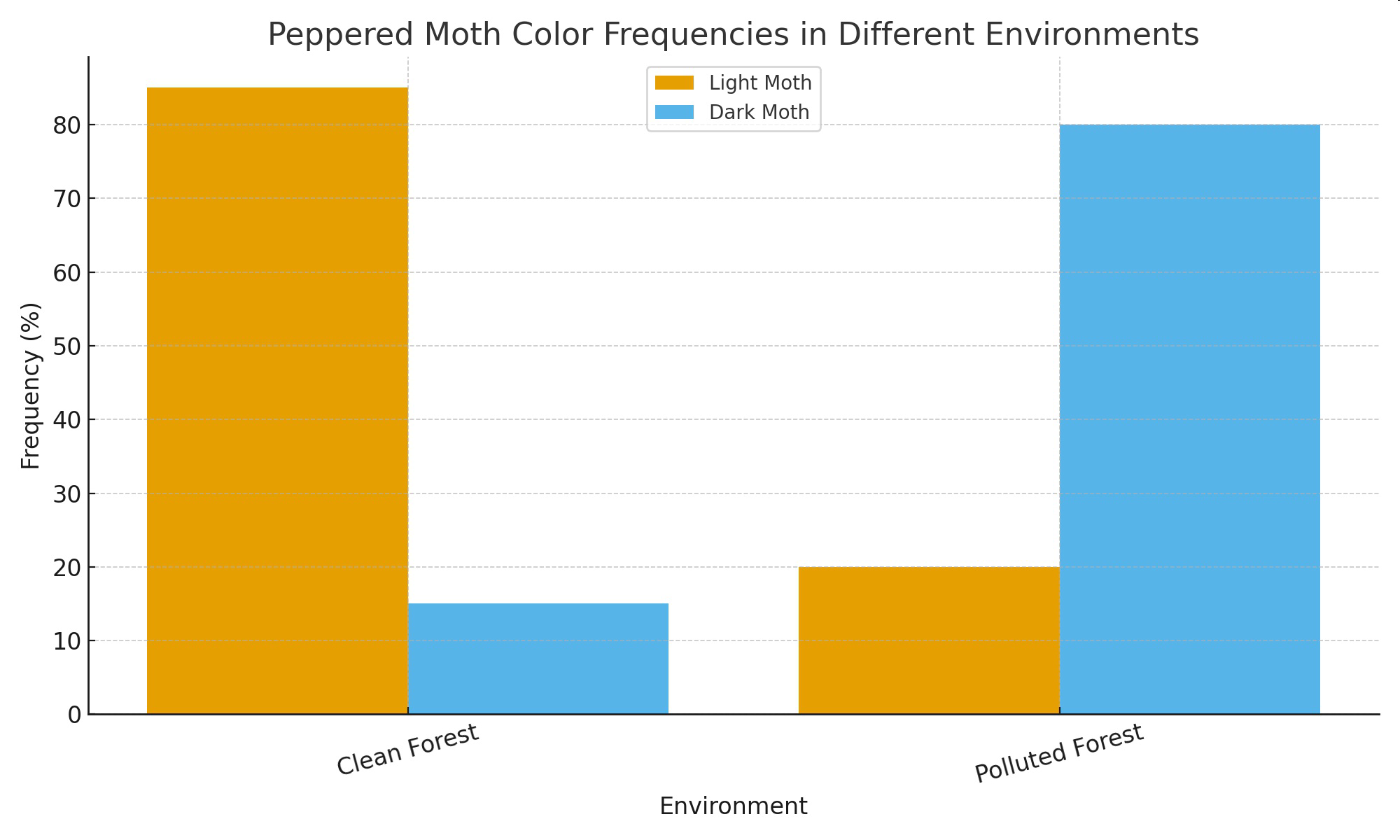
Table 2.
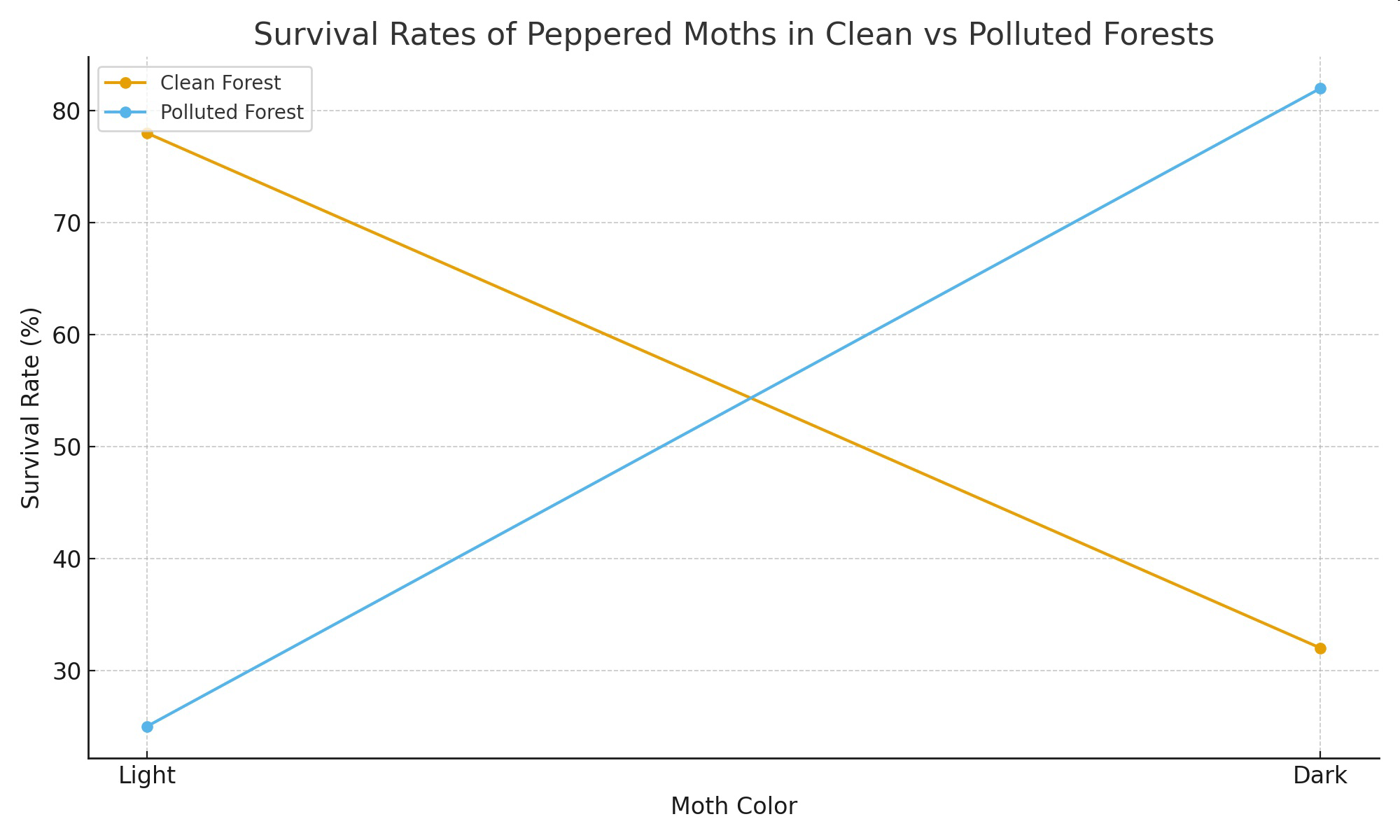
Moth Color | Survival in Clean Forest (%) | Survival in Polluted Forest (%) |
|---|
Light | 78 | 25 |
Dark | 32 | 82 |
Graph of Information - Figure 2.