The Black Guillemots of Cooper Island
Key Points
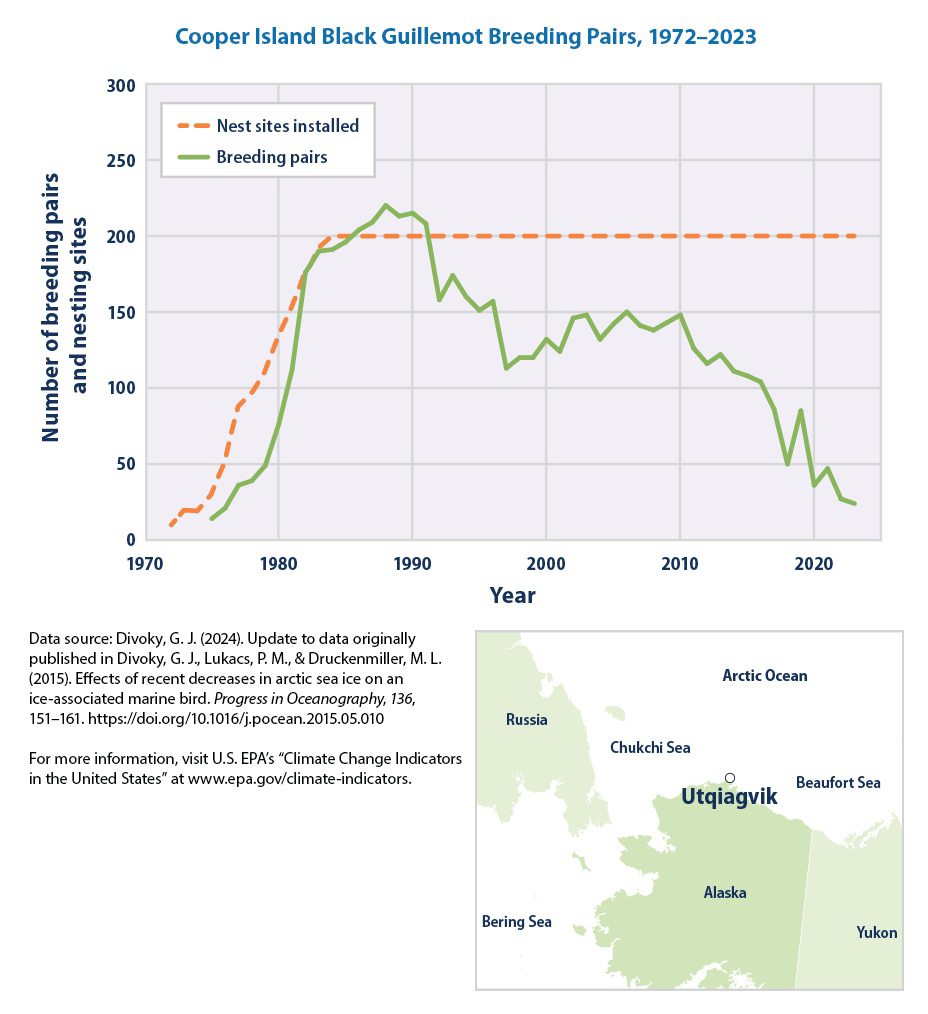
The black guillemot population on Cooper Island reached a peak of more than 200 pairs in the late 1980s, but the number has decreased by more than 80 percent since then (see Figure 1). In 2023, scientists observed only 24 breeding pairs.
Although the initial increase in breeding pairs coincided with an expansion of available nesting sites, the decrease since the 1980s has occurred despite a constant number of nesting sites.
The decline over the last three decades has coincided with reduced breeding success, earlier egg laying, and a decrease in the presence of sea ice in the region.
Data from another long-studied colony on the edge of the Beaufort Sea (Herschel Island, Canada) suggest that similar trends are occurring across the western Arctic region.
Background
A colony of black guillemots have made Cooper Island near Utqiagvik (formerly Barrow), Alaska, home for at least 50 years. The area’s unique landscape and sea ice are integral components of this bird’s habitat. The black guillemot spends the winter on Arctic sea ice, and it breeds on land near the edge of the ice in summer. One of the primary food sources for the birds’ chicks is the Arctic cod, which thrives in cold, ice-covered waters. Warming temperatures and other changes are reducing the extent and persistence of Arctic sea ice, which has been linked to a decline in the abundance of Arctic cod over the last few decades.
The region has experienced an increase in the number of days without snow cover each year. This longer period has helped the black guillemots during breeding season, when they prefer a snow-free nest cavity. However, as the Arctic has warmed, sea ice has decreased significantly - melting earlier and freezing later. This change, for certain parts of the year, has led to more open water and increased the distance from the coast to the edge of the ice, where these birds forage for Arctic cod. This type of ecosystem change has broader implications not only for these two species, but also for other animals in the Arctic that depend on marine prey, such as polar bears, and for people who depend on Arctic animals for food and other resources.
A group of scientists and volunteers have been observing and counting birds at the Cooper Island colony for almost 50 years. Birds are counted every summer and identified as breeding pairs if two are found to be inhabiting a specific nesting site on the island. This long-term record provides valuable clues about how rapid changes being observed in the Arctic may be influencing the natural environment.
Figure 1.
Year | Breeding pairs | Nest sites installed |
|---|
1972 | 10 | 10 |
1973 | 10 | 20 |
1974 | 10 | 20 |
1975 | 14 | 30 |
1976 | 21 | 52 |
1977 | 36 | 88 |
1978 | 39 | 97 |
1979 | 49 | 110 |
1980 | 76 | 134 |
1981 | 112 | 153 |
1982 | 176 | 175 |
1983 | 190 | 192 |
1984 | 191 | 200 |
1985 | 196 | 200 |
1986 | 204 | 200 |
1987 | 209 | 200 |
1988 | 220 | 200 |
1989 | 213 | 200 |
1990 | 215 | 200 |
1991 | 208 | 200 |
1992 | 158 | 200 |
1993 | 174 | 200 |
1994 | 160 | 200 |
1995 | 151 | 200 |
1996 | 157 | 200 |
1997 | 113 | 200 |
1998 | 120 | 200 |
1999 | 120 | 200 |
2000 | 132 | 200 |
2001 | 124 | 200 |
2002 | 146 | 200 |
2003 | 148 | 200 |
2004 | 132 | 200 |
2005 | 142 | 200 |
2006 | 150 | 200 |
2007 | 141 | 200 |
2008 | 138 | 200 |
2009 | 143 | 200 |
2010 | 148 | 200 |
2011 | 126 | 200 |
2012 | 116 | 200 |
2013 | 122 | 200 |
2014 | 111 | 200 |
2015 | 108 | 200 |
2016 | 104 | 200 |
2017 | 86 | 200 |
2018 | 50 | 200 |
2019 | 85 | 200 |
2020 | 36 | 200 |
2021 | 47 | 200 |
2022 | 27 | 200 |
2023 | 24 | 200 |
Graph of Information from Figure 1.
This figure shows the number of breeding pairs in the black guillemot colony that inhabits Cooper Island along the north coast of Alaska, measured at the peak of breeding season (green line). The dashed orange line indicates the number of installed nest site structures available to black guillemots on Cooper Island each year.