Read the passage “The Straw, the Coal, and the Bean” and then answer Numbers 1 through 6.
The Straw, the Coal, and the Bean
adapted from the Brothers Grimm
1 In a village lived a poor old woman, who had gathered some beans and wanted to cook them. So she made a fire on her hearth. To make the fire burn more quickly, the old woman used a handful of straw.
2 While she was emptying the beans into a pan, one dropped without her realizing it and lay on the ground beside a straw. Soon afterward, a burning coal from the fire leaped down to the bean and straw.
3 The straw said, “Dear friends, where did you come from?”
4 The coal replied, “Luckily, I came out of the fire. If I had not escaped, I would have been turned into ashes.”
5 The bean said, “Like you two, I also escaped. But if the old woman had gotten me into the pan, I would have been made into soup.”
6 The straw explained, “The old woman used all my friends to make the fire. She took sixty of them at once. I luckily slipped through her fingers.”
7 “What are we going to do now?” asked the coal.
8 “I think,” answered the bean, “that since we were all able to escape, we should stay together and help each other. Let’s go away to a distant place in case there is trouble for us here again.”
9 This plan pleased the two others, and they set out on their way together. Soon, however, they came to a little brook. As there was no bridge, they did not know how to get over.
10 At last the straw said, “I will lay myself across so you can walk over me as on a bridge.”
11 The straw stretched herself from one bank to the other. The coal, who had a habit of making careless decisions, hurried forward on the newly built bridge. But when she reached the middle and heard the water rushing underneath, she became
scared and stood still.
12 The straw began burning from the coal and broke into two pieces. They both fell into the stream. The coal hissed as she sank
into the water.
13 The bean had smartly stayed behind on the shore. She could not help laughing at these events. But she ended up laughing so
energetically that she burst.
14 A tailor who was traveling in search of work had sat down to rest by the brook. He had seen everything. Feeling sorry for the
bean, the tailor pulled out his needle and thread and sewed her together. The bean was very thankful. But as the tailor used black
thread, beans ever since have always had a black seam.
Select one sentence from the passage that tells why the straw
wants to escape.
Read this sentence from the passage.
“To make the fire burn more quickly, the old woman used a
handful of straw.” (paragraph 1)
What is the meaning of handful as it is used in this sentence?
This question has two parts. First, answer Part A. Then, answer
Part B.
Part A
What do the straw’s actions at the brook show about her
perspective?
Part B
Which detail from the passage shows the straw’s perspective?
What do paragraphs 12 and 13 add to the passage?
What is the theme of the passage?
Read the passages “Early Traders” and “Museums of the Sea” and
then answer Numbers 7 through 12.
Passage 1: Early Traders
1 For thousands of years, people have traded with each other to get the things they need. For example, more than two thousand years ago, people traveled by road from Asia to Europe. This network of roads was called the Silk Road. The travelers brought tea, spices, and other precious items to places where they could sell them. Then, they would return, bringing different products back with them.
Goods and Services
2 The exchange of goods and services is called trade. Goods are products that you can touch. Examples of goods are food, cars, and clothing. Services are actions that one person does for another person. Services include car repairs, haircuts, and going to see the doctor.
Imports and Exports
3 In the early days, people grew much of their own food. They also made many of the things they needed in life. But some things, such as spices and tea, can only be grown in certain places in the world. Other countries had special skills and knowledge, such as how to make silk. Still, other countries had valuable natural resources, such as tin and copper.
4 To get things they needed, people would trade goods. An import is a product bought from another country. When you sell your product to another country, it is an export. For example, some countries grow a lot of wheat. But they might not grow rice. The wheat-growing country can sell its wheat as an export. Then, it can buy rice from another country.
Trade in the American Colonies
5 Trade in the American colonies took place at seaports and along rivers. In the North, people exported fur, wood, maple syrup,
and fish.
6 In the South, people exported tobacco, cotton, sugar, and other types of farm products.
7 The colonies traded these raw materials for finished goods. Examples of finished goods are machinery and tools. They also imported food products, such as tea.
Passage 2: Museums of the Sea
8 Between the middle of the sixteenth and eighteenth centuries, many ships came to explore the New World. The Spanish wanted to claim Florida as a colony. They were also looking for new places to trade.
Precious Cargo
9 The Spanish ships brought clothing, food, and household goods to the colonists. They returned to Spain with gold, silver, and gemstones. They also carried tobacco, animal hides, sugar, spices, and dyes.
10 The Spanish required all of their merchant ships to sail in large groups because England, France, and the Netherlands tried to steal their cargo. These countries competed for the same resources.
Dangerous Waters
11 The eastern coast of Florida is sometimes called the Treasure Coast. Many Spanish treasure ships sank there. The return trip to Spain was the most dangerous part of the journey.
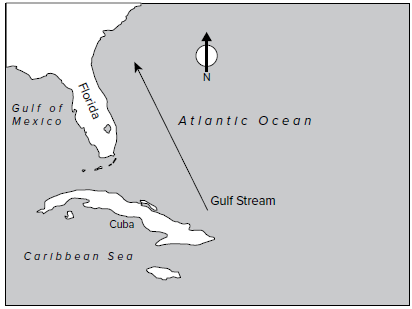
12 The Spanish fleet sailed from Spain down the coast of Africa. Then, they sailed to the Caribbean. The fleet would then split up. Some ships went to South America, others to the Gulf of Mexico. Then, they would ride the Gulf Stream before crossing the Atlantic
Ocean.
13 The ships faced many dangers. Hurricanes caused many shipwrecks. The high winds and water caused ships to hit the coast and reefs.
Famous Shipwrecks
14 Many shipwrecks happened off the coast of Florida. In 1559, the Spanish colonists were anchored near Pensacola Bay. Then, a hurricane hit. They lost a large number of ships. The wreckage from the 1559 hurricane was discovered in 1992.
15 In 1622, the Tierra Firme Fleet was preparing to return to Spain. But it lost two of its ships in the Florida Keys during a hurricane. At least 380 people died on board. The ships had gold pieces, silver from Peru and Mexico, gold and emeralds from Columbia, and pearls from Venezuela. One of the ships was found in 1985.
Undersea Adventure
16 Finding Florida’s lost ships has been very popular since the 1800s. People competed to find the cargo in these wrecked ships.
17 The shipwrecks have become important in other ways, too. They can teach the public about history. They also provide habitats for marine life. Some shipwrecks are protected now. Divers go down to the ships to do archaeological research. And some tourists even come to Florida to tour the famous wrecks.
Now answer Numbers 6 through 12. Base your answers on the
passages “Early Traders” and “Museums of the Sea.”
Read this sentence from Passage 1.
“This network of roads was called the Silk Road.” (paragraph 1) What is the meaning of network as it is used in Passage 1?
Read this sentence from Passage 1.
“The colonies traded these raw materials for finished goods.”
(paragraph 7)
What is the meaning of raw as it is used in Passage 1?
Read these sentences from Passage 1.
“In the early days, people grew much of their own food. They also made many of the things they needed in life.” (paragraph 3)
What is the meaning of the phrase in life as it is used in Passage 1?
What does Museums of the Sea mean as it is used in the title of
Passage 2?
Select two reasons that tell why the author included paragraph 8
in Passage 2.
How are Passages 1 and 2 alike?
Read the passages “The Robinson Farm” and “One Troubled Spring
Day” and then answer Numbers 13 through 19.
Passage 1: The Robinson Farm
1 Rebecca opened her eyes and blinked. Sun filled her room with light. She threw the heavy comforter aside and ran to the window.
Snow covered the fields. It was a sight she’d been waiting for. Finally, winter was officially here.
2 “Mother, Father!” Rebecca yelled to her parents. “It snowed last night!” She threw on her warmest clothes and bounded down
the stairs.
3 Her mother stepped out from the kitchen. “Wait, one minute. You need to help Father with the horses.”
4 Rebecca sighed and trudged into the kitchen. Her mother handed her a bowl of steaming oatmeal. She gulped it down quickly, burning her tongue, before heading to the breezeway to put on her work boots.
5 She charged out the door, almost tripping on the icy steps. Her father was already in the barn. He looked up and smiled at her when she entered. “Ready to clean out the stalls?” he asked, knowing what her answer would be.
6 “Never! It’s a beautiful day to play outside!” she exclaimed. She picked up a shovel and pulled the wheelbarrow over to Treasure’s stall. “Good morning, Treasure!” Rebecca opened the stall and led Treasure out. Then, Rebecca returned to the barn to clean out the stall.
7 An hour later, Rebecca had finished her chores. “Father, I finished cleaning out the stalls. I’m going to go play in the
snow now.” Father replied, “I still need some help with the chickens. Would you let them out and take the eggs to Mother?”
9 Rebecca muttered under her breath, “I’ll never get to play in the snow.”
10 “Oh, yes you will. But you know a farmer’s work is never done. You have to make hay while the sun shines!” her father exclaimed.
11 “Oh, Father. You say that all the time!” Rebecca replied. “But I have my own saying: You have to make play while the snow
shines! That’s my most important job!”
12 Her father laughed as Rebecca ran outside and threw herself down into the snow. She flapped her arms and legs until she had
made a beautiful snow angel. She leapt up and continued to the chicken coop, taking in the cool fresh air of the first snow.
Passage 2: One Troubled Spring Day
13 Jaxon walked home slowly. His schoolbag felt especially heavy in the warm weather. Even though he usually took his time to enjoy the new spring flowers, his slow steps had another reason. He didn’t want to tell his parents about his report card.
14 Suddenly, he heard a caw and looked up to see a pair of eagles flying high above. One of the birds flew up into the air and then dove into the field, reappearing with a small animal in its talons.
15 Jaxon gasped and ran the rest of the way. “The eagles are back! One of them caught a rabbit!” he called. “That’s great!” his mom replied. “One less critter to eat the
garden this spring.”
17 Jaxon frowned. How could his mother be happy about the eagle eating a rabbit? “I think we should rescue it.”
18 “When pigs fly!” Mom responded. Seeing her son’s confused face, she continued, “There’s no way you can take food from an
eagle. Don’t worry. There are other rabbits!”
19 “What do pigs have to do with it?” Jaxon ran up to his room, his face hot with shame.
20 “What’s wrong? You know the eagle needs to eat, too,” his mother asked, concerned.
21 “It’s not the eagle,” Jaxon sputtered. “I got a C on my report card.”
22 “A C is not the end of the world. You will do better next time,” his mother said. “Did you think we would be angry?”
23 “Yes,” Jaxon, said worriedly. He turned to face his mother. “You’re not?”
24 “No,” her mother replied. “You were sick and missed class. These things happen.”
25 Jaxon let out a sigh of relief. “Thank you for understanding, Mom,” he said as he gave her a hug. “You’re the best.”
26 Mom squeezed him back. “Now let’s get a snack and go out to the garden. We need to mulch that new garlic.”
Now answer Numbers 13 through 22. Base your answers on the passages “The Robinson Farm” and “One Troubled Spring Day.”
Read this sentence from Passage 1.
“Snow covered the fields.” (paragraph 1)
What is the meaning of covered as it is used in the sentence?
This question has two parts. First, answer Part A. Then, answer Part B.
Part A
Which sentence describes Rebecca’s perspective in Passage 1?
Part B
Select two sentences from paragraph 4 & 5, in Passage 1, that support your answer in Part A.
Read these sentences from Passage 1.
“‘But I have my own saying: You have to make play while the snow shines! That’s my most important job!’” (paragraph 11)
Why does Rebecca use the expression You have to make play while the snow shines?
This question has two parts. First, answer Part A. Then, answer
Part B.
Part A
Read this sentence from Passage 2.
“‘When pigs fly!‘ Mom responded.” (paragraph 18)
What does the expression when pigs fly mean as it is used in
this sentence?
Part B
Which sentence from Passage 2 supports your answer in Part A?
This question has two parts. First, answer Part A. Then, answer Part B.
Part A
Which sentence describes Jaxon’s feelings at the beginning of Passage 2?
Part B
Which sentence tells what happens because of Jaxon’s feelings?
How is Jaxon’s perspective different from his mom’s perspective in Passage 2?
Passage 1 | Passage 2 | Both Passages | |
|---|---|---|---|
People are understanding. | |||
Do your work before you have fun. | |||
There is beauty in the changing seasons. |
Read the passage “Our Nearest Neighbor” and then answer Numbers 23 through 28.
Our Nearest Neighbor
1 The Moon is Earth’s closest companion. It is about 239,000 miles (384,000 kilometers) away from Earth. The diameter of the Moon is about 2,160 miles (3,476 kilometers). You can see it in the sky on most nights. Sometimes, it is so bright that it lights up the night. The Moon does not make its own light. The sun shines on the Moon. We see sunlight as it reflects back on us.
How Was the Moon Formed?
2 No one is completely sure how the Moon was formed. However, many scientists agree on one idea. They believe that long ago, Earth hit another planet and a chunk of Earth broke off. That chunk is now the Moon.
How Does the Moon Affect Us?
3 The Moon actually affects many events on Earth. The Moon is very heavy. This heavy mass of rock has gravity, a force that pulls
things toward its center.
4 Earth has gravity too. Earth’s gravity keeps your feet on the ground. It pulls you back to the ground when you jump. The Moon’s gravity is much less than Earth’s. You could jump much higher if you were on the Moon. But even though the Moon’s gravity is not as strong as Earth’s, it is strong enough to do
other things.
5 The Moon’s gravity pulls on Earth. It is not strong enough to pull Earth toward it, but it is strong enough to pull the water in the
oceans. That is why we have tides. As the Moon pulls on the water, oceans rise and fall.
6 Tides are easy to see if you stand on a beach. When the tide rises, water comes closer to shore. When it falls, the water flows
away from the shore.

The Moon’s Surface
7 The surface of the Moon is quite harsh. It is either very cold or very hot. There is no air to breath. There is no wind. It has no running water. There are no plants or living things there. It would not be a very comfortable place to live. Still, the Moon is our neighbor, and we want to know as much about it as we can.

The Moon Today
8 Several countries, including India, China, Japan, and the United States, continue to explore the Moon. As we further develop our
knowledge, we plan to have Americans return to the Moon.
9 In the future, scientists hope to send humans to other planets, such as Mars. The Moon could be an ideal place to launch other
missions. The Moon could help us learn more about space and other planets than we have ever known before.
Now answer Numbers 23 through 30. Base your answers on the
passage “Our Nearest Neighbor.”
This question has two parts. First, answer Part A. Then, answer Part B.
Part A
What is the central idea of this passage?
Part B
Which sentence supports your answer in Part A?
Complete the table to match each heading with its central idea.
How Was the Moon Formed? | How Does the Moon Affect Us? | The Moon's Surface | The Moon Today | |
|---|---|---|---|---|
explains how the Moon first came to be | ||||
explains how the Moon is different from earth | ||||
explains how the Moon is important for science | ||||
explains how the Moon causes events on the surface of the earth |
This question has two parts. First, answer Part A. Then, answer Part B.
Part A
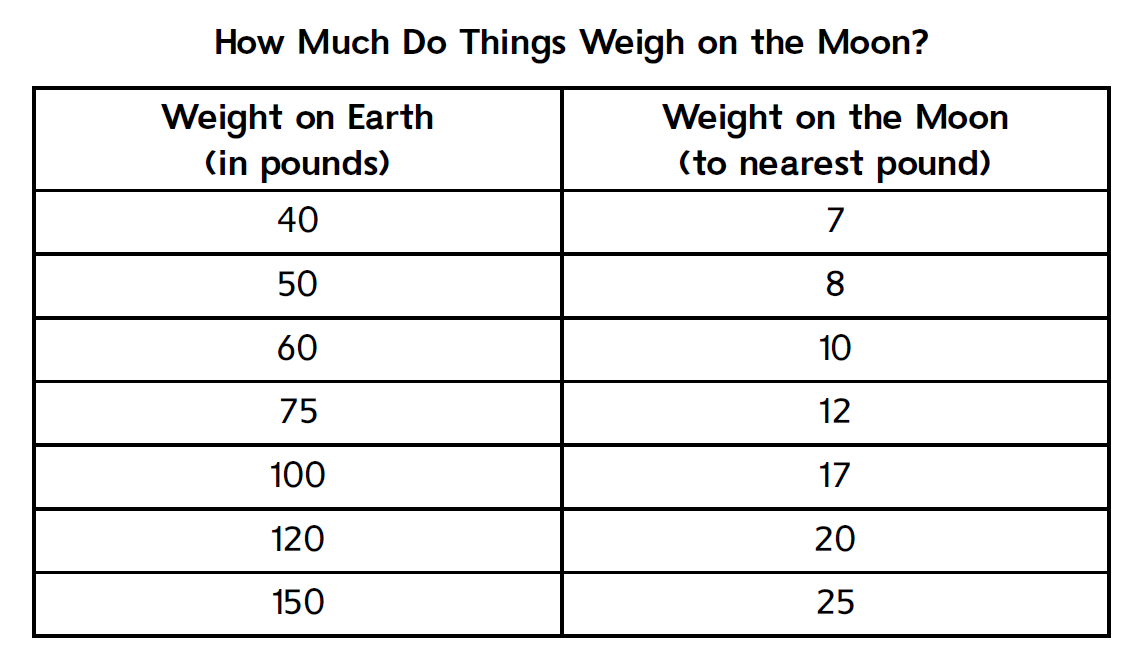
Select the idea from the passage that the table How Much Do
Things Weigh on the Moon? helps explain.
Part B
Which part of the table supports your answer in Part A?
This question has two parts. First, answer Part A. Then, answer Part B.
Part A
Read this sentence from the passage.
“Several countries, including India, China, Japan, and the United States, continue to explore the Moon.” (paragraph 8)
What is the meaning of explore as it is used in the sentence?
Part B
Which phrase from the passage supports your answer in Part A?
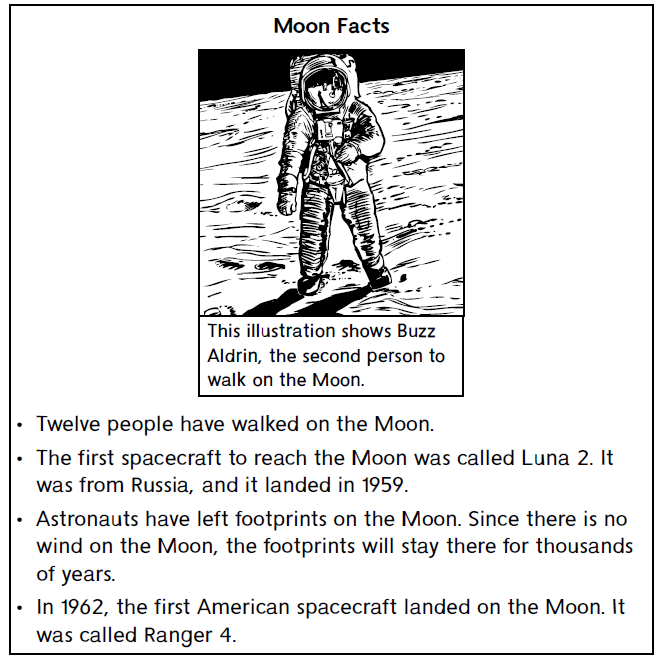
What is the purpose of the Moon Facts sidebar in the passage?
Read the passages “Moon Rabbit” and “The Woodcutter” and then
answer Numbers 31 through
Passage 1: Moon Rabbit
Here, little rabbit, come tell me a story.
A special tale that tells of your glory.
For once upon a time, a long time ago,
You rose to the Moon, from Earth down below.
5 “Why should I tell the tale?” asks Jade Rabbit,
I must make medicine and don’t have time to share it!
For my dear companion, the great Chang‘e,
She needs me to pound the elixir of life for her.
Of course, little rabbit, you are humble and kind,
10 You work so hard, I’m sure you never have time.
Every full Moon, we see your tail and long ears,
Shining bright for all to see, year after year.
Oh, ok, if I must, I will tell you what I did,
I helped three immortals when they were looking
15 for food.
But my offering was an embarrassment, and so
guilty felt I,
I jumped into the fire, but for my sacrifice I did not die.
Thank you, dear rabbit, for telling your tale,
20 Your life shows that in the end you did not fail.
When we see the autumn Moon and dream of the
Moon Palace,
We honor you and your call to duty, your offering
so pious.
Now answer Numbers 31 through 39. Base your answers on the passages “Moon Rabbit” and “The Woodcutter.”
Read this line from Passage 1.
“I jumped into the fire, but for my sacrifice I did not die.” (line 18)
What is the meaning of sacrifice as it is used in the poem?
This question has two parts. First, answer Part A. Then, answer Part B.
Part A
What type of poem is Passage 1?
Part B
Which lines from the poem support your answer in Part A?
What do lines 13–16 add to Passage 1?
Complete the table to create a summary of Passage 2.
First | Next | Finally | |
|---|---|---|---|
Yang speaks with the woodcutter. | |||
Yang puts a moon cake in his pocket. | |||
Yang finds out he will visit his Auntie. |
Read this sentence from Passage 2.
“Soon, he was fast asleep.” (paragraph 9)
What is the meaning of fast as it is used in this sentence?
Why does Yang thank the woodcutter at the end of Passage 2?
How are Passage 1 and Passage 2 alike?
How is the speaker’s perspective in Passage 1 and the main
character’s perspective in Passage 2 alike?