Red–Green Color Vision
Color vision in humans depends on specialized cone cells located in the retina. These cells contain proteins called opsins, which absorb specific wavelengths of light. Humans normally have three types of cone opsins - blue, green, and red - each encoded by different genes. The structure of an opsin protein determines which wavelengths it absorbs best, allowing the brain to distinguish millions of colors by comparing signals from these cells.
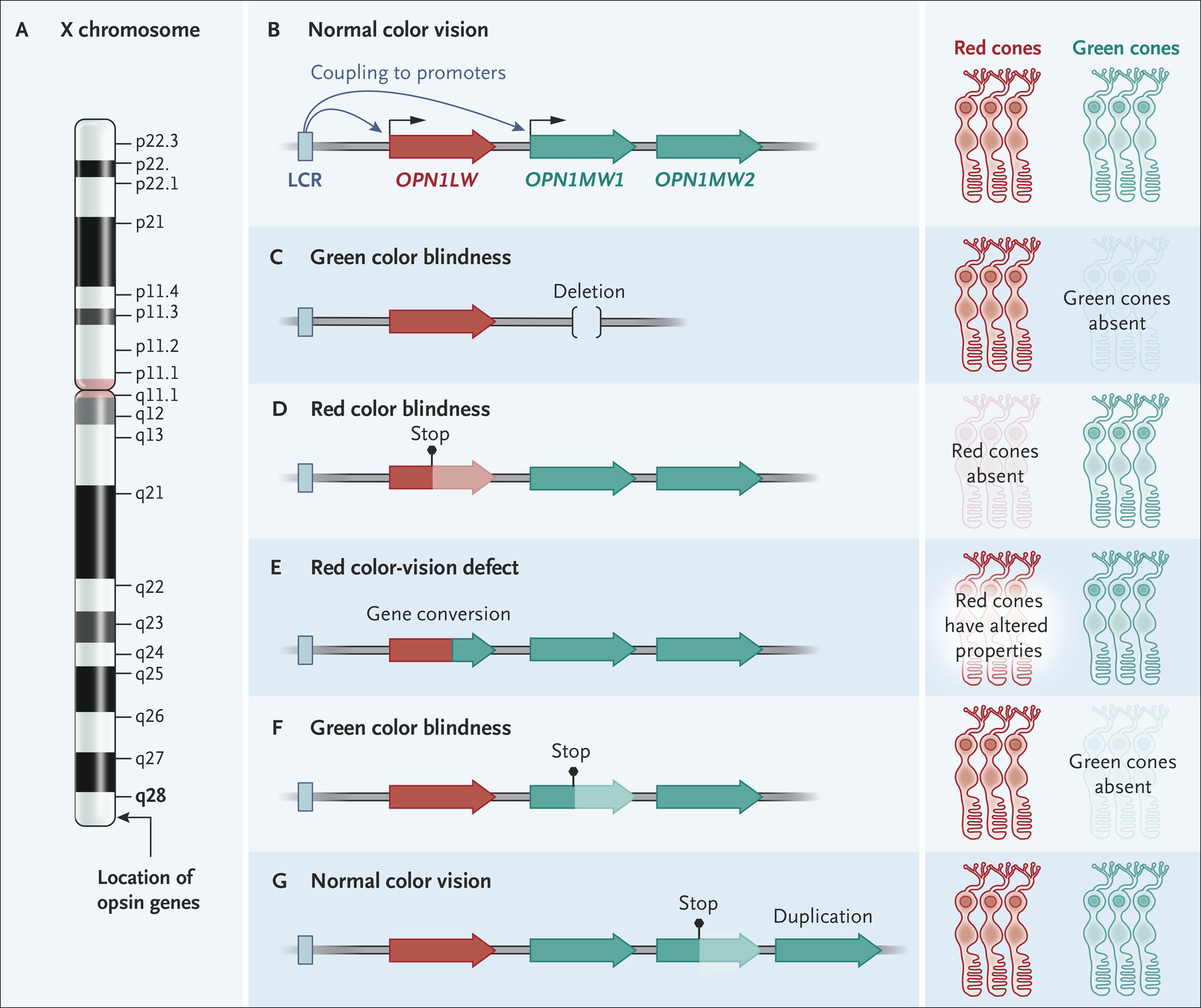
Red–green color vision deficiencies, including protan (red-shifted) and deutan (green-shifted) types, are caused by mutations in the OPN1LW (red) or OPN1MW (green) opsin genes. These genes are remarkably similar and located next to each other on the X chromosome. Because of this similarity, during meiosis the DNA can misalign, leading to unequal crossing-over events or point mutations. Even a single amino acid substitution in an opsin can shift its absorption peak by altering the protein’s shape and how it interacts with light-sensitive molecules.
Opsins bind to retinal, a light-absorbing molecule. The exact amino acids surrounding retinal determine the wavelengths of light the opsin is most responsive to. When a mutation alters the amino acids in the binding pocket, the opsin’s structure changes slightly. This small structural difference can shift the protein’s absorption peak by 5–20 nanometers. While such a shift is chemically minor, its impact on color detection is significant: wavelengths that were once distinguishable become confused.
For example, individuals with a green opsin mutation (deutan) produce a protein that absorbs light more like a red opsin. Their cone cells send overlapping signals that the brain cannot interpret as distinct colors. Similarly, a red opsin mutation (protan) shifts sensitivity toward the green range. Because these traits are X-linked, they occur more frequently in males.
Color vision deficiencies illustrate the central idea: DNA determines protein structure, and protein structure determines function. A mutation that changes one or more amino acids alters the shape and absorption properties of opsin proteins. This change affects how cone cells detect light, ultimately influencing the nervous system’s ability to interpret color. Though the molecular changes are small, their effects cascade across cells, tissues, and neural pathways, demonstrating the critical connection between genetic sequence and biological function.
Table 1.
Genotype | Red Green Discrimination Accuracy ($\%$) | Opsin Mutation Frequency ($\%$) |
|---|
Normal (OPN1LW/OPN1MW) | 98 | 5 |
Deutan (Green Opsin Shift) | 45 | 8 |
Protan (Red Opsin Shift) | 30 | 6 |
Graph of Information - Figure 1.
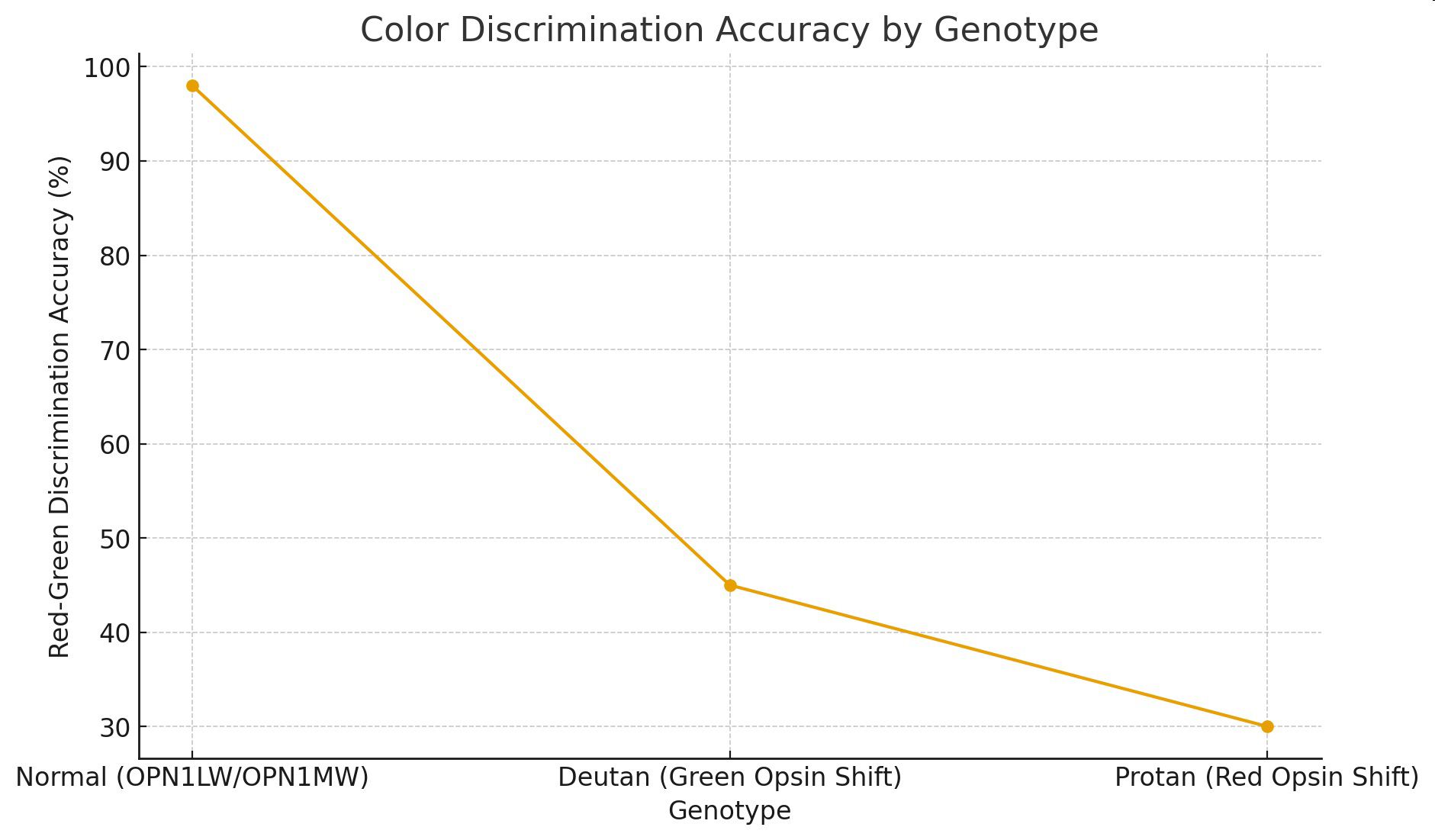
Table 2.
Wavelength (nm) | Normal Response (arb. units) | Mutant Response (arb. units) |
|---|
500 | 20 | 15 |
520 | 50 | 25 |
540 | 80 | 40 |
560 | 60 | 25 |
580 | 30 | 10 |
Graph of Information - Figure 2.
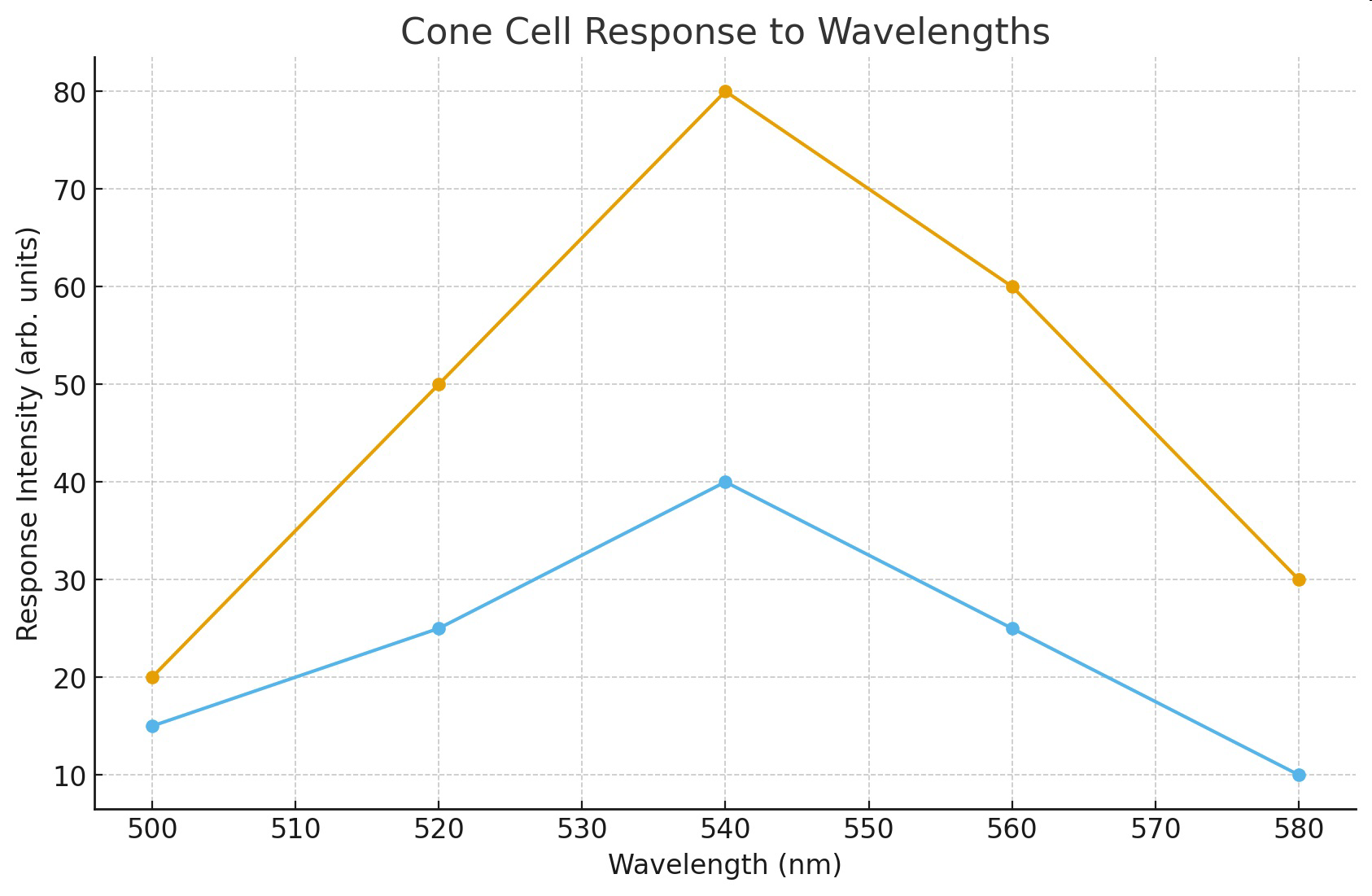
Figure 3.
 Source: https://www.nejm.org/doi/full/10.1056/NEJMra1809315