Use the historical document(s) and the short readings in the left panel to answer the associated questions.
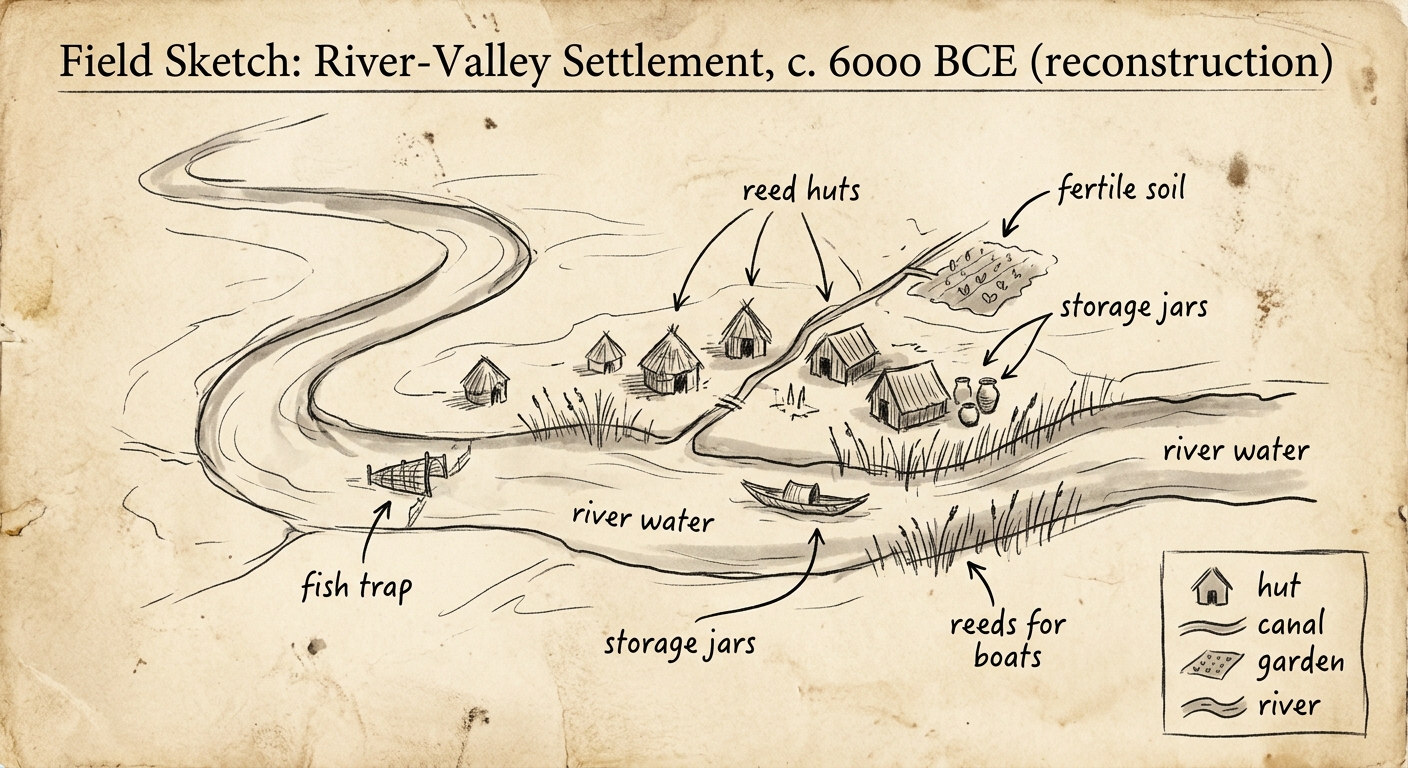
Read the short note below and study the field sketch.
A river settlement could use water for drinking, fishing, and small gardens. Nearby reeds and clay could become boats and pots. Compare how people might adapt differently in deserts, mountains, rainforests, or along coasts.

Based on the document and reading, which resource most directly supports both gardening and fishing in this settlement?
Which adaptation would be MOST similar if the same group lived along a coast instead of a river valley?
Which challenge is a river-valley settlement like this one MOST likely to face?
Compare this river-valley settlement with either a desert oasis settlement or a mountain settlement.
Explain how the environment would likely change
(1) where people live and
(2) how they get food.
Use at least two pieces of evidence from the document/reading.
What can you infer about how people in this river settlement might have organized work or trade?
Choose one inference (for example: cooperation to maintain canals, sharing fishing areas, storing surplus, or trading pots/boats) and support it with evidence from the document/reading.
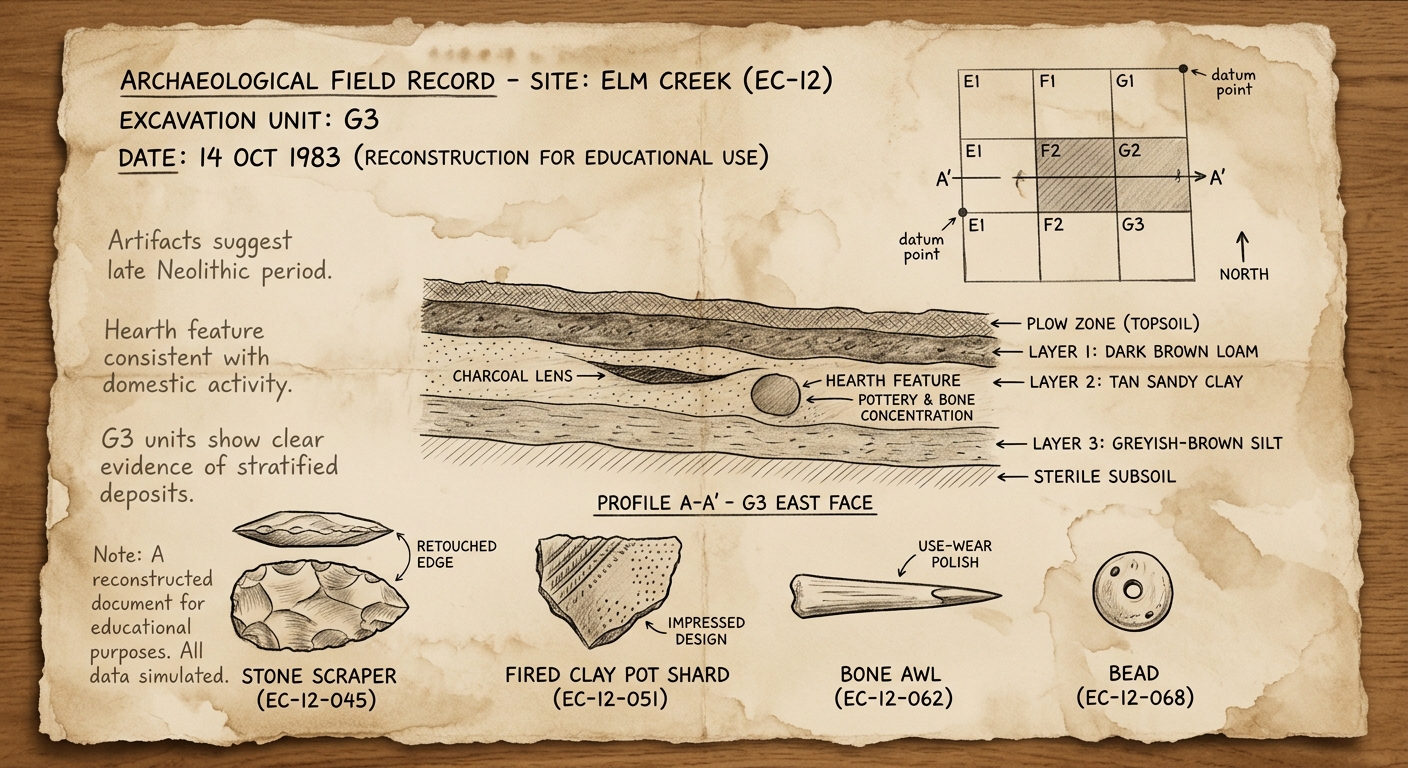
Archaeologists record soil layers, map a site grid, and sketch artifacts to understand how people lived. In this dig, a hearth feature and tools were found in different layers. Compare what this evidence might suggest in a riverside camp versus a mountain shelter.

Based on the excavation record, which item is MOST clearly an example of an artifact (not a feature)?
Which conclusion is BEST supported by finding a hearth feature and charcoal in one layer and different tools in another layer?
If a similar set of artifacts were found in a mountain rock shelter instead of near a river, which additional evidence would BEST support the idea that people were adapting to mountain conditions?
Compare what archaeologists might infer from this excavation record if it came from
(A) a riverbank campsite and
(B) a desert oasis campsite.
In your comparison, explain how the environment could change both
(1) the kinds of artifacts/features left behind and
(2) what people did to get food or water.
Use at least two pieces of evidence from the document/reading.
Choose ONE artifact shown in the document and explain what it might suggest about daily life. Then explain one limitation of using that single artifact as evidence (what it cannot prove).
Use evidence from the excavation record and reading.
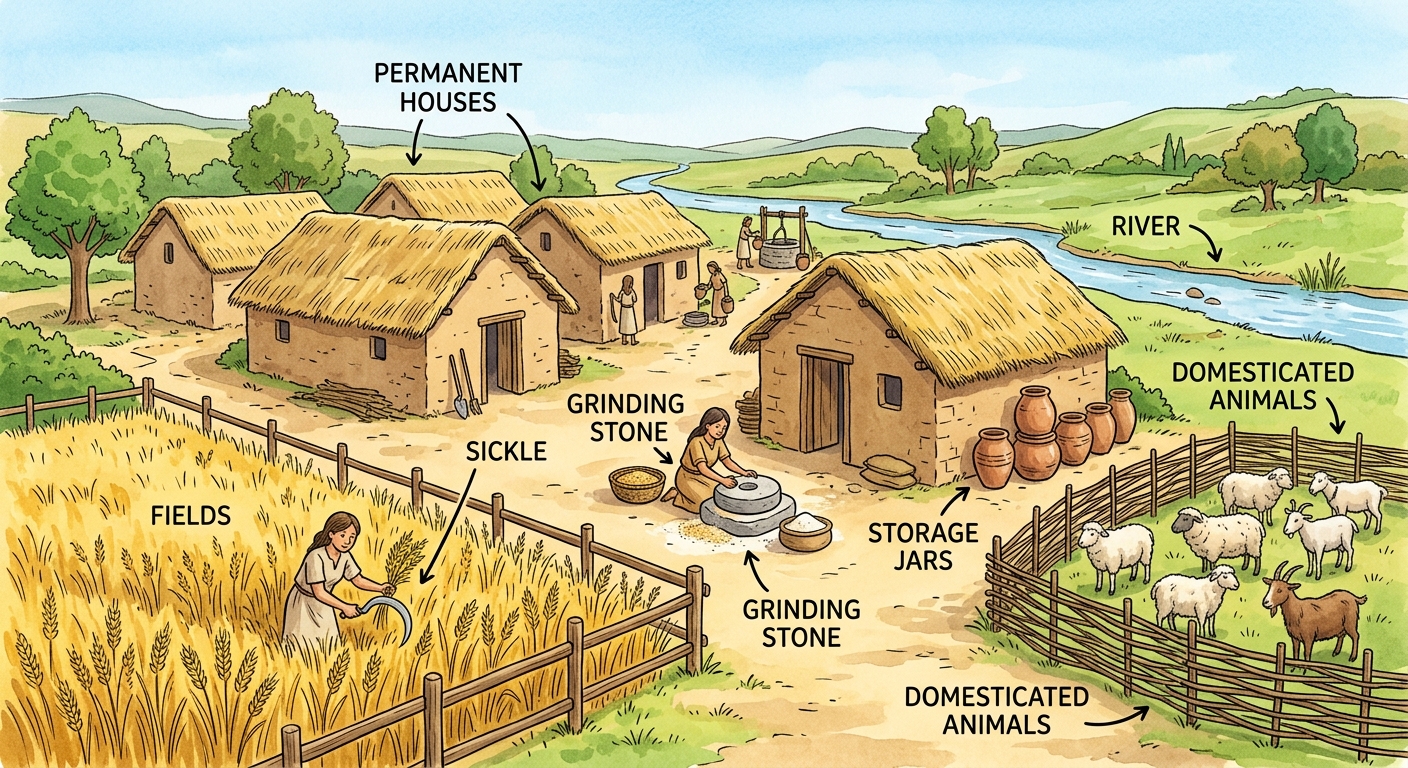
Study the document above. During the Neolithic Revolution, new farming tools and domesticated animals made it possible for some groups to stay in one place. Compare what this village suggests about daily life to what you would expect in a hunter-gatherer camp.

Which detail in the document BEST supports the idea that this group lived in a sedentary settlement (stayed in one place)?
Which pair of items from the document MOST directly represents technological advances of the Neolithic Revolution?
Compared with hunter-gatherer groups, which challenge would MOST likely increase for people living in a farming village like the one shown?
Compare what daily life might have been like in this Neolithic village and in a hunter-gatherer camp. In your comparison, explain (1) how people got food and (2) how often they likely moved. Use at least two pieces of evidence from the document/reading.
What can you infer about how domesticated animals and stored crops could change work or trade in this village? Choose one inference (for example: new jobs, shared labor, or exchanging surplus) and support it with evidence from the document/reading. Then explain one limitation of your inference.
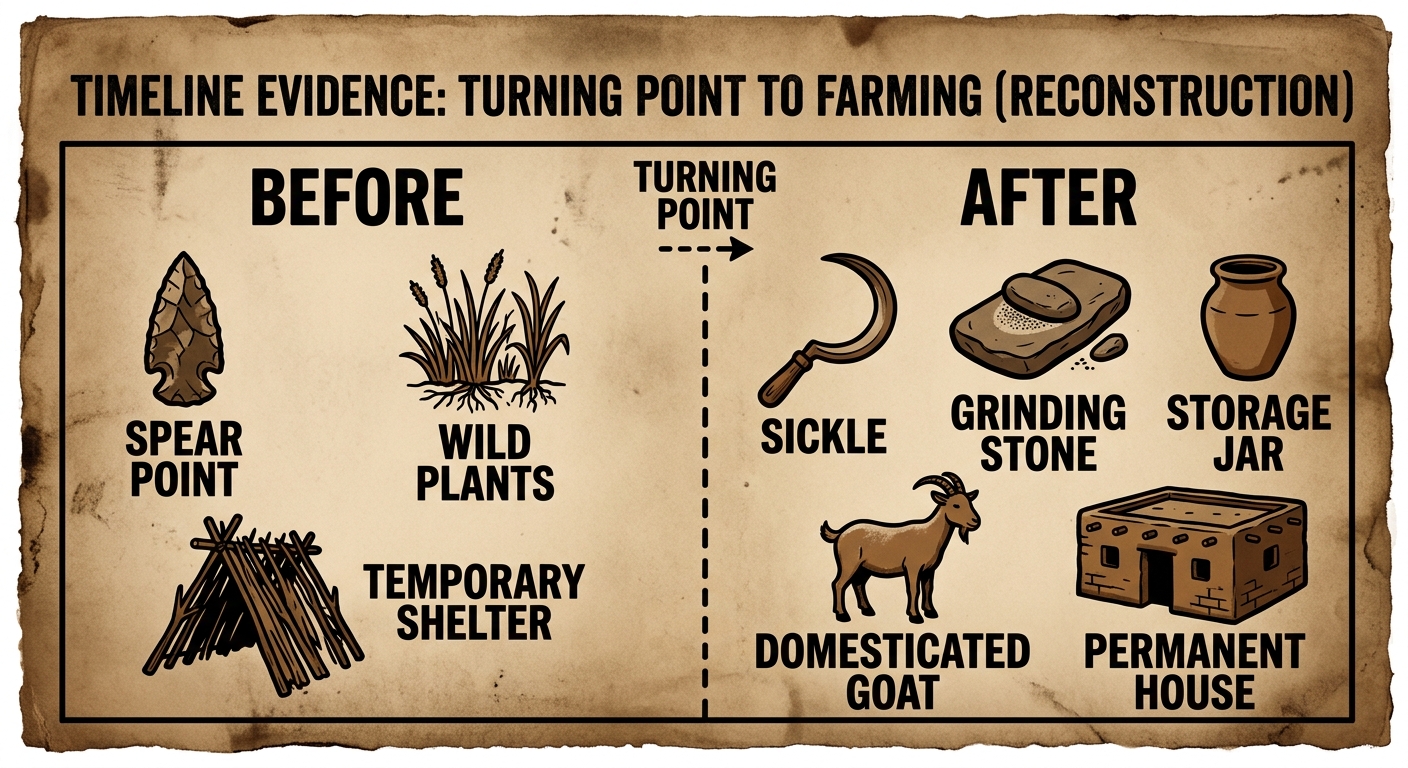
Historians and archaeologists use artifacts and other evidence to identify turning points—changes that reshape daily life. This reconstructed timeline shows evidence from a group before and after people began farming and keeping animals. Compare what life might look like in each period using the evidence.

Based on the document, which change is BEST evidence that this society experienced a turning point?
Which piece of evidence from the "After (early farmers)" part of the document MOST directly suggests a change in the food supply?
Which comparison is BEST supported by the evidence in the document?
Explain how the evidence in the document could help a historian argue that the shift to farming was a turning point. In your answer, compare life before and after the turning point and use at least two specific pieces of evidence from the document/reading.
Choose ONE type of evidence from the document (for example: storage jar, sickle, domesticated animal, or temporary shelter). Explain what it suggests about daily life AND explain one limitation of using only that evidence to identify a turning point.