Ɛhia
1
6.1.d
DOK.SS.2
Ɛhia
2
6.1.d
DOK.SS.2
Ɛhia
1
6.1.d
DOK.SS.2
Ɛhia
1
6.1.d
DOK.SS.2
Ɛhia
2
6.1.d
DOK.SS.2
Use the historical document(s) and the short readings in the left panel to answer the associated questions.
Use the historical document(s) and the short readings in the left panel to answer the associated questions.
Maps can show climate zones, landforms, bodies of water, and resources. Use the legend to identify deserts, monsoon regions, mountains, major rivers, and resource symbols. Then use those features to explain how geography can shape movement, trade, and settlement across regions.
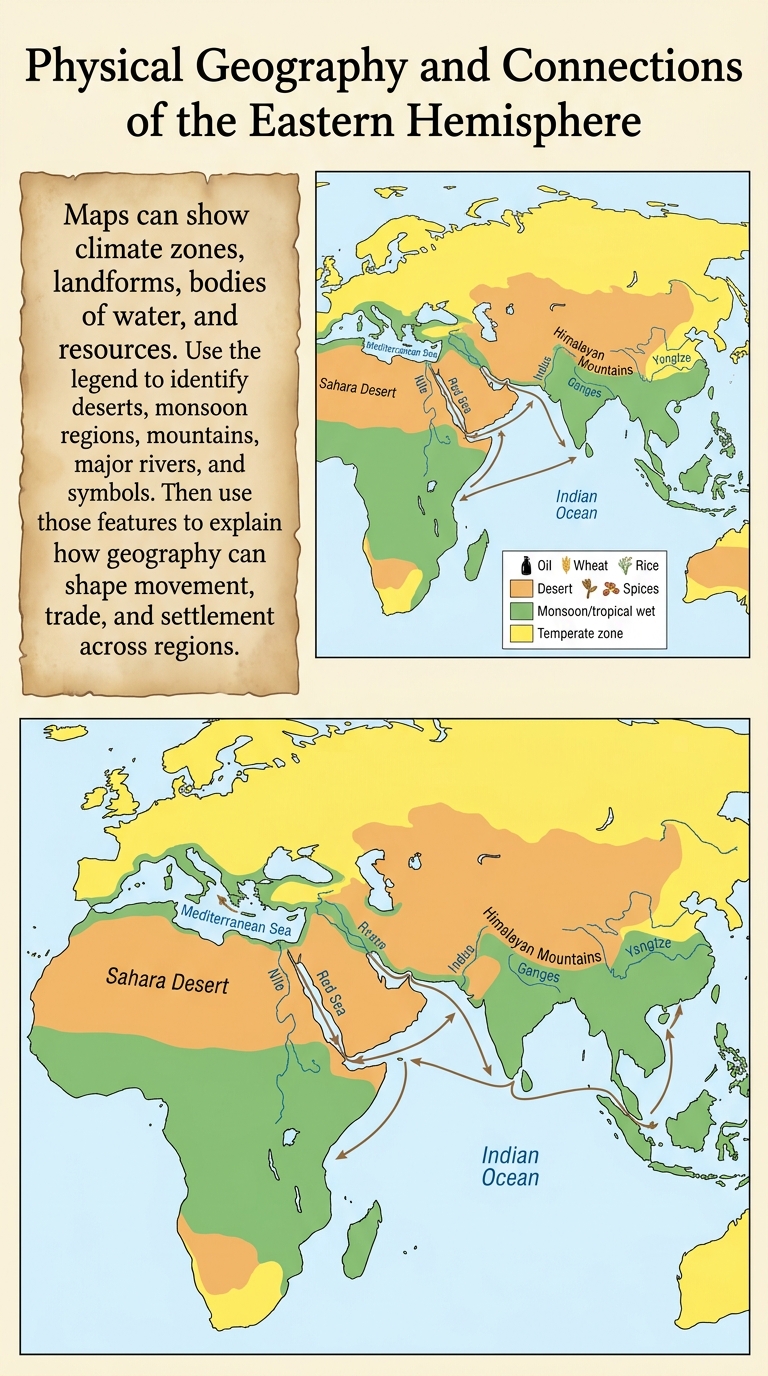
Which map evidence best supports the conclusion that bodies of water can connect regions through trade?
Which inference about settlement patterns is best supported by the map’s river and climate evidence?
Which map feature is the strongest evidence that a landform could limit overland movement between regions?
Choose one Eastern Hemisphere region shown on the map. Use two specific map features (a climate zone and either a landform or body of water) to explain how physical geography could influence movement or trade in that region.
Contextualize one resource icon on the map (oil, wheat, rice, or spices) by explaining how nearby physical features (climate, landform, river, or sea) could shape how that resource is produced or traded. Cite at least two map features.
Regions are areas that share identifiable characteristics. This poster map labels major Eastern Hemisphere regions and includes symbols for climate, landforms, bodies of water, and resources. Use the legend to identify patterns and to explain how geographers define regions using evidence, not only political borders.
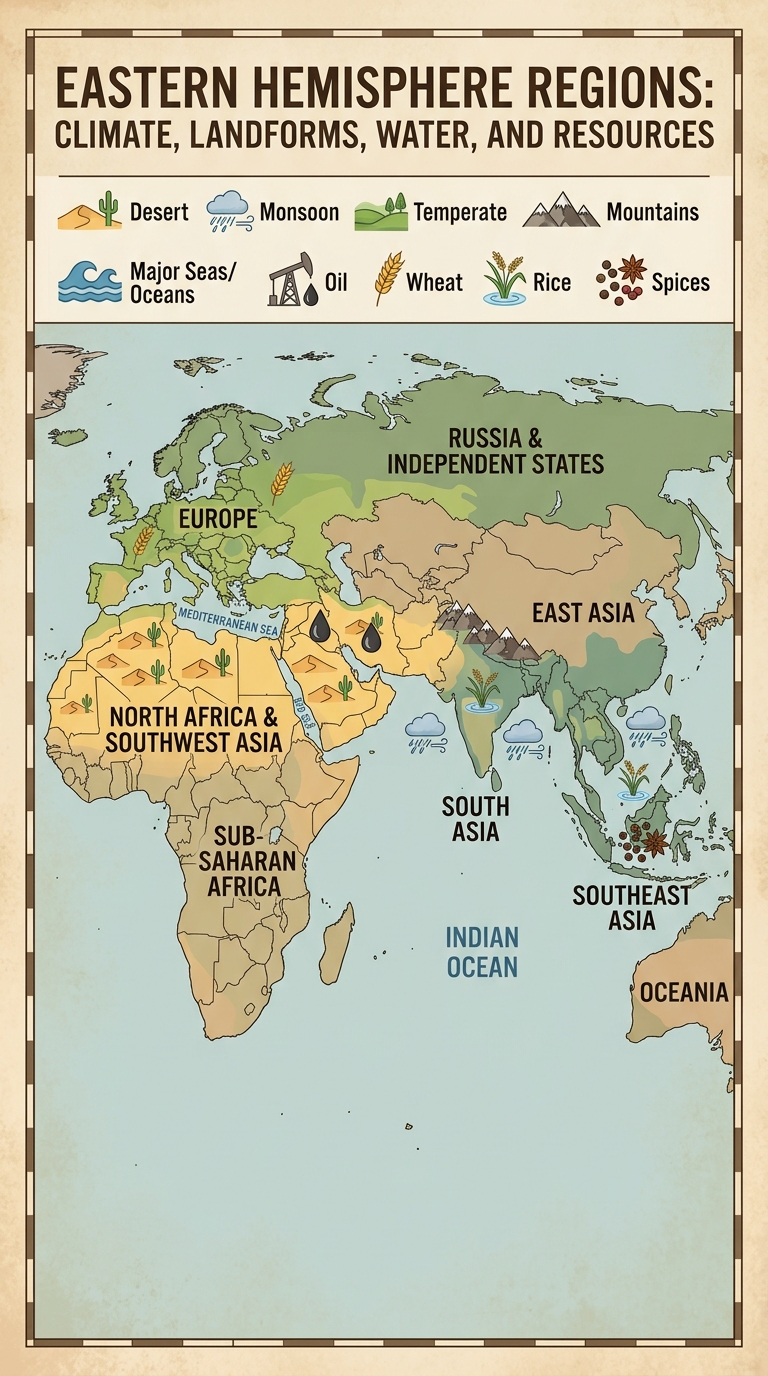
Which region is best supported by the evidence of a monsoon icon and rice symbol grouped together on the map?
Which piece of map evidence best supports the idea that regions can be defined using shared physical characteristics?
Choose one labeled region on the map. Cite two specific map details (one climate icon/zone and one landform or body of water) and explain how they support defining that region by shared characteristics.
Use two map features to make a geographic inference about connections between regions (trade, travel, or cultural exchange). Explain how bodies of water or landforms could encourage or limit those connections. Cite the evidence you use.
Which pair of regions is best supported by the map evidence as sharing a major desert climate characteristic?
The physical environment influences where people settle, how land is used, and how regions connect. This document compares two river regions in the Eastern Hemisphere. Use evidence from climate zones, landforms, and bodies of water to explain patterns in settlement, farming, trade routes, and political connections.
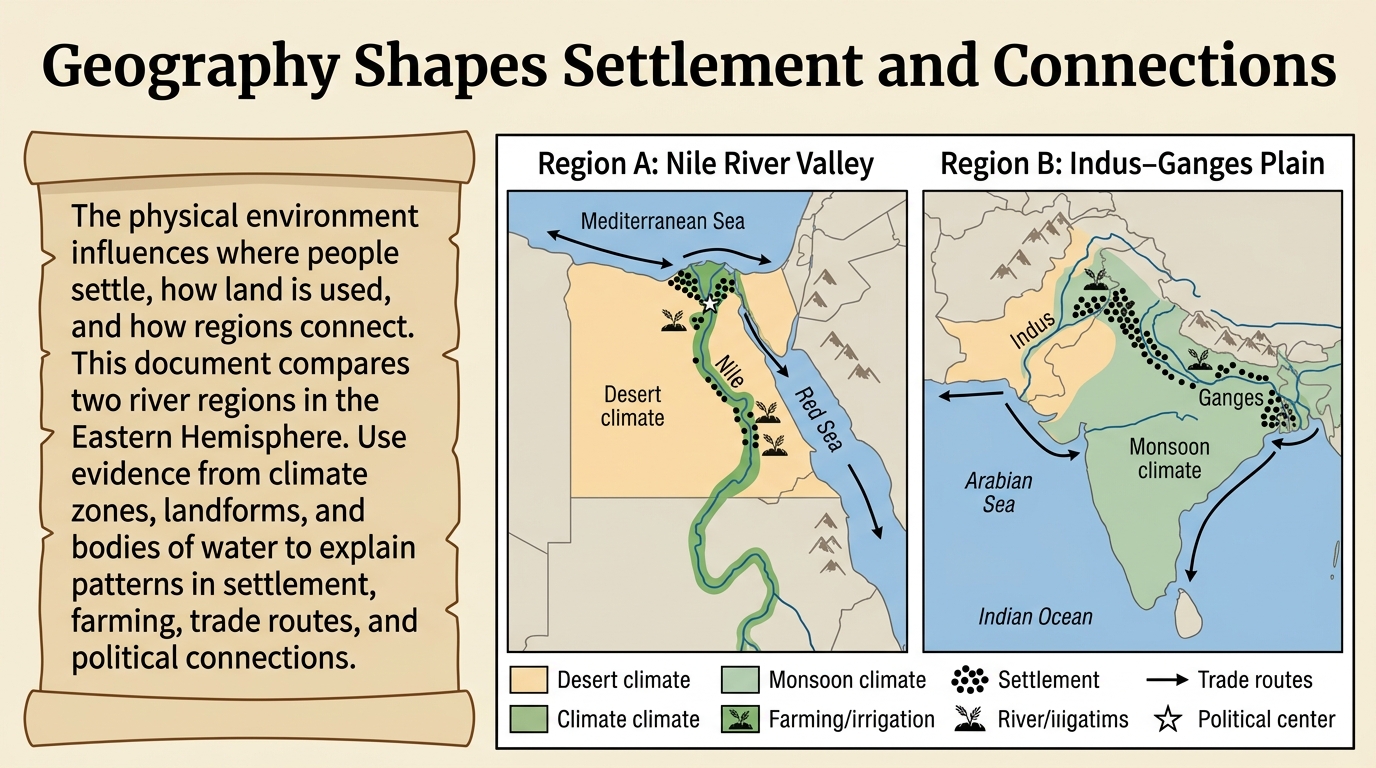
Compare the two regions using two specific pieces of poster evidence (one from each map). Explain how the physical environment could lead to different land use or economic activities in each region.
Which inference about population distribution is best supported by the settlement symbols on both maps?
Which comparison is best supported by the climate evidence on the poster?
Use poster evidence to explain one way the physical environment could influence political connections in either Region A or Region B. Cite two features (for example, a river, sea route, climate zone, or landform) and explain your reasoning.
Which map evidence best supports the conclusion that waterways can strengthen political and economic connections?
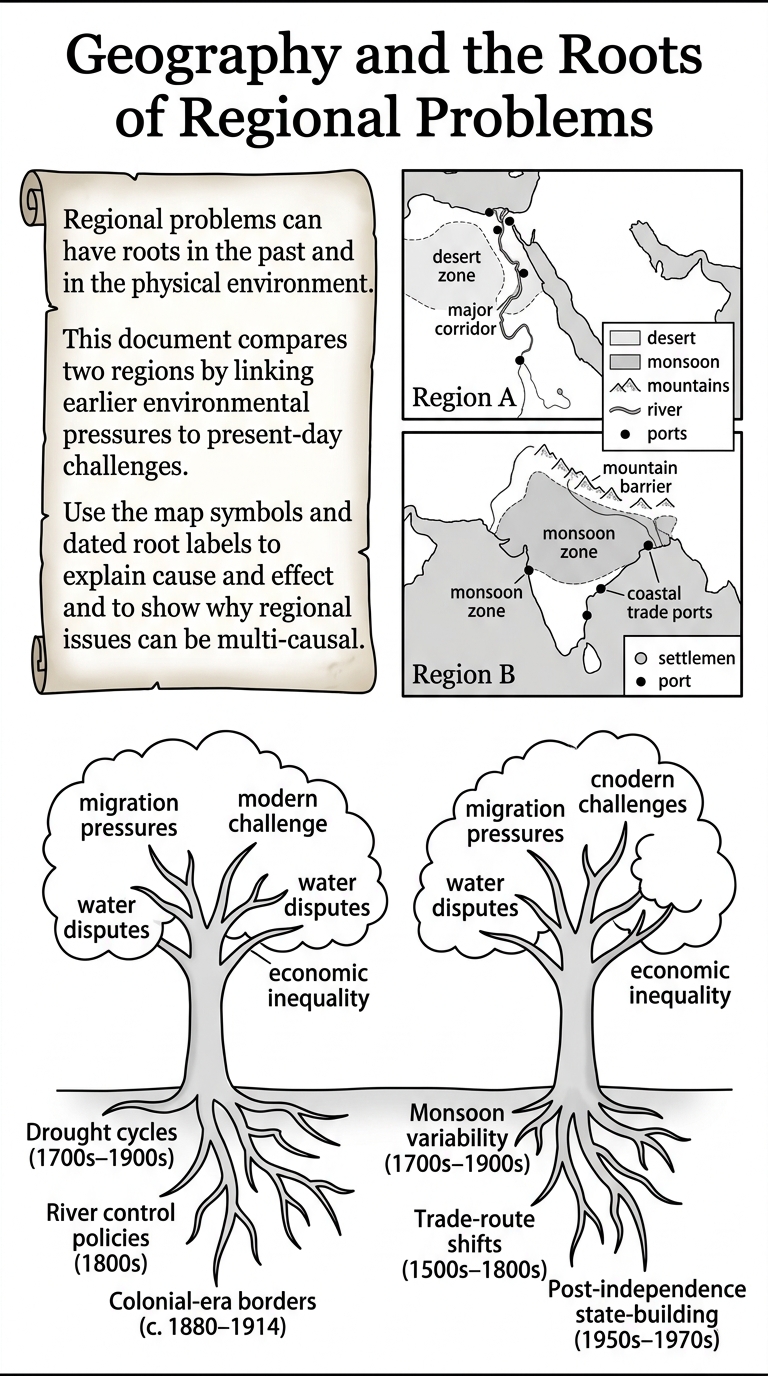
Which detail from the document is the clearest evidence that present-day regional problems can have roots in the past?
Choose one present-day issue shown on a branch. Compare Region A and Region B by citing one map feature and one root label from each region. Explain how the evidence helps contextualize why both regions could experience the same issue.
A student says: “The document shows that each present-day issue has only one cause.” Which response best evaluates this claim using evidence?
Which inference is best supported by the map and root labels for Region A?
Contextualize one region’s present-day issues by explaining how two dated roots suggest a sequence of cause and effect over time. Cite the two roots and include at least one map feature in your explanation.