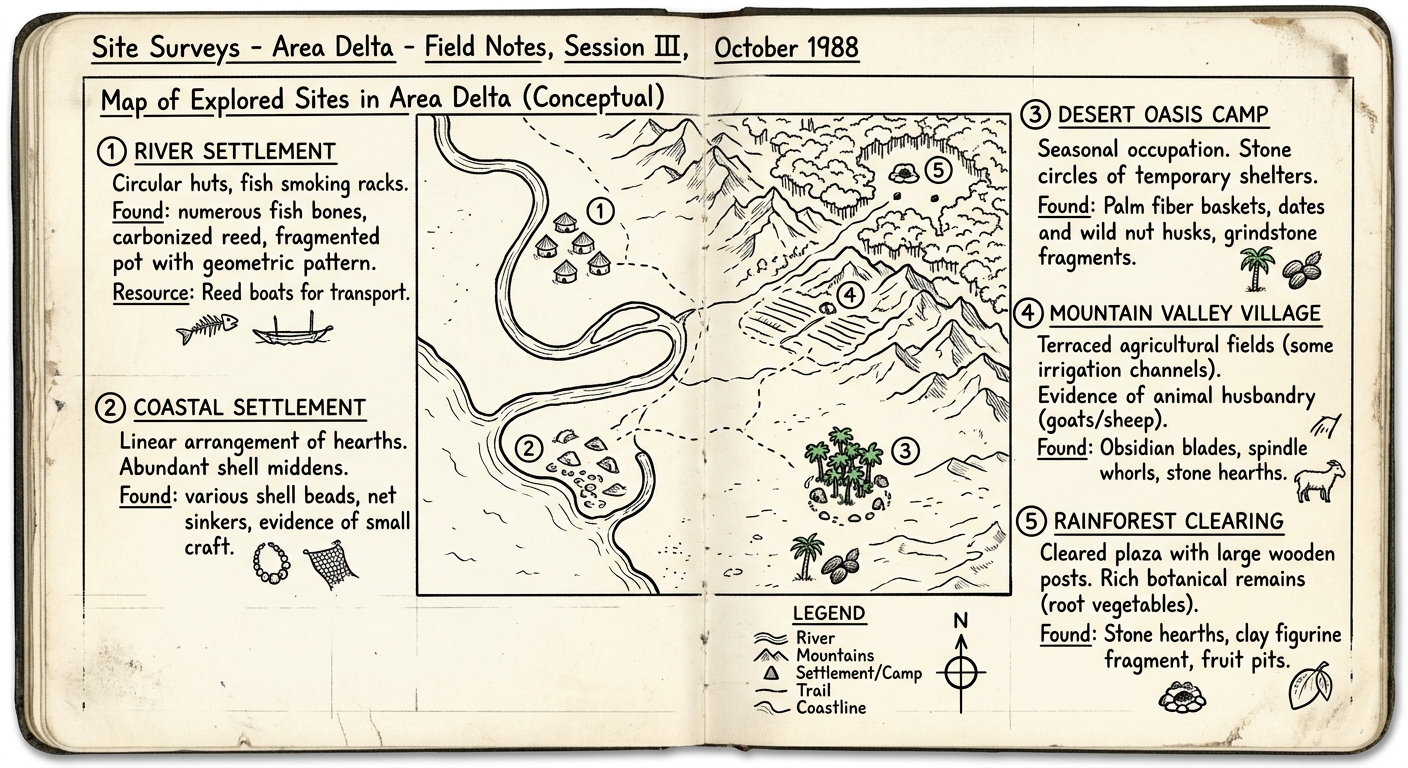
Use the historical document(s) and the short readings in the left panel to answer the associated questions.

Archaeologists compared evidence from five settlements in different environments. Each site shows how people used local resources for food, tools, and shelter. Use the field notes to compare choices across places and explain how the environment helps explain similarities and differences among groups.
Which pair of settlements shows the MOST similar strategy for getting food from water sources, based on the evidence?
Which inference best explains a key DIFFERENCE between the Mountain Valley Village and the Desert Oasis Camp, using evidence from the field notes?
Which claim is BEST supported when you place the Rainforest Clearing in its environmental context (rainfall, dense vegetation) and compare it to the Coastal Settlement?
Compare TWO settlements from different environments. Explain one similarity and one difference in how people used resources for food or shelter. Support each with specific evidence from the field notes.
Choose ONE settlement and contextualize its choices by explaining how its environment would have limited or enabled certain resources. Then explain how that context helps you interpret ONE piece of evidence in the field notes.

Archaeologists studied five early settlements. In each place, they recorded evidence left over from daily activities. Use the field notes to infer which resources people used first, how their choices changed over time, and how different environments (river, coast, desert, mountain, rainforest) shaped movement and survival.
Across the field notes, which change is most clearly shown from the Early layer to the Late layer at several settlements?
Which sequence best describes how people at the River Settlement likely changed their food production over time, based on the layers?
At which settlement does the evidence most strongly suggest a shift toward more permanent food production in the Late layer compared with the Early layer?
Choose ONE settlement. Explain how the evidence changes from Early to Late layers, and what that suggests about how people adapted over time to that environment.
Use at least TWO specific pieces of evidence from the document.
Historians sometimes argue that a shift toward more permanent settlements happens gradually.
Using evidence from at least TWO different settlements, explain whether the field notes support a gradual change over time or a sudden change.
Cite specific evidence from the layers.

Archaeologists studied five early settlements. In each place, they recorded evidence left over from daily activities. Use the field notes to infer which resources people used first, how their choices changed over time, and how different environments (river, coast, desert, mountain, rainforest) shaped movement and survival.
Which comparison best explains how the environment could shape shelter choices at the two sites?
Which piece of evidence best supports the inference that people at the River Settlement relied on water resources for food?
Choose ONE piece of evidence from the document (for example, an irrigation ditch, water skins, or net weights).
Contextualize it by explaining what the environment would make easier or harder at that site. Then explain how that context helps you interpret what the evidence suggests about daily life.
Based on the evidence, which inference most strongly compares likely movement patterns at the two settlements?
Compare the River Settlement and the Desert Oasis Camp.
Explain one similarity and one difference in how people used resources for survival.
Support your comparison with at least TWO specific pieces of evidence from the document.

Archaeologists studied five early settlements. In each place, they recorded evidence left over from daily activities. Use the field notes to infer which resources people used first, how their choices changed over time, and how different environments (river, coast, desert, mountain, rainforest) shaped movement and survival.
Which geographic reasoning best explains why animal tracks and a portable tent appear together at the Desert Oasis Camp?
Which evidence from the Desert Oasis Camp is most directly linked to scarcity of water in the surrounding environment?
Choose ONE artifact shown in the document and explain how its usefulness depends on the physical environment (river or desert).
Then explain what that suggests about where people traveled or stayed.
Use at least TWO details from the document.
Which inference best connects the river environment to the evidence at the River Settlement?
Use geographic reasoning to compare the two locations. Explain how water availability could lead to one difference in food strategies and one difference in movement patterns.
Support each claim with specific evidence from the document.

Archaeologists studied five early settlements. In each place, they recorded evidence left over from daily activities. Use the field notes to infer which resources people used first, how their choices changed over time, and how different environments (river, coast, desert, mountain, rainforest) shaped movement and survival.
Which evidence best supports the inference that the Desert Oasis Camp took part in long-distance exchange?
Choose ONE item from the document that suggests trade (for example, shell beads or an obsidian blade).
Contextualize it by explaining why that item would be valuable in that environment.
Then explain what the item suggests about economic connections (who might trade, what might be exchanged, and why).
Which claim about specialization is best supported by the evidence at the River Settlement?
Which comparison best explains how environment could influence the way each group stored or transported resources?
Compare the two settlements as economic systems. Explain one similarity and one difference in how each community met needs (food, tools, or shelter) through production and exchange.
Support your comparison with at least TWO specific pieces of evidence from the document.