Social Studies Released Items 2023
star
star
star
star
star
Last updated 4 months ago
8 Nsɛmmisa
This list shows rules for students and teachers at school:
Be kind to others.
Work hard and do your best.
Be on time.
1
1
1
This list shows rules for students and teachers at school:
Be kind to others.
Work hard and do your best.
Be on time.
Which additional rule belongs on
the list because it is a responsibility
of both students and teachers?
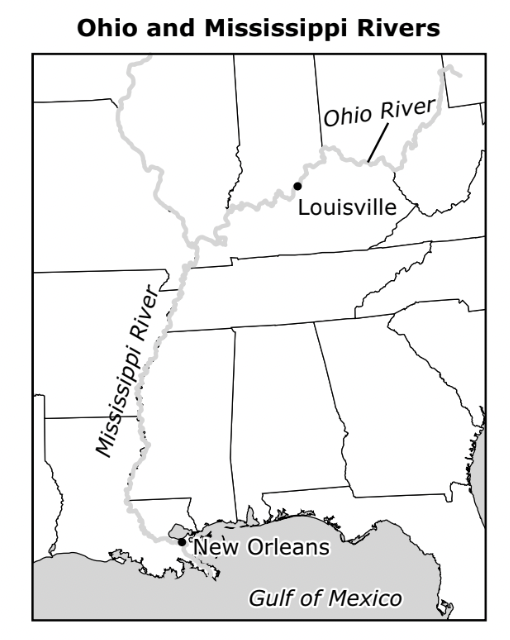
Steamboat travel was introduced to the United States in the early 1800s. Louisville’s location on the Ohio River meant that the city could take advantage of the steamboat. The Ohio River flowed into the Mississippi River. The Mississippi River connected to ports on the Gulf of Mexico, such as New Orleans. The steamboat gave Kentuckians access to these ports and made travel on the rivers faster than before. Louisville became an important port in the state.
—based on Tim Talbott, “Louisville’s Steamboat Era,” Kentucky Historical Society, 2020
How did the introduction of the steamboat affect economic decision-making for Kentuckians?
Identify whether each statement describes a producer or a consumer. Move two answers into each box.
A dairy farmer makes butter from her cows' milk.
A customer orders food from a restaurant.
A dairy farmer purchases milking equipment.
A cook uses ingredients to make food at a restaurant.
Producer
Consumer
Analyze each source and then answer the questions that follow.
While you are analyzing the sources, think about the compelling question “How do human settlement and movement affect diverse groups of people?”
Introduction
Analyze these sources about why people leave Cuba in order to investigate the compelling question “How do human settlement and movement affect diverse groups of people?”
Source 1
This source is about the relationship between Cuba and the United States.
For many years, Cuba and the United States had a close relationship. Then, in 1959, a man named Fidel Castro led a revolution in Cuba. He made the country communist. In
communist countries, the leader has almost total power. The people may vote in elections, but they only have one choice on the ballot. The government controls the economy and decides what is produced and consumed. The government even chooses jobs for its citizens and decides how much money citizens get paid for those jobs.
The ideas of communism are opposite of the ideas that the United States values. For this reason, the United States and Cuba became enemies. Castro ruled for almost 50 years.
During this time, travel and trade between the United States and Cuba stopped. However, Cubans who opposed communism often escaped the country and came to the
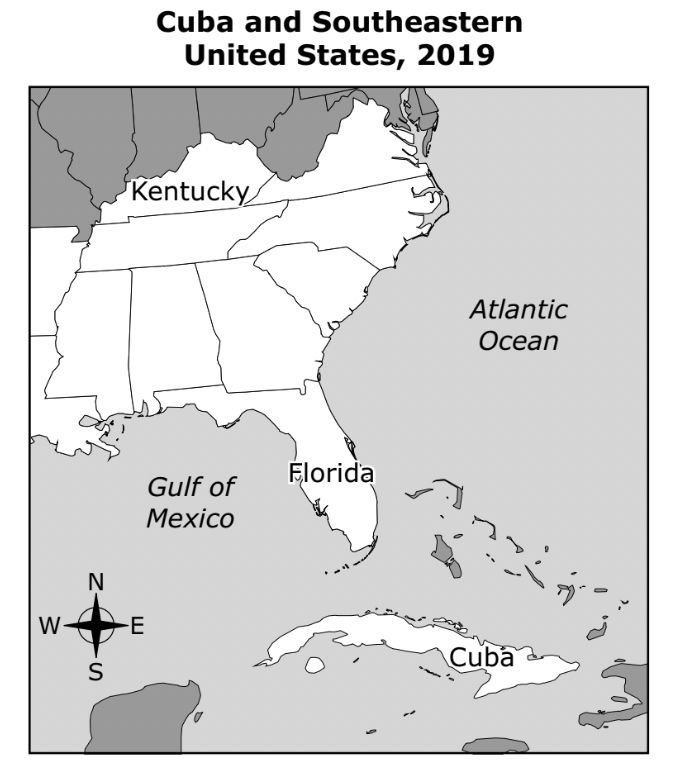
United States in search of freedom. Although most of these people settled in southern Florida, many Cubans now live in Kentucky.
—based on “Cuba Profile—Timeline,” British Broadcasting Corporation (BBC), May 1, 2018
Source 2
This sourc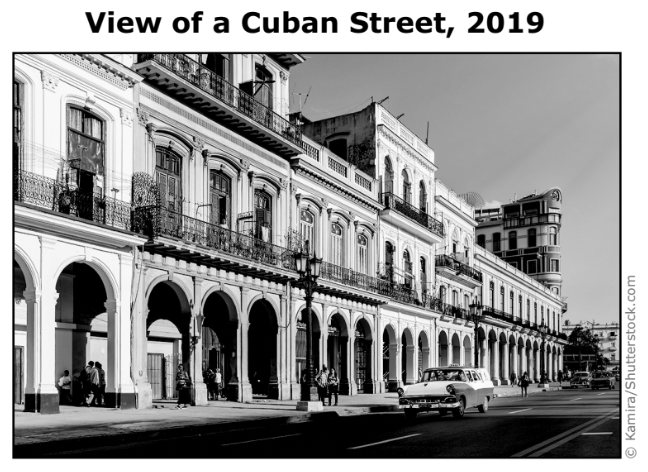 e includes comments from a U.S. reporter who visited Cuba in 2015 and a photograph of a Cuban street.
[Cuba is] visually stunning. . . . With so few vehicles, it’s an easy city to move through. And those 1950s cars, of course! The “frozen in time” feel—all real. It’s fascinating to be in a commercial‐free zone—no chain stores, no ads, few signs—without the visual clutter of so much of our lives. . . .
There’s the lack of internet connections. Frozen in time, right?
—Jeffrey Brown, “Reporting from Cuba, a Place Frozen in Time Yet Full of Potential,” PBS NewsHour, June 15, 2015
Source 3
This source describes developments in Cuba's economic policies in 2011.
In April 2011, the government held the first Cuban Communist Party Congress in almost 13 years. Party leaders approved a plan for changes to the economy. There have
been small changes ever since. For example, Cubans have been allowed to buy appliances and cell phones, stay in hotels, and buy and sell used cars. The number of government-sponsored jobs was reduced. This has led to some people starting new businesses.
—adapted from “Central America: Cuba,” The World Factbook, 2020
Source 5
This source is about Cuban migrants in Louisville, Kentucky.
There were 9,190 Cubans in the Louisville/Jefferson County metropolitan area in 2014. . . .
“Our population growth has been dependent over the last five years on immigrants coming to our community and the single largest immigrant group has been Cuban,” says Bryan Warren, director of the city’s Office of Globalization. “We want to continue to foster that opportunity for them to come here and open businesses and to get jobs and buy houses.” . . .
Cecilia Batista and her son arrived . . . earlier this year. . . . “I had heard about this place, so I came here. . . . We came for a better life,” she says. “I have to learn many things. The hardest part is learning the language.”
—Tracey Eaton, “Fastest-Growing Immigrant Group in Louisville, Kentucky? Cuban Americans,” NBC News, August 17, 2016
Which aspect of culture led some people to leave Cuba after 1959?
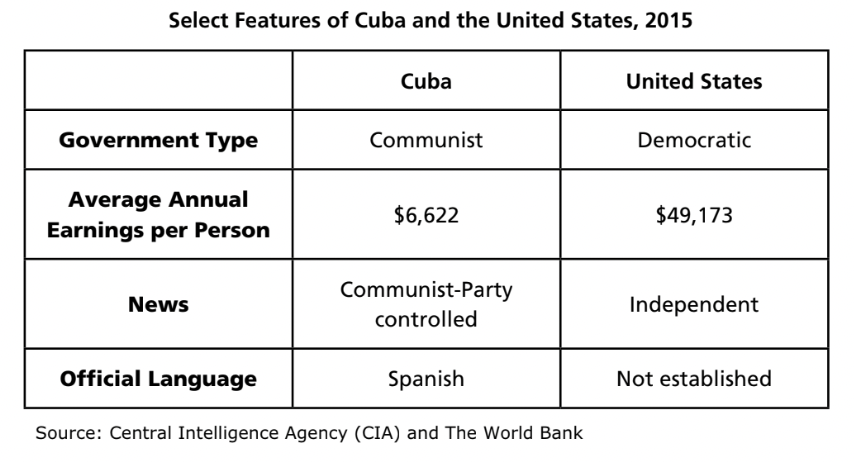
Which response best answers the supporting question “How are Cuban citizens and U.S. citizens governed differently?”
Which two sources best show the diffusion of people and ideas to other communities?
Which supporting question would be best for understanding why Cubans have immigrated to Kentucky?
Read the question carefully. Then enter your answer in the space provided.
Construct a response to answer the supporting question “How did movement and settlement impact people who left Cuba for the United States?” Use reasoning and evidence from multiple sources to support your response. Sources used may include the introduction.
Write at least two paragraphs.