Log in
Sign up for FREE
arrow_back
Library

HUG Unit 6-7 Assessment

star
star
star
star
star
Last updated about 3 hours ago
43 questions
Required
1
Required
1
Required
1
Required
1
Required
1
Required
1
Required
1
Required
1
Required
1
Required
1
Required
1
Required
1
Required
1
Required
1
Required
1
Required
1
Required
1
Required
1
Required
1
Required
1
Required
1
Required
1
Required
1
Required
1
Required
1
Required
1
Required
1
Required
1
Required
1
Required
1
Required
1
Required
1
Required
1
Required
1
Required
1
Required
1
Required
1
Required
1
Required
1
Required
1
Required
1
Question 1
1.

Which of the following is the RESULT of the shift of industry to developing countries over time? For example - when American factories began to move to places like Mexico after NAFTA made such a move more profitable?

Question 2
2.

How did the British 2nd Agricultural Revolution impact the Industrial Revolution in that country?

Question 3
3.

Wallerstein's World-System Theory provided what commercial advantage to core countries in Europe in the 15th and 16th centuries?

Question 4
4.

Weber's Least Cost Theory is used to explain the location of manufacturing plants. Which three factors accounted for the placement of these plants in this theory?

Question 5
5.

We have touched on the importance of women to society in pretty much every unit. Which statement correctly describes the role of women in the labor force?

Question 6
6.

Which of the following world regions has the lowest HDI because of a lack of educational opportunities for women? Remember that HDI includes SOCIAL factors as well as economic ones.

Question 7
7.

Which of these factors is most likely to prevent a subsistence economy from advancing to a more industrial economy?

Question 8
8.

How did the Industrial Revolution transform Western society?

Question 9
9.

Which of the following fuel sources would be least likely to indicate a movement towards sustainability for the future?

Question 10
10.

When thinking of world cities like New York, Tokyo, London and Paris - which of the following statements is true?

Question 11
11.

Which of these describes the phenomenon when the largest city of a nation has twice the population size as the next largest city in the country, like London and Birmingham in England ?

Question 12
12.

In the Harris and Ullman multiple-nuclei model, which of these would explain WHY a city lacks a central business district?
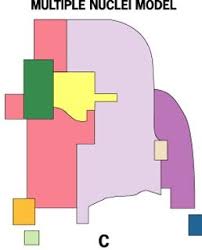
Question 13
13.

Which statement describes HOW the Burgess Concentric Zone City Model allows for urban citizens to move up socially and economically?

Question 14
14.

According to the Hoyt Sector Model - why does a city grow outward from it's center?


Question 15
15.

Which of the following BEST explains why New York City has more specialty stores than do smaller urban areas in the United States. (specialty stores "specialize" or offer goods that many might not be able to afford)

Question 16
16.

Which improvement can increase the sustainability of large urban areas with sprawling suburbs?

Question 17
17.

Thinking about the Latin American City Model, the African City Model, and the SE Asian City Model - they all share one commonality. What is that common element?

Question 18
18.

Which statement explains how the practice of redlining led to the segregation of neighborhoods in the United States in the 1950s?

Question 19
19.

In many core countries today - multinational manufacturing companies that do tertiary and quaternary work - will often move their headquarters and factories to other countries in a process called:

Question 20
20.

New York City and Los Angeles are approximately 3000 miles apart. However, they are connected on an economic and cultural level. Which statement explains this connectedness?

Question 21
21.

In Weber's Least Cost Theory - agglomeration occurs because:

Question 22
22.

Which of these factors has played the smallest role in the growth of the suburbs in the United States?

Question 23
23.

A list of the top ten largest cities of the world would have which of the following characteristics?

Question 24
24.

The eastern seaboard of the United States has a long stretch of urbanized landscape from Washington DC to Boston. This represents what type of urban location?

Question 25
25.


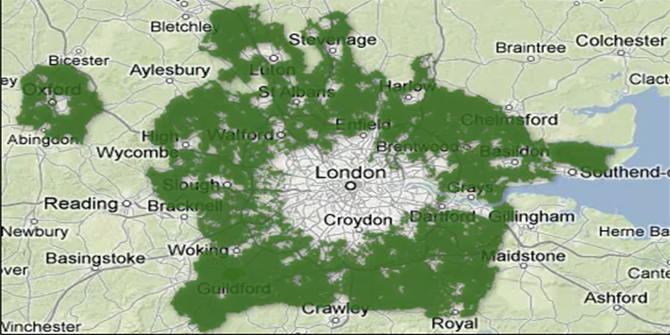
In London in England, and some other European cities, these have been created as a way to preserve farmland, and keep some land undeveloped - as a part of using smart growth policies. They prevent urban sprawl.

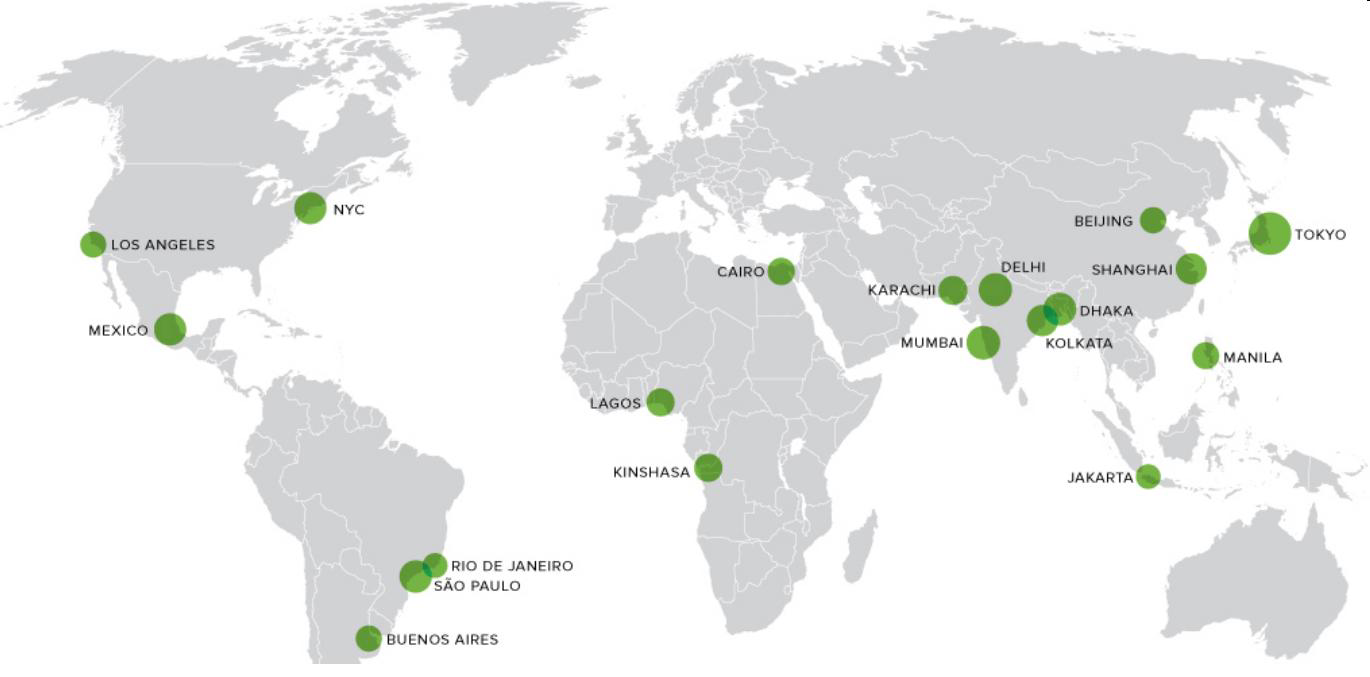
Megacities across the globe in 2010 were distributed according to the map shown below.
Required
1
Required
5
Question 28
28.

Suzy is a waitress in a small town. Waitressing is a job within the ___ sector.

Question 29
29.

When studying urban areas, geographers will often use census data - looking for information not only on the size of populations, but on their composition. Census data best represents ___ data.

Question 30
30.

Redlining, blockbusting, and restrictive covenants - are all associated with the urban problem of:

Question 31
31.

Poverty, homelessness and discrimination are problems for both the CORE and the PERIPHERY - but the creation of ____, unplanned housing areas with few (or no) public services like water, electric and sewar is more a PERIPHERY problem.

Question 32
32.

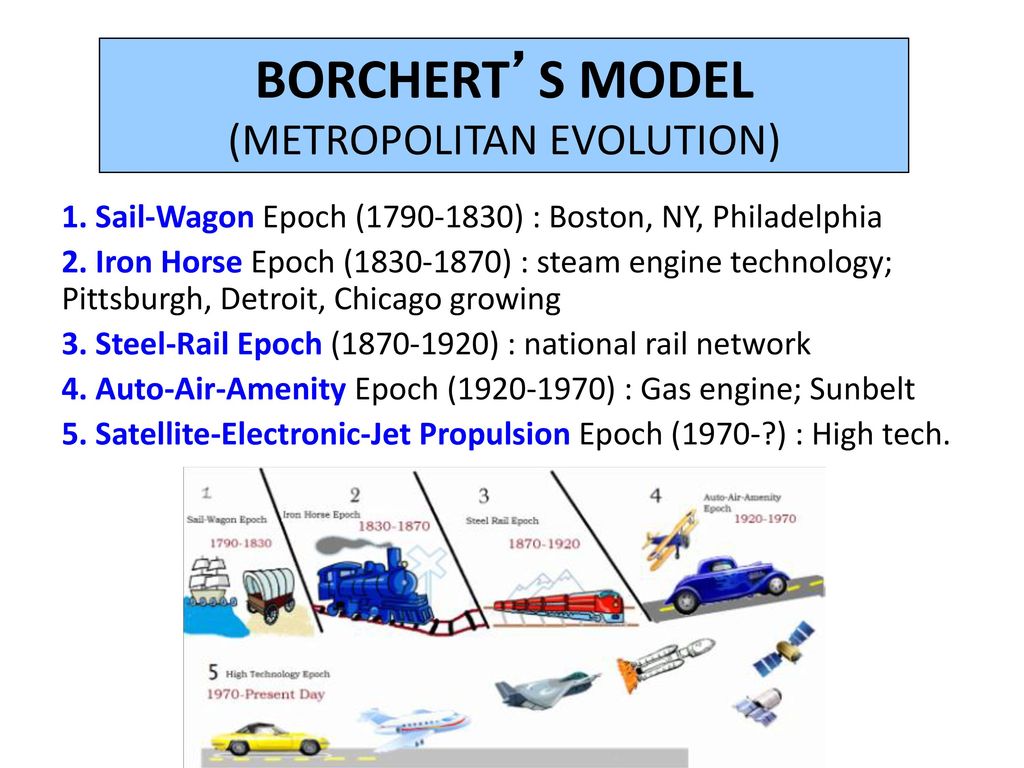
Which generalization does the image below support?

Question 33
33.

Which of the following refers to the minimum number of people required to support a business or service ? This is used both in the Gravity Model and Christaller.

Question 34
34.

A megacity is defined as a metropolitan area with a population greater than?
Question 35
35.

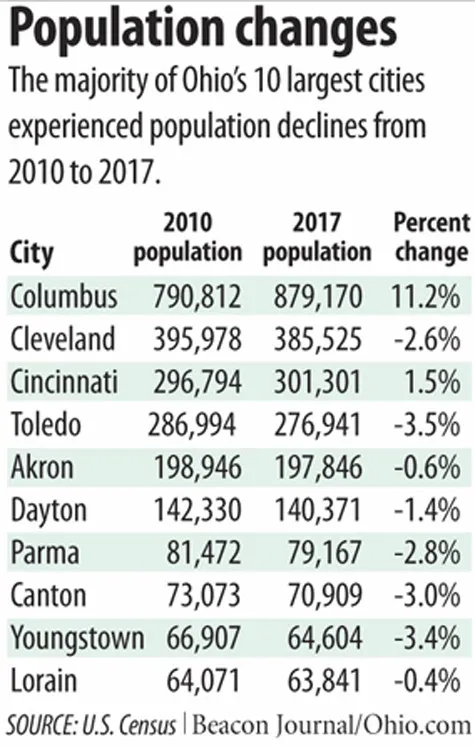
Which concept is MOST clearly demonstrated by the population information shown on the chart?
Question 36
36.

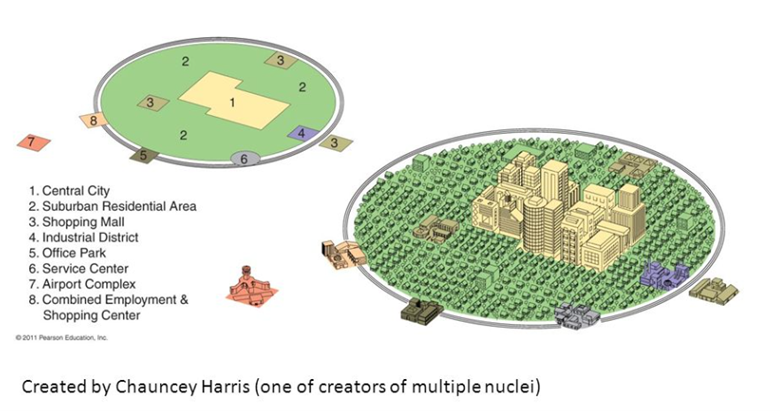
One distinguishing feature of the Harris and Ullman - Multiple Nuclei or Galactic City model is:
Question 37
37.

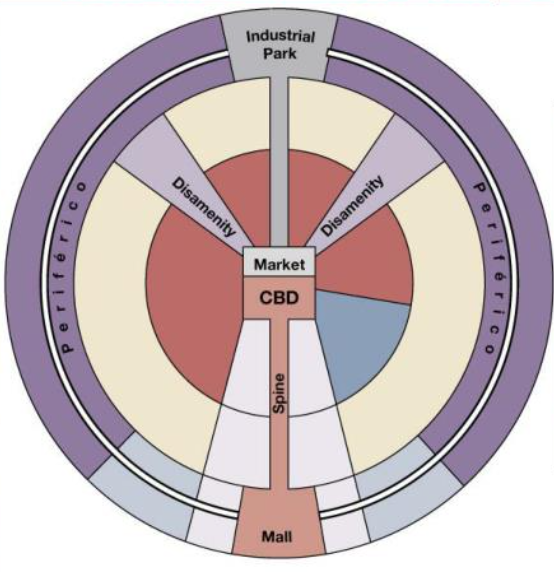
In the Latin American City Model - the SPINE (center - connecting CBD to the Mall)

Question 38
38.

Which of the following urban sustainability challenges DO WE NOT see in the Phoenix Metro?

Question 39
39.

The basic difference between GDP (gross domestic product) and GNP (gross national product) is:

Question 40
40.

Your city has a population of 60,500 people (in 2016), and is strongly integrated with its adjacent counties socially, and economically. It is best described as:

Question 41
41.

BONUS: The warehouse district of a city has recently been getting a second life as old factories and abandoned buildings have been renovated to be museums of modern art, restaurants, and rental properties. Tensions that arise during this transformation process are most likely rooted in what process?

Question 42
42.

BONUS: An area with one or mor abandoned factories - which have not been redeveloped is referred to as a/an:

Question 43
43.

BONUS: This poor little coyote was caught in the city of ____ - he was enjoying the refrigerator in a grocery store. I guess it was hot outside!


a lower standard of living in developing countries.
an increase in unemployment in developing countries.
a stronger economy for the United States and Europe.
Automation in the Agricultural Revolution provided a surplus of displaced agricultural workers that were able to provide labor in factories.
Mechanization in the agricultural revolution occurred more quickly than the industrialization in factories.
The Industrial Revolution competed with the Agricultural Revolution for technology, money, and laborers.
These countries established free trade agreements with other core countries.
These countries colonized other countries for their resources, and goods for trade and commerce.
supply chains, transportation, and climate
agglomeration, climate, and capital investment
the economic contribution of women to the labor force has decreased over the past 30 years
attitudes of women in the workplace have become less favorable in the past 20 years
Northern Europe
Western Europe
Oceania
the lack of a banking system
a lack of a well-connected transportation in transportation infrastructure
By increasing the wages of laborers worldwide
Through mechanization and the creation of new markets
solar energy
geothermal energy
the top ten world cities are decreasing in their financial and cultural significance due to the process of globalization today.
the world cities with the largest populations have much more power and are the largest drivers of globalization.
the world cities with smaller populations can be expected to experience the fastest rates of population growth in the next few decades.
rank-size rule
primate city model
world city model
different industries are concentrated in one of the suburbs on the outskirts of the city.
different industries are located throughout the city's center.
many similar industries are scattered along the periphery of the city.
they can move away from the commuter zone
they can move away from the central business district
because lakes and ponds make up a majority of the geography of the city center
because there are not enough bike and foot paths within the city for local residents to use
because the commercial district in the city center is always relocated away from the center or CBD
because major avenues of transportation can carry commuters and goods to outlying areas
The rank-size rule
The Burgess, Concentric Zone Model
Eliminate green spaces to provide more areas for parking lots and garages
Decrease funding for public schools
Create a public transit system of buses and rails as part of the infrastructure
They are all organized around a port for easy trade
They all have a colonial and a traditional CBD / central business district
They are all organized around transportation hubs and rail lines
Corporate real estate developers stopped building new homes.
Banks would not lend money to people of color for home purchases.
Historic homes were not allowed to be renovated or redecorated.
economic restructuring
outsourcing
free-trade zones
Both cities are airport, cultural and economic hubs, which encourages connection and frequent travel between the two locations.
Both cities have large, diverse populations, which negate any distance in the gravity model.
Both cities have similar transportation infrastructure, which increases their interaction.
a factory or business will tend to locate near similar businesses, or businesses needed for production - to take advantage of labor and transportation.
horizontal articulation and government intervention
Government both state and national, encouraged housing developers like William Levitt to buy land on which to build modestly priced homes.
Subway and rail systems became more prominent in connecting urban areas with the suburbs in most American cities creating less reliance on cars by the 1970s.
The Baby Boom after World War II meant that many families needed homes - spurring development.
The majority of the cities are located in Africa.
The majority of the cities are located in core countries.
The majority of the cities are located in peripheral countries in Asia.
an agglomeration area
a primate city
an edge city
greenscapes
urban infill
transit oriented developments
smart-growth policies
greenbelts
Question 26
26.

The map here reflects megacities in 2010, what is the projected change to these megacities by 2100?

Question 27
27.

As new megacities emerge, which strategies will best support sustainable development? Please mark all that apply!

tertiary
quaternary
zones of abandonment
urban blight
Each new form of transportation technology slowed urban growth by leading to suburbanization, reurbanization, and exurbanization.
Some new forms of transportation technology spurred urban growth while other factors slowed it down.
Each new form of transportation technology spurred urban growth by producing a new system for moving people and goods.
Each new form of transportation technology spurred urban growth by allowing more people to live and work in the central city.
hearth
travel time
25 million
50 million
Unitary State
Rank-Size Rule
Central Place Theory
The development of both a 2nd and 3rd CBD
The development of suburbs
The development of a squatter settlement at the edges
is a middle class area with old, traditional homes that are well maintained
is a middle class area with new homes
is an area of wealthy, and upper class homes
The urban canyon effect
The urban heat island effect
Urban sprawl as suburban cities seem to be growing unchecked
GDP reflects per capita production of goods and services, how much each person in a county makes or the work they do. GNP is a broader number that includes all the workers in the country and the goods and services they create.
GDP reflects the total of goods and services produced by the people of a nation within their borders, and GNP includes goods produced by the people or businesses of that nation inside and outside of the country.
GNP reflects the total of goods and services produced by the people of a nation within their borders, and GDP includes goods produced by the people or businesses of that nation inside and outside of the country.
a metropolitan area
a metropolitan statistical area
The relocation of new urbanites into the area can create an edge city.
Commercialization can decrease the property values in the area.
Gentrification can cause original inhabitants to lose their sense of place in the area.
disamenity zone
streetcar suburb
zone of abandonment
Chicago
Detroit
New York City
Los Angeles
Immigration away from urban areas will decrease the number of megacities.
The world’s megacities will be increasingly concentrated in currently developing countries.
The number of megacities will become stable over time.
Increasing paved areas to promote maximum usage of limited area.
Providing mixed use development and walkable areas with greenspace.
Purchasing large tracts of land on the outskirts of town for outward growth.
Providing carpool lanes on the major highways to promote carpooling, and limit the number of drivers.