Use the historical document(s) and the short readings in the left panel to answer the associated questions.
Historical Document
This broadside from Charleston, South Carolina, dated November 10, 1860, was published days after Abraham Lincoln’s election. The author warns that a Republican victory threatens slavery and argues that the South must leave the Union. Read the document below as evidence of a regional perspective.
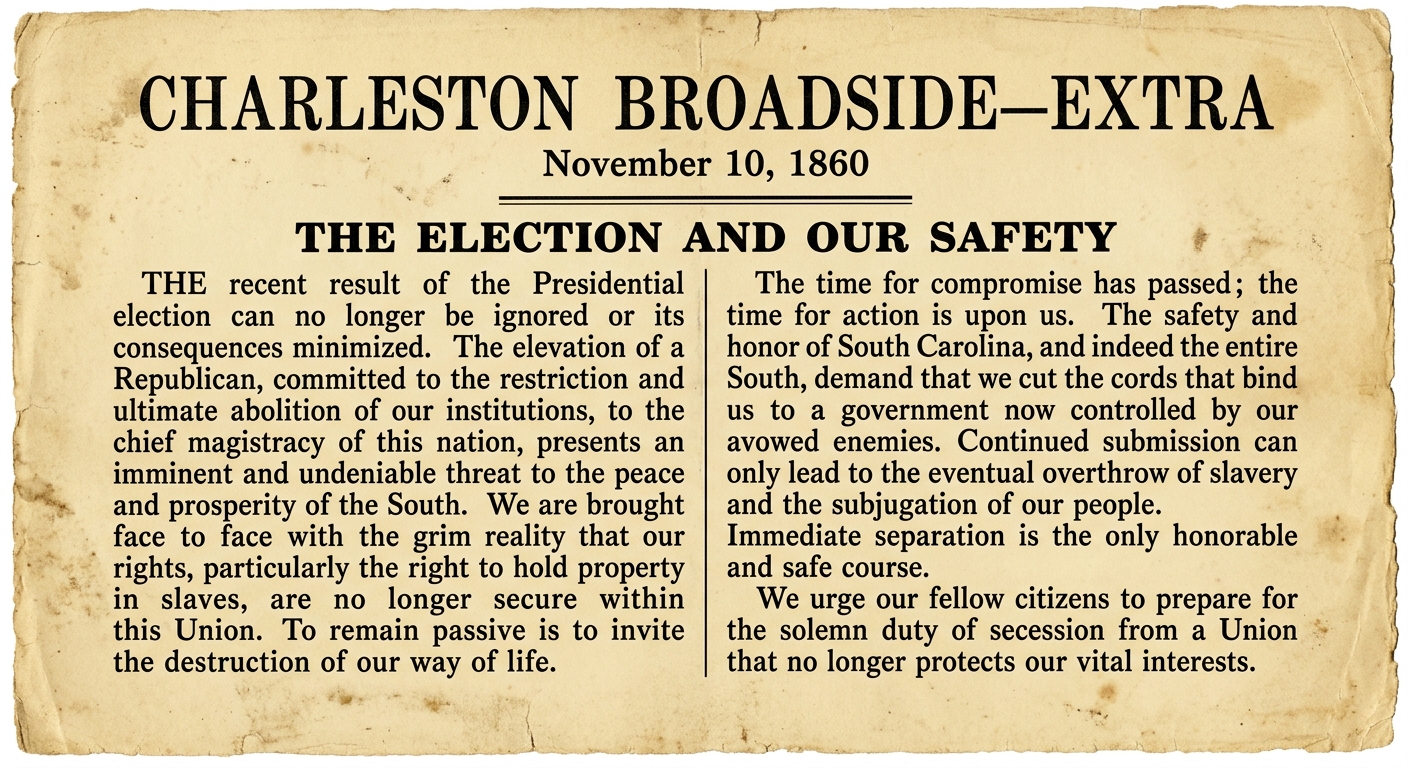
Which phrase from the Historical Document is the strongest evidence that the author is worried about the future of slavery?
Explain how the author’s regional perspective shapes their explanation of the 1860 election.
Use at least two specific pieces of evidence (words or phrases) from the Historical Document.
Based on the language of the Historical Document, who is the most likely intended audience?
Which conclusion is best supported by the Historical Document about why some Southern leaders saw the 1860 election as an immediate cause of secession?
A Northern Unionist in 1860 might argue against secession.
Write one likely counterargument and explain how the Historical Document helps you infer that counterargument (use evidence from the document).
Historical Document
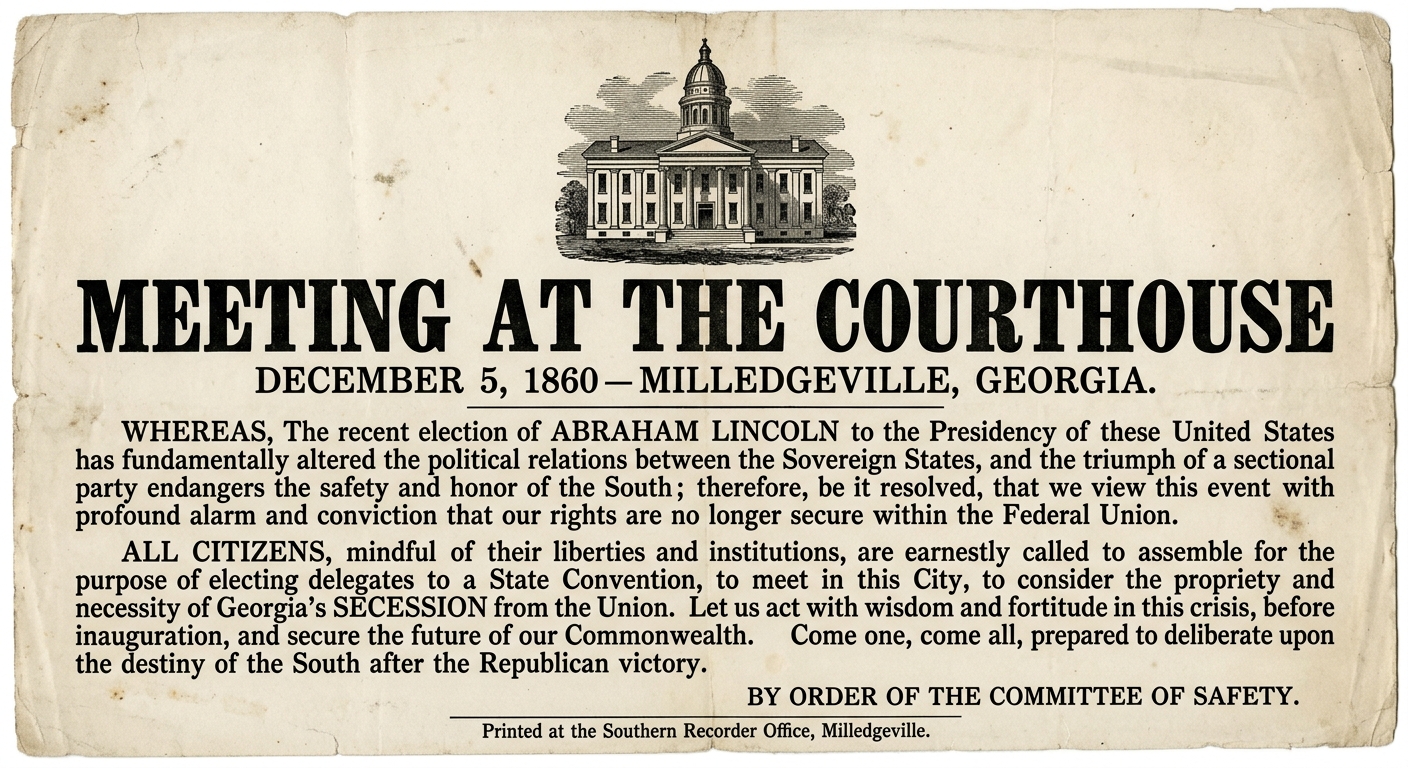
This Georgia handbill, dated December 5, 1860, was published about four weeks after Abraham Lincoln’s election and weeks before his inauguration. It reflects how some Southerners treated the election as a turning point requiring immediate political decisions about secession.

Why does the document’s timing (after the election but before inauguration) matter for understanding the author’s purpose?
Which phrase in the Historical Document is the strongest evidence that the author sees Lincoln’s election as an immediate cause for urgent action?
Explain how the Historical Document connects the election of 1860 to the next political step the author wants readers to take.
Use at least two specific pieces of evidence (words or phrases) from the document.
A person who opposed secession in late 1860 might argue that the handbill is rushing the public.
Write one likely counterargument and explain how the timing and language of the Historical Document help you infer that counterargument (use evidence).
Compare the author’s reasoning in the Historical Document to a likely Northern Unionist viewpoint in early 1861.
Write one similarity OR one difference, and support your comparison with at least two pieces of evidence (one from the document and one inferred Unionist idea).
Historical Document
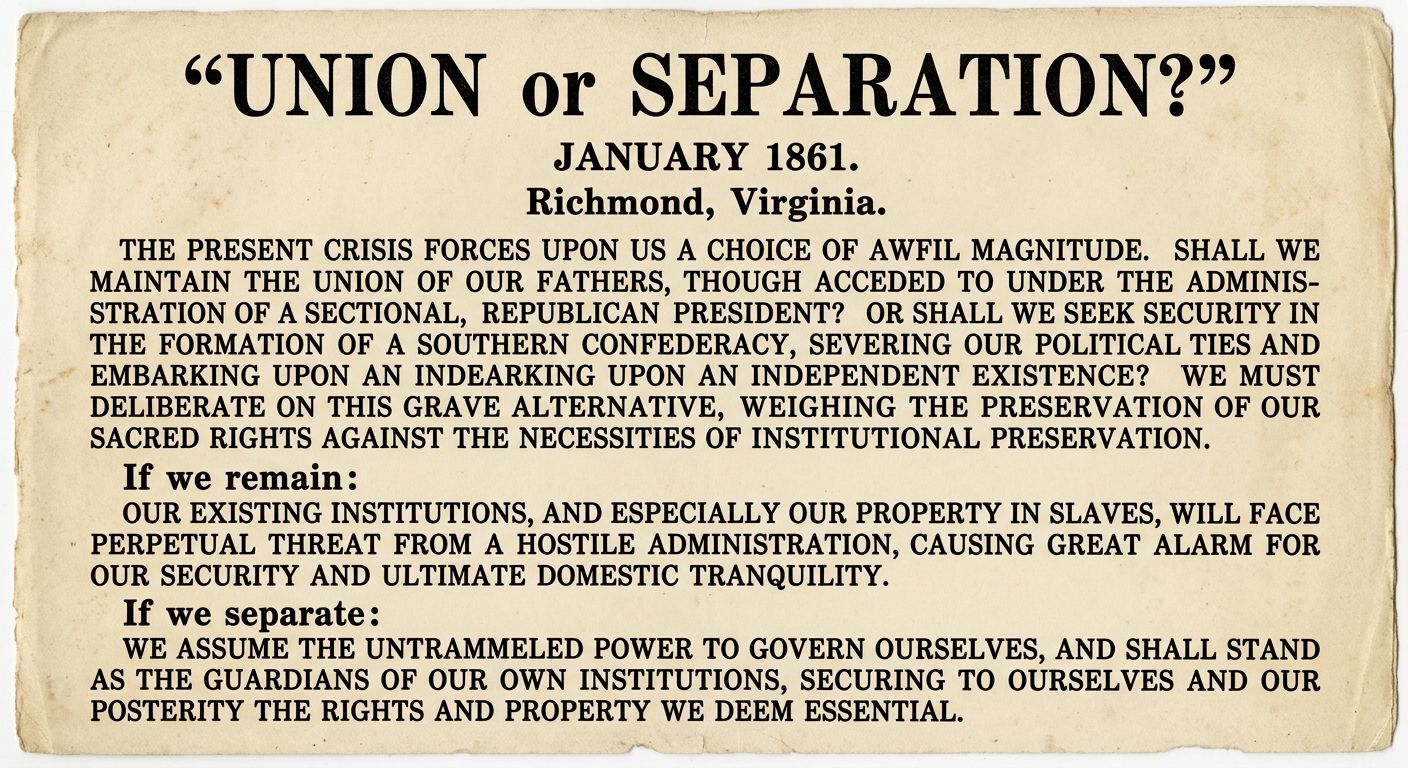
This excerpt from a Richmond, Virginia pamphlet dated January 1861 compares two choices: remaining in the Union after the election of a Republican president or forming a separate Southern government. Use the document to analyze how the author connects the election to arguments about secession.

Which phrase from the Historical Document best shows how the author connects the election of a Republican president to the concept of “security”?
Explain how the Historical Document defines or uses two concepts (choose two: “rights,” “security,” “institutions,” or “property”).
For each concept, quote or paraphrase one piece of evidence from the document.
Based on the document’s “If we remain” and “If we separate” structure, what is the author’s main purpose?
Which comparison is most clearly developed in the Historical Document?
Compare the author’s reasoning in the Historical Document to a likely Northern Unionist viewpoint in early 1861.
Write one similarity OR one difference, and support your comparison with at least two pieces of evidence (one from the document and one inferred Unionist idea).
Historical Document
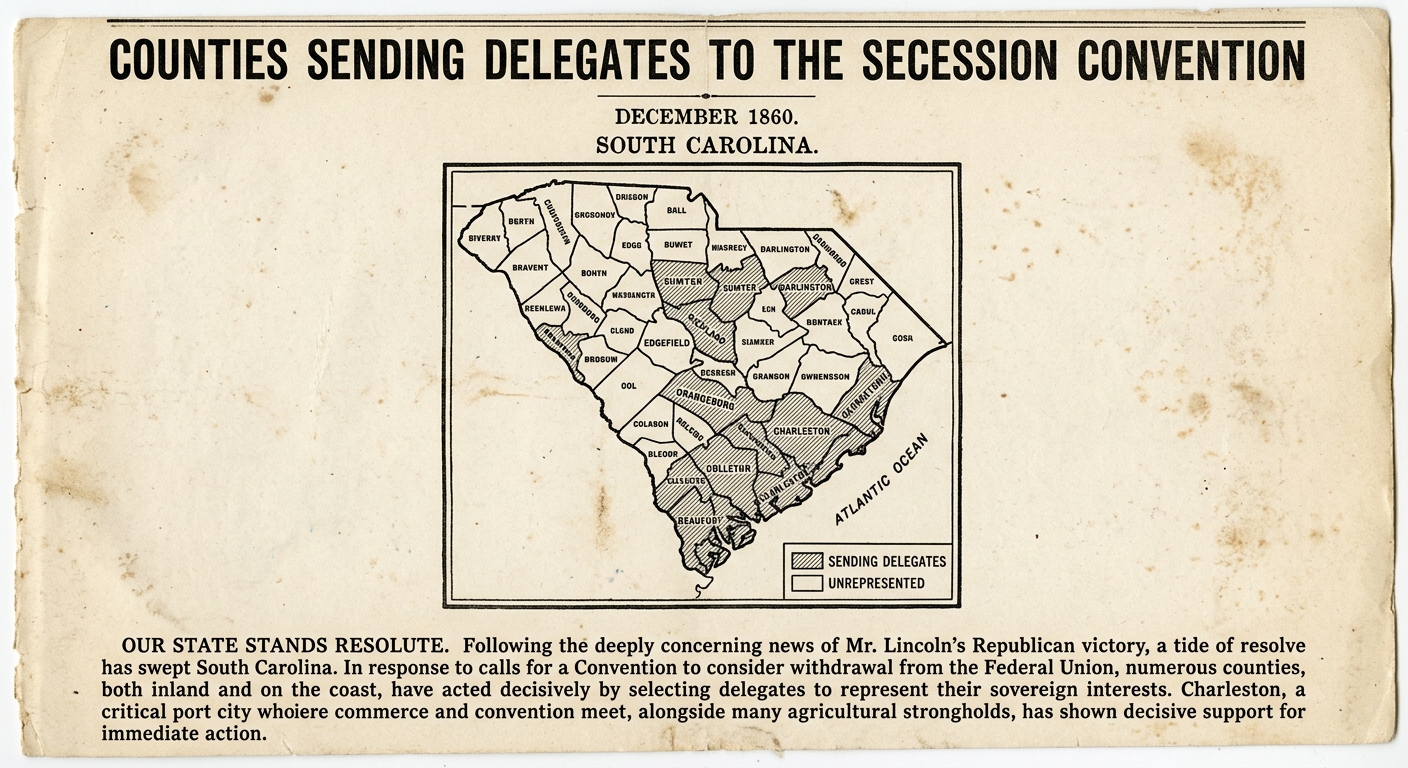
This newspaper map from South Carolina, dated December 1860, highlights counties reported to be sending delegates to a secession convention after Abraham Lincoln’s election. Use the map and caption to infer how geography and regional connections shaped calls for secession.

Which piece of evidence from the Historical Document most directly links a place to political action?
Compare how a coastal county and an inland county might interpret the election of 1860 differently, based on geographic location and regional connections.
Support your comparison with at least two pieces of evidence from the Historical Document (map features or caption).
Describe one geographic pattern you observe in the Historical Document (for example, coastal vs. inland or clustered vs. scattered).
Then explain what that pattern might suggest about how news of the 1860 election spread or how political organizing happened.
Use at least two pieces of evidence from the map/caption.
Which conclusion best connects the map’s regional focus to regional perspectives on the causes of the Civil War?
Which inference about geography is best supported if the shaded counties cluster near Charleston and other coastal areas?
Historical Document
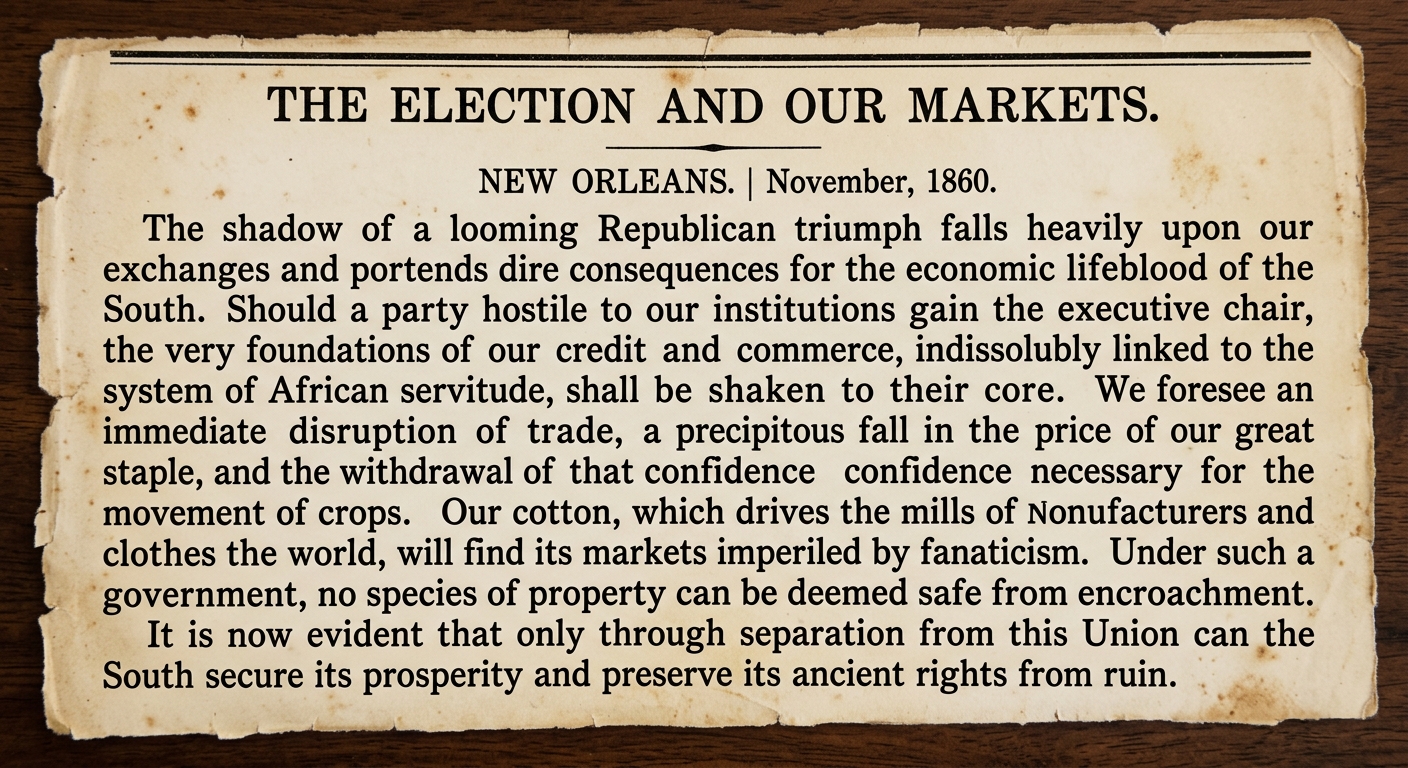
This newspaper editorial from New Orleans, dated November 1860, reacts to Abraham Lincoln’s election by linking politics to the Southern economy. The author argues that a Republican victory threatens an economic system connected to slavery, cotton exports, and credit, and presents separation as a way to protect prosperity.

Which piece of evidence from the Historical Document best supports the idea that the author connects the 1860 election to fears about trade or markets?
Explain how the author uses economic concepts to argue for or justify secession (for example, markets, trade, labor system, property, or credit).
Use at least two pieces of evidence from the Historical Document.
Which conclusion best connects the Historical Document to regional perspectives on the causes of the Civil War?
Compare the economic reasoning in the Historical Document to a likely Northern Unionist viewpoint in late 1860.
Write one similarity OR one difference, and support your comparison with at least two pieces of evidence (one from the document and one inferred Unionist idea).
Which economic relationship is the author most clearly emphasizing in the Historical Document?